
Hello again! Welcome to our final lesson on the modern history of Bogotá.
In our last session, we delved into the turbulent 20th century. We saw how the Bogotazo and La Violencia triggered an explosion of unplanned urban growth. We then analyzed the estratos system—a policy designed to create equity in utility payments that inadvertently carved deep socio-spatial inequality into the very fabric of the city. This system created a starkly divided Bogotá, a reality we saw reflected in the conflicts over public space involving delivery workers.
Today, we bring our story into the 21st century. Our learning objective is to critique the urban design and user experience of major 21st-century projects like the TransMilenio system and public space renewals.
Drawing on your expertise in product design and user experience, we'll approach these massive urban projects as if they were products. We'll analyze their "features," their intended "user journey," and critically evaluate their real-world performance. Did they solve the user's (the citizen's) problems? Did they create new ones? Let's find out if these modern designs succeeded in healing the city's historical divisions or simply gave them a new look.
A Framework for Urban User Experience
Before we examine Bogotá's specific projects, let's establish a quick framework for what makes a city's design "good" from a human-centered perspective. A city, like a digital product, can be intuitive, joyful, and enabling, or it can be frustrating, inefficient, and exclusionary.
The following video provides a concise overview of key urban design concepts that focus on the "user."
Every Urban Planning Concept Explained in 9 Minutes
To set the stage, let's watch a short segment from the 'Every Urban Planning Concept Explained' video. It contrasts human-centric design with car-centric design, which is a perfect lens for our critique.
Please watch the section on 'Urban Design' from 07:17 to 09:00. Pay close attention to the characteristics of good design: walkability, safety, places to rest, and social interaction. Think of these as the 'usability heuristics' for a city.
As the video argues, good urban design is not just about aesthetics; it's about public health, economic vitality, and quality of life. The core principle is designing for people, not just for cars. With this framework in mind, let's turn to our first major case study: TransMilenio.
Case Study 1: TransMilenio, The User Journey
Launched in 2000, TransMilenio was a revolutionary project—a Bus Rapid Transit (BRT) system designed to tackle Bogotá's infamous traffic congestion and connect a fragmented city. On paper, its goals were perfectly aligned with good urban design.
To understand the system's intended design and its complex reality, we'll look at a detailed case study.
TransMilenio Bus Rapid Transit - Inclusive Infrastructure
The following report from the Global Infrastructure Hub, titled 'TransMilenio Bus Rapid Transit - Inclusive Infrastructure,' details the project's objectives, its implementation, and its outcomes. It gives us both the 'product pitch' and the user reviews.
Please read the following sections: 'Summary' and 'Project Description' to understand the system's goals and scale. Then, jump to 'Benefits Realisation' to see the reported successes. Finally, read 'Key challenges' within the 'Lessons Learned' section to understand the system's main problems. As you read, think about the gap between the intended user experience and the actual one.
Now, let's critique TransMilenio from a UX perspective.
The Problem Statement: To alleviate heavy traffic, provide an efficient and affordable transit system, and connect low-income citizens on the periphery with the city center.
The Design Solution (The Good):
- Efficiency: By using dedicated lanes, TransMilenio functions almost like a surface-level metro, achieving impressive speeds and capacity. The report notes it reduced average travel time significantly for many users.
- Inclusivity by Design: The project explicitly aimed for social inclusion. It incorporated Universal Design principles, discounted fares for vulnerable groups, and designed routes to serve the lowest
estratos. It was a direct attempt to bridge the city's spatial divide. - Global Benchmark: As noted in the resource "bogota 2030," the system became a model for cities worldwide, from Peru to India.
The User Experience (The Bad):
Despite its brilliant design concept, the user experience of TransMilenio is notoriously difficult. The system is a victim of its own success, often operating far beyond its intended capacity.
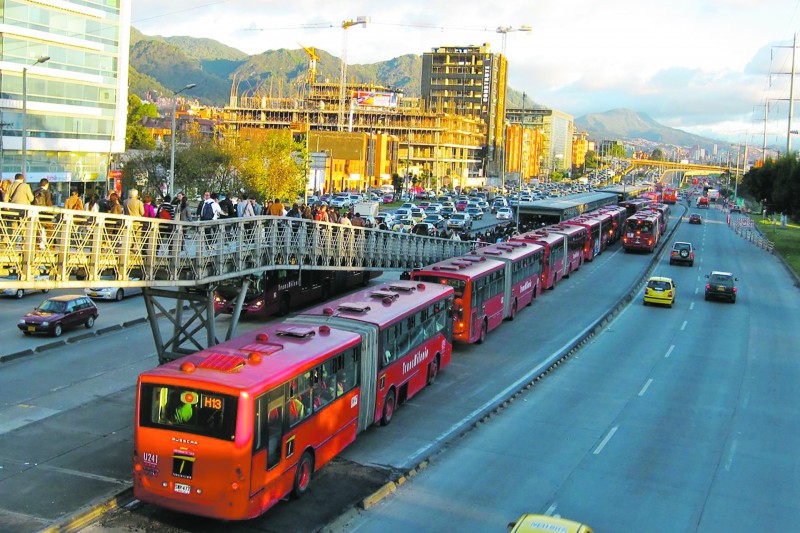
Key user pain points include:
- Severe Overcrowding: The most common complaint. The experience of being packed into buses and stations can be dehumanizing and physically exhausting.
- Safety Concerns: The reading mentioned that Bogotá's transport system was ranked as one of the most dangerous for women. Harassment and theft are persistent problems that degrade the user's sense of safety.
- System Failures: When a bus breaks down or there's an accident, the entire line can collapse, creating huge delays with no easy alternative for stranded passengers.
TransMilenio is a fascinating paradox. It is an innovative design solution that successfully addressed its core functional goals (moving lots of people relatively quickly). However, it often fails on crucial aspects of user experience: comfort, safety, and dignity. It connects the city physically, but the journey it provides can reinforce the daily stress of urban inequality.
Test your understanding!
Imagine you're a UX designer at TransMilenio. You can't change the physical infrastructure (buses, stations), but you can propose new digital or service-based solutions. Based on the user pain points identified, what is one service design idea you could pitch to improve the user journey?
Show answer
There are many possibilities. One service design approach could focus on the pain point of safety and overcrowding.
Idea: A real-time crowd-sourced safety and capacity feature within the official TransMilenio app.
- How it works: Users could anonymously report the capacity level of their bus (e.g., "Empty," "Seats available," "Standing room only," "Full") and flag safety concerns (e.g., "Harrassment incident," "Theft," "Medical emergency").
- User Benefit: This data could be displayed on a live map, allowing passengers waiting at a station to make more informed decisions. For example, they might choose to wait for a less crowded bus if they see one is just a few minutes behind a full one. Instant reporting of safety incidents could also speed up response times from authorities.
- Business Benefit: This provides TransMilenio with invaluable real-time data on system stress points and safety hotspots, allowing them to deploy security personnel or adjust bus frequency more dynamically. It also shows users that their feedback is valued, improving their relationship with the service.
Case Study 2: Public Space - Designing for Whom?
Alongside mobility, a major focus of 21st-century urbanism in Bogotá has been the recovery and creation of high-quality public space—parks, plazas, and pedestrian walkways. This initiative directly addresses the "human-scale" principles we discussed earlier.
Let's look at some examples from the "bogota 2030" report.
- TransMiCable in Ciudad Bolívar: A truly transformative project. More than just a cable car, it's an integrated urban renewal project. It cut commute times from over an hour to just 13 minutes for residents in one of the city's poorest and most inaccessible areas. Crucially, the project included a new library, parks, and the
SuperCADE Manitas—a hub for public services. This is holistic, user-centered design at its best, combining mobility, services, and public space to dramatically improve quality of life. (Source: "bogota 2030," pages 12-17). - Park Renovations: The city has renovated hundreds of neighborhood parks with better lighting, modern play equipment with safe flooring, and new sports courts. This directly improves the "user experience" of daily life for families and communities across the city. (Source: "bogota 2030," pages 22-23).
These projects are clear successes. However, the design of public space always begs the question: who is the intended user? As we saw in the last lesson, different groups have different needs and uses for public space.
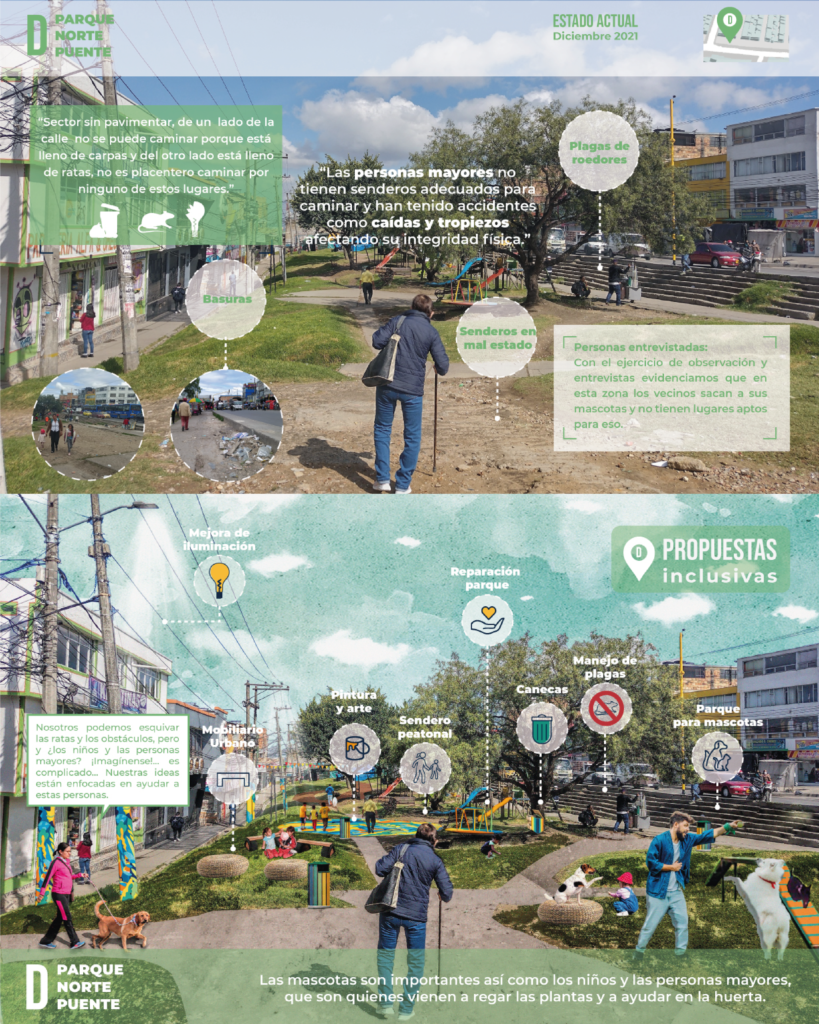
The challenge arises when a single design must serve conflicting uses. The bogota 2030 report mentions the "recovery" of 59 kilometers of public space by removing informal vendors to create clear sidewalks. While this improves mobility and safety for pedestrians (one user group), it displaces people who rely on that space for their livelihood (another user group).
This highlights the central conflict in urban UX design: optimizing for one "user story" (e.g., "As a pedestrian, I want a clear path to walk") can break another ("As a vendor, I need a visible place to sell my goods"). The most successful projects, like TransMiCable, seem to be those that design for a whole ecosystem, not just a single user's journey.
Conclusion
In this lesson, we've critiqued Bogotá's major 21st-century urban projects through the lens of user experience and design.
- A UX Framework for Cities: We established that good urban design prioritizes the human-scale experience—walkability, safety, and community interaction.
- TransMilenio's Paradox: We analyzed TransMilenio as a system that is brilliant in concept but often fails in its real-world user experience due to issues of overcrowding and safety, revealing a gap between functional design and human-centered design.
- Public Space and Its Users: We celebrated successful public space renewals like TransMiCable, which take a holistic approach. We also questioned who the "user" of public space is, noting that designing for leisure and aesthetics can sometimes exclude the economic life of the city.
The story of 21st-century Bogotá is one of ambitious attempts to design a better, more integrated city. The results are a mixed bag of impressive successes and frustrating failures, reminding us that designing for millions of diverse users is perhaps the most complex challenge there is.
This concludes our journey through the key moments that have shaped modern Bogotá. In our final summary lesson, we will synthesize these historical layers to understand Bogotá's multifaceted contemporary identity as Colombia's political, economic, and cultural heart.
Can't find a good explanation? Sign up and we'll make it for you
Sign up