
Hello, and welcome to the first lesson of your Numeracy Exam Sprint. This module builds the number skills that appear across many exam questions: interpreting information accurately, choosing the right calculation, and showing an answer in the form requested.
Fractions, decimals, and percentages are not three different quantities. They are three ways of writing the same proportion of a whole. In this lesson, you will learn to move confidently between them, recognise which form an exam question needs, and check that an answer makes sense in context.
One amount, three representations
A fraction describes equal parts of a whole:
In , the numerator tells you how many parts are being considered, and the denominator tells you the total number of equal parts.
A decimal uses place value:
- means three tenths, or
- means three hundredths, or
- means three thousandths, or
A percentage means “out of one hundred”:
So these all represent exactly the same amount:
Imagine a test with questions where a student answers correctly. The score can be written in several equivalent forms:
The value has not changed; only its representation has changed. In an exam, the question determines the form you should give:
- “What fraction of the questions?” calls for a fraction.
- “Write the probability as a decimal” calls for a decimal.
- “What percentage was correct?” calls for a percentage.
Before converting, always identify the whole. A fraction or percentage is meaningful only in relation to a total.
2025 ATI TEAS 7 Math Converting Fractions, Percentages, and Decimals (Practice Questions and Answer)
Watch “2025 ATI TEAS 7 Math Converting Fractions, Percentages, and Decimals” by Nurse Cheung. Although it is framed around an admissions test, its explanation of place value and “percent means per hundred” gives a useful foundation for all exam questions.
Watch fraction basics for the meaning of numerator, denominator, and equivalent fractions. Then watch decimal place value and percent meaning. Finish with conversion methods, including the worked examples. Focus on why a percentage is based on 100, rather than trying to memorise a trick.
The central idea: tenths, hundredths, and “per hundred”
The easiest conversions come from place value.
Notice the important difference between and :
A zero can change the value dramatically. In an exam, writing when the correct value is makes an answer ten times too large.
Here is a visual example of turning a fraction into a decimal by making its denominator .
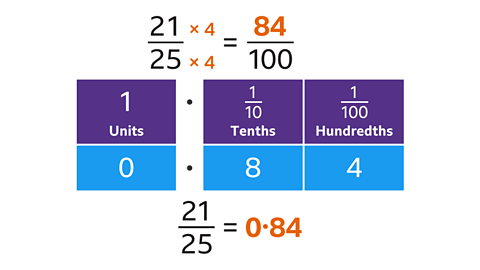
Because , we multiply both parts of the fraction by :
Once the denominator is , the other forms are immediate:
Multiplying the numerator and denominator by the same number does not change the fraction’s value. It simply changes its name into a more useful equivalent fraction.
A reliable conversion toolkit
Rather than memorising disconnected rules, use the fact that every percentage is a fraction out of .
| Starting form | Method | Example |
|---|---|---|
| Fraction to decimal | Divide numerator by denominator, or make a denominator of , , or | |
| Decimal to fraction | Use place value, then simplify | |
| Decimal to percentage | Multiply by | |
| Percentage to decimal | Divide by | |
| Percentage to fraction | Write it over , then simplify | |
| Fraction to percentage | Make the denominator , or convert to a decimal then multiply by |
Fractions to decimals
If the denominator is already , , or , use place value directly:
If you can turn the denominator into , that is often quick. For example:
For other denominators, divide the numerator by the denominator:
Some fractions produce decimals that continue forever:
In a question requiring a decimal or percentage, follow any rounding instruction. If none is given, use the level of accuracy appropriate to the context; for example, money is normally rounded to two decimal places.
Decimals to fractions
Read the decimal using its place value, then simplify.
The denominator depends on the number of decimal places:
- one decimal place: denominator
- two decimal places: denominator
- three decimal places: denominator
Always simplify unless the question specifically asks for a fraction with a particular denominator.
Decimals and percentages
Moving between decimals and percentages changes the scale between “out of ” and “out of .”
To turn a decimal into a percentage, multiply by :
To turn a percentage into a decimal, divide by :
Writing a leading zero in a decimal is good exam practice:
not .
Converting fractions, decimals and percentages - BBC Bitesize
Read the BBC Bitesize guide to consolidate the place-value method and see the two main methods for converting fractions to percentages.
Start with the subsection “Converting decimals to fractions,” reading its examples through to the question on 0.7. In “Converting fractions to decimals,” pay particular attention to the division method and its examples. Next, read “Converting decimals to percentages” and both methods in “Converting fractions to percentages”; the key principle is making one hundredths. Finish with “Converting percentages to or from fractions and decimals,” including the 85\% example and its questions. In the final “Test section,” attempt Questions 1–10 without revealing the answers first, then use the explanations to correct any errors.
Converting in context
In exam questions, the numbers may appear in a recipe, a survey, a score, a discount, or a probability statement. The calculation is the same, but the meaning of the answer matters.
Example 1: A score
A student answers questions correctly out of .
The fraction correct is:
Make the denominator :
Therefore:
A score of is sensible because is a little less than , so the answer should be a little less than .
Example 2: A portion of a recipe
A recipe uses of a kilogram of flour.
Using division:
So the recipe uses kg, which is:
of one kilogram.
The decimal form is useful if the question asks for a measurement in kilograms. The percentage form is useful if the question asks for a comparison with a whole kilogram.
Example 3: A survey result
A survey states that of respondents chose a particular option.
As a decimal:
As a simplified fraction:
Thus:
The survey does not mean people chose the option unless the total number of respondents was . It means out of every , proportionally.
Exam checks that catch common mistakes
A few quick checks can prevent lost marks.
Check the size
For a proper fraction, the numerator is smaller than the denominator. Its decimal should be less than , and its percentage should be less than .
For example:
These values are all below one whole, so they agree.
If you wrote , the percentage would mean more than eight wholes. That cannot match .
Keep equivalent fractions balanced
To create an equivalent fraction, multiply or divide the numerator and denominator by the same number.
Correct:
Incorrectly changing only one part of a fraction changes its value.
Do not confuse a decimal with its percentage
but:
The percent sign is not decoration. It tells you the number is being compared with .
Match the requested answer form
If an exam asks for a fraction in simplest form, do not stop at:
Simplify it:
If it asks for a percentage, include the percent sign:
A mathematically related answer can still lose marks if it does not answer the form requested.
A short method for exam questions
When you see a conversion question, use this routine:
- Underline the requested form: fraction, decimal, or percentage.
- Identify the starting form and the whole being described.
- Choose the most direct method:
- use place value for denominators of , , or ;
- make the denominator when possible;
- otherwise divide numerator by denominator.
- Simplify fractions if required.
- Check size and context: a result should be plausible for the quantity described.
- Write the correct label or symbol, such as , kg, or “of the questions.”
You now have one central connection to rely on:
Fractions describe parts of a whole, decimals express those parts through place value, and percentages express them per hundred. Converting is not a collection of unrelated tricks; it is a change of representation while keeping the amount the same.
Next, you will use these representations to calculate percentage amounts, percentage increases and decreases, and discounts—skills that build directly on writing percentages accurately.
Can't find a good explanation? Sign up and we'll make it for you
Sign up