
Good to see you again. Last lesson established that percentages, fractions, and decimals represent the same proportion: for example, . This lesson puts that connection to work.
You will learn to calculate a percentage of an amount, work out a percentage increase or decrease, and deal with discounts. The aim is not to depend on one memorised layout. Instead, you will identify what the percentage refers to, choose a sensible calculation, and check whether your answer fits the situation.
Percentage means a part of the original amount
When a question asks for a percentage of an amount, it is asking for a part of that amount.
For example, “Find of ” means find parts out of every parts of .
Since:
we can calculate:
The word of is a strong clue that multiplication is needed.
For any question, first identify:
- the whole or original amount;
- the percentage;
- whether you need the percentage amount itself, or a new total after an increase or reduction.
For instance, of is . It is not , , or , because those would involve subtracting from or adding to . The wording has only asked for the percentage part.
Finding a Percent of a Number | Calculating Percentages
Watch “Finding a Percent of a Number | Calculating Percentages” from Math with Mr. J. It reinforces the central idea that finding a percentage of an amount means multiplying the amount by an equivalent fraction or decimal.
Watch the full method. Focus especially on why 50\% can be treated as \frac{1}{2}, 25\% as \frac{1}{4}, and any percentage as a decimal multiplier. The final 65\% example is useful because the answer is not a whole number.
Choose a method that makes sense
There is more than one correct way to calculate a percentage. A good exam strategy is to choose the method that makes the numbers easiest to handle.
Method 1: Convert the percentage to a decimal
This method works for every percentage, including awkward ones such as , , or .
To find of :
So:
If this were money, write it as .
Method 2: Use familiar fraction equivalents
Some percentages have useful fraction forms:
| Percentage | Fraction equivalent | Fast meaning |
|---|---|---|
| halve | ||
| divide by | ||
| find a quarter, then multiply by | ||
| divide by | ||
| divide by |
For example:
Therefore:
Method 3: Build the percentage from , , , or
This is particularly useful without a calculator.
To find of :
Now combine and :
So:
A quick mental check helps: is a little more than one third, and one third of is , so is plausible.
How to calculate percentages - BBC Bitesize
Read BBC Bitesize’s “How to calculate percentages” to see how percentage building blocks and equivalent fractions give flexible methods rather than a single rule to memorise.
In the section “Find a percentage of an amount using combinations of percentages,” read the building block method, including the 65\% of 360 example. Then, in “Find a percentage of an amount using equivalent fractions,” follow the examples for 30\% of 160, 80\% of 90, and 32\% of 50. Notice that the method changes to suit the numbers, but each method still finds the same proportion of the whole.
Percentage change: compare the change with the starting amount
Percentage change tells you how large a change is relative to where you started.
Suppose a price rises from to . The actual increase is:
But an increase of means different things depending on the original price. Compared with the original , it is:
So the price has increased by:
The general calculation is:
The most important word is initial. The starting amount is the base used for comparison.
A decrease example
A laptop is reduced from to .
First, find the size of the reduction:
Then compare that reduction with the original price:
Therefore, the laptop’s price has decreased by:
Do not divide by the final price of . The question asks how much the price changed from its original value, so must be the denominator.
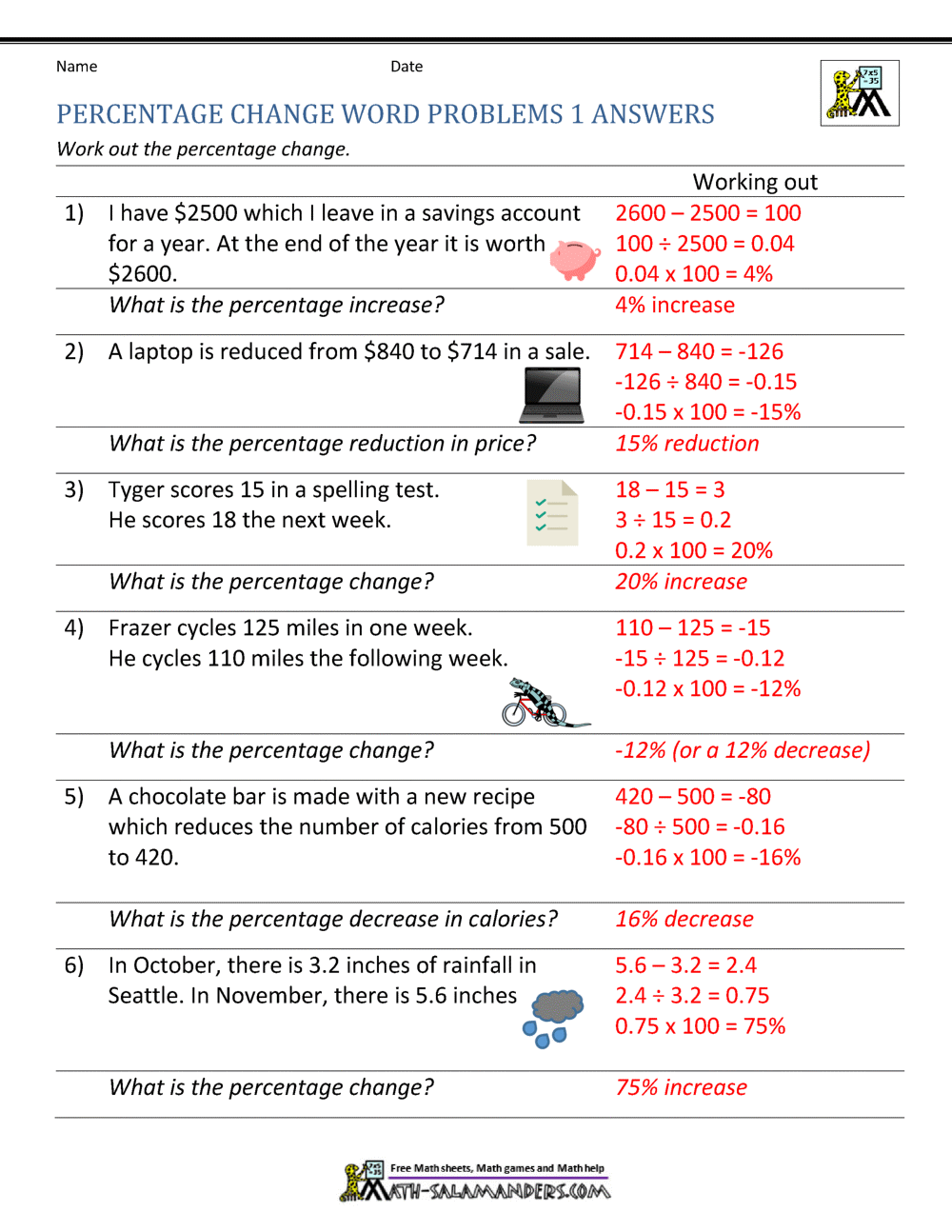
In the worksheet, compare Questions 1, 2, and 6. The contexts differ—savings, a sale price, and rainfall—but the comparison is always made with the first value given. A negative difference can show a decrease during working, but the final response should normally state the direction clearly: for example, a decrease.
An increase or decrease gives a new total
Some questions ask for the percentage change. Others give you a percentage change and ask for the new amount. These are different tasks.
Consider a jacket costing that increases by .
First find the increase:
Then add the increase to the original price:
The new price is:
A percentage increase has two parts:
- the original amount, which is ;
- the extra percentage.
So a increase gives:
As a decimal multiplier:
This gives a shorter calculation:
The multiplier is not a fact to memorise separately. It comes from keeping all of the original and adding another .
For an increase of :
Discounts are percentage decreases
A discount is money taken off an original price. It is therefore a percentage decrease.
Suppose headphones have an original price of and are reduced by .
Method 1: Find the discount, then subtract
Find of :
This is the amount saved:
Subtract it from the original price:
The sale price is:
Method 2: Find the percentage that remains
A discount means the customer pays:
Convert to a decimal:
Then calculate:
Both methods must give the same answer. Method 1 makes the saving visible; Method 2 is often quicker when you only need the final price.
For a discount of :
The key idea is that, after a discount, you pay the remaining percentage, not the discount percentage itself.
GCSE Maths - Percentage Increase and Decrease (Multiplier Method) (2026/27 exams)
Watch Cognito’s “GCSE Maths - Percentage Increase and Decrease (Multiplier Method).” It connects the find-the-percentage method with the faster multiplier method for increases, reductions, and discounts.
Watch increase and discount first. The examples show the two-stage method: find the percentage amount, then add it for an increase or subtract it for a decrease. Continue with the multiplier method to see why 1.18 represents an 18\% increase and 0.70 represents a 30\% decrease. Finish with the common trap, especially the reminder that 3\% = 0.03, not 0.3.
Finding an original price from a discounted price
A common exam trap is to reverse a discount incorrectly.
If an item costs after a discount, it is tempting to add of . That would be wrong because is not the original ; it is the remaining .
Let the original price be .
So:
The original price was:
A useful check confirms this:
The original value is , not . Adding to the sale price does not undo a discount, because the two percentages would be calculated from different starting amounts.
Exam checks that prevent common mistakes
Before finalising a percentage answer, use these quick checks.
1. Check the decimal conversion
Confusing these makes an answer ten times too large.
2. Check whether you need the part or the final total
If a item has a discount:
The discount is , but the sale price is:
3. Use the initial amount for percentage change
For a change from to :
The denominator is the starting value, .
4. Check the direction and size
- After an increase, the final amount should be greater than the original.
- After a discount, the final price should be lower than the original.
- A discount should halve the price.
- A change should be small, so an answer that changes the amount greatly is suspicious.
5. Round money only at the end
Keep full calculator values during working when possible. Round the final monetary answer to two decimal places:
A flexible routine for percentage questions
When you see a percentage problem, use this sequence:
- Identify the original whole. What amount does represent?
- Decide what the question asks for. Is it a percentage amount, a new total, a percentage change, a discount, or an original value?
- Translate the percentage. Use a decimal, fraction, or mental building blocks.
- Calculate from the correct base amount. For percentage change, this is the initial value.
- Add or subtract only when the context requires it.
- Check the answer against the situation and include the correct unit, such as , kg, or .
The central ideas are these:
For an increase, retain the original and add the extra percentage. For a discount, retain the percentage left after the reduction. Once you identify what represents , the calculation becomes much more reliable.
Next, you will extend this proportional thinking to ratios, rates, and everyday comparison problems.
Can't find a good explanation? Sign up and we'll make it for you
Sign up