
Hello. In the previous lesson, you used ratios and rates by keeping units and matching quantities in the correct positions. The same discipline matters here: before you calculate, decide what is being measured, make units consistent, and include the correct unit in your answer.
This lesson covers metric length conversions, perimeter, area, volume, and elapsed time. These topics often appear as practical exam questions about fencing, flooring, boxes, journeys, and timetables. Plan for about minutes, including the video and reading.
First: identify the kind of measurement
A number alone is rarely a complete measurement. The unit tells you what the number means.
| Measurement | What it describes | Common units |
|---|---|---|
| Length | One-dimensional distance, such as the height of a door or distance travelled | , , , |
| Perimeter | Total distance around the outside of a shape | , |
| Area | Surface covered by a flat, two-dimensional shape | , |
| Volume | Space inside a three-dimensional object | , |
| Elapsed time | Duration between a start and finish time | minutes, hours |
The exponent on an area or volume unit matters:
- is a length.
- is an area.
- is a volume.
Do not treat them as interchangeable. A floor might be long, cover , and need a box with volume measured in .
How to Convert Units of Length, Area and Volume - Full Lesson - IGCSE Mathematics Extended & Core
Watch “How to Convert Units of Length, Area and Volume” by Radford Mathematics for a clear method for converting metric lengths. It gives you the basic factors that support the later area and volume work.
Watch the unit map for the relationships between millimetres, centimetres, metres, and kilometres. Then watch two examples, pausing to check why a conversion to a smaller unit makes the numerical value larger.
For length, the core facts are:
A reliable rule is:
- Converting from a larger unit to a smaller unit gives a larger number, so multiply.
- Converting from a smaller unit to a larger unit gives a smaller number, so divide.
For example:
Calculate only after units match
Suppose a path consists of followed by . To find the total distance in kilometres, first convert :
Now add:
So the total distance is:
Adding and immediately would be meaningless because they use different units.
Perimeter: length around the boundary
Perimeter uses length units, because it is the distance around the outside edge of a shape. For a rectangle:
A rectangular garden is long and wide. Find its perimeter in metres.
First make the units match:
Then calculate:
If the question is about fencing, edging, or walking around an object, perimeter is usually what you need. If it is about carpet, paint, grass seed, or tiles, it is more likely to involve area.
Area and volume: the conversion factor changes
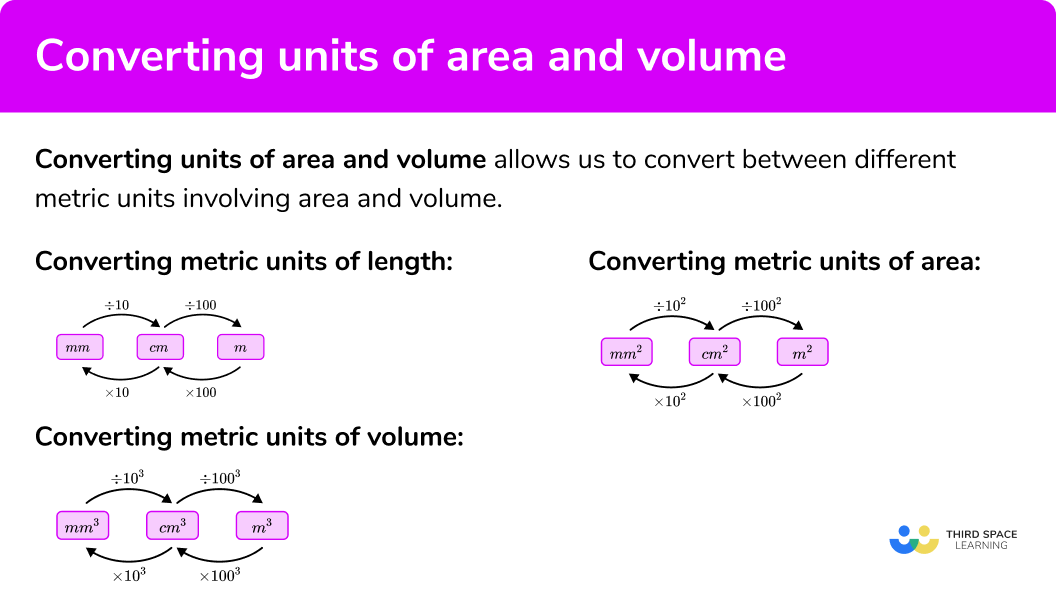
Length has one dimension. Area has two dimensions, and volume has three. That is why the conversion factors are not the same.
Converting metric units for area and volume - KS3 Maths - BBC Bitesize
Read “Converting metric units for area and volume” from BBC Bitesize. Its diagrams show why converting area requires two length conversions, while converting volume requires three.
In the opening area explanation and its “Examples,” read from the area introduction, then continue through the worked examples and the rectangle question. Focus on why both dimensions must be converted. Next, find the section titled “Converting units for volume.” Read its introduction and examples, especially the cube explanation. Continue through the cuboid-dimensions question, noting that every length, width, and height must use the same unit before you calculate.
Area: square units
Area measures the space a flat shape covers. For a rectangle:
For a square:
Because a square has a length and a width, a length conversion must be applied twice.
Since:
then:
Similarly:
A frequent exam error is writing:
This is incorrect. A square that measures by measures by , so it contains small square centimetres.
Worked area example
A rectangular noticeboard is long and wide. Find its area in square metres.
Convert the width first:
Now multiply the matching dimensions:
The answer is:
A useful check: because the width is less than , the area should be less than . The answer, , is sensible.
Volume: cubic units
Volume measures how much space a three-dimensional object occupies. For a cuboid, such as a box or rectangular tank:
Volume conversion applies the length factor three times. Since:
then:
Also:
Worked volume example
A storage box measures long, wide, and high. Find its volume in cubic metres.
Convert the centimetre measurements to metres:
Now calculate:
The box has a volume of:
The method is always the same: convert every dimension to one unit, then multiply.
Elapsed time: use a number line or bridge through an hour
Time is different from metric units because hour contains minutes, not . Treating time as though it were a decimal number causes mistakes.
For elapsed time, a safe approach is to count forward from the start time:
- Count from the start time to the next easy time, often the next full hour.
- Count the full hours.
- Count the remaining minutes to the finish.
- Add the durations.
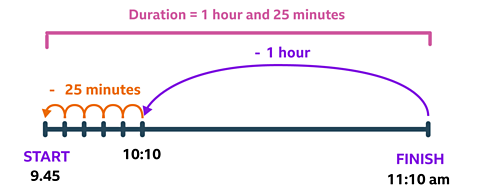
Worked elapsed-time example
A film starts at and ends at . Find its duration.
First, go from to :
Then from to :
Finally, from to :
Add the minutes:
So the film lasts:
Finding a finish time
The same idea works when you know a start time and a duration. A train departs at and the journey lasts hour minutes.
Add the hour first:
Then add minutes:
The train arrives at:
An exam routine that prevents common mistakes
Before finalising an answer, use this short checklist:
- Underline the measurement required. Is it a length, perimeter, area, volume, or duration?
- Check the units given. Convert them before adding or multiplying.
- Choose the operation.
- Add lengths for a total distance or perimeter.
- Multiply length and width for rectangle area.
- Multiply length, width, and height for cuboid volume.
- Count forward in stages for elapsed time.
- Write the correct unit. Use , , , minutes, or hours and minutes as required.
- Check whether the answer’s size makes sense. A conversion to a smaller unit should have a larger numerical value. An area in should be much larger numerically than the same area in .
The most common errors are mixing units in a calculation, forgetting to square or cube the conversion factor, using a length unit for area or volume, and treating time as base .
You can now distinguish length, area, and volume; convert metric units accurately; calculate perimeter, rectangle area, and cuboid volume; and work out elapsed time by bridging through convenient times.
Next, you will practise extracting the right values from tables, charts, and graphs, then using those values to make justified calculations.
Can't find a good explanation? Sign up and we'll make it for you
Sign up