
Hello. In the previous lesson, you practised extracting the right values from tables, charts, and graphs, then choosing a calculation and giving an answer with its unit. This final Numeracy Exam Sprint lesson brings those habits together for longer word problems.
Multi-step problems can look difficult because the information arrives as a story. Usually, however, the arithmetic is familiar. The real task is to decide what each number represents, put the calculations in a sensible order, and check that the final answer fits the situation.
Plan for about minutes, including the short video and reading.
Turn the story into a plan
A word problem may contain numbers, units, comparisons, and extra context. Do not begin calculating halfway through reading it. First read all the way to the question at the end.
This “UPS check” visual gives a useful four-part routine.
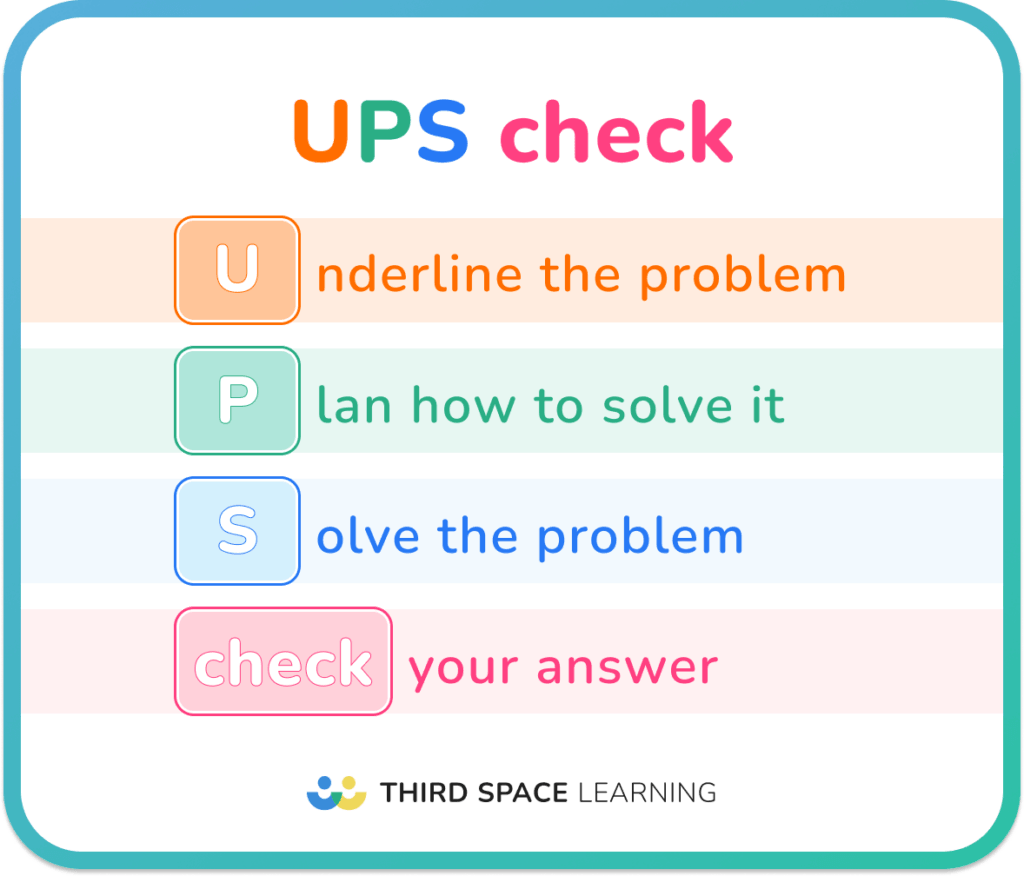
For exam questions, make the routine more specific:
| Step | What to do |
|---|---|
| U — Underline | Underline what you must find. Circle the important numbers and their units. Cross out no information yet; first decide whether it matters. |
| P — Plan | Write a short list of what must be found first, second, and last. A sketch, table, or bar model can help. |
| S — Solve | Calculate one stage at a time. Label intermediate answers so you know what they mean. |
| Check | Use estimation, units, and the original information to test whether the answer is sensible. |
The word at the end of the question often tells you the final quantity:
- How much does each person pay? Your final unit should be money per person.
- How many are left? Your final answer should be a remaining number of items or people.
- What is the total distance? Your final unit should be distance.
- How long altogether? Your final unit should be time.
A calculation can be correct but still answer the wrong question. For example, if a question asks for the cost after a discount, stopping at the original total is incomplete.
Watch “Understanding Word Problems” from Mometrix Academy for a compact explanation of why careful setup matters more than rushing the arithmetic.
Watch the setup routine first. Focus on reading the whole problem, identifying the missing quantity, and writing down what any unknown means. Then watch operation clues for common words linked with addition, subtraction, multiplication, and division. Treat these words as clues, not automatic rules: the full situation decides the operation.
Operation words are clues, not commands
Words such as “total,” “remaining,” “each,” and “difference” can help, but they do not solve the problem for you.
For instance, each has two common meanings:
- “There are pens in each pack” means multiply the number of packs by .
- “Share pens equally between tables” means divide by .
The difference is the unknown. In the first sentence, you know the number in one group and want the total across groups. In the second, you know the total and want the amount in one equal group.
Make the hidden structure visible
Before using a calculator or doing written arithmetic, turn the wording into a brief plan. You do not need to write a long paragraph. A few labelled lines are enough.
Consider this problem:
A school buys packs of pens for an event. Ten pens are used at the registration desk. The remaining pens are shared equally among classroom tables. How many pens does each table receive?
First, underline the target: pens per table.
Next, organise the facts:
- packs
- pens per pack
- pens used
- tables
Now write a plan:
- Find the number of pens bought.
- Find the number remaining after the registration desk uses some.
- Share the remaining pens equally between the tables.
The calculations follow that plan:
There are pens at the start.
There are pens remaining.
Each classroom table receives pens.
Notice how the units guide the work:
Then you subtract pens from pens, and finally divide pens by tables. If you ever find yourself trying to add “packs” and “pens,” pause: the calculation is probably not yet set up correctly.
Bar models can clarify relationships
A bar model is a simple diagram made of rectangles. It does not do the arithmetic for you; it shows the relationship between a whole, its parts, and equal groups. It is especially useful when a problem involves “times as many,” sharing, or several linked steps.
Learn how to use a bar model to represent and solve mathematical problems – KS3 Maths – BBC Bitesize
Read BBC Bitesize’s “How to use the bar method to model and solve problems.” Its multi-step examples show how a diagram can reveal the calculation order before you start working.
In the section “Using a bar model for multi-step problems,” read the marble example. Follow how the total is split into 1, 2, and 4 equal parts before any calculation is done. Then continue through the example about Esther and Frank’s cards, focusing on why the multiplication must be completed before the equal sharing calculation.
You do not need to draw a perfect bar model in an exam. A rough sketch of equal boxes or a labelled list can prevent a major error. Use one when the words “twice,” “three times,” “share equally,” or “remaining” make the relationship hard to hold in your head.
A complete multi-step example
Now combine skills from earlier lessons: multiplication, percentages, subtraction, and division.
A cinema group buys tickets at each. The group receives a discount on the ticket total. The discounted cost is shared equally between families. How much does each family pay?
1. Identify the final target
The question asks for the amount each family pays. The final answer should be in pounds per family.
2. Plan the stages
The order matters:
- Find the full cost of all tickets.
- Find the discount amount.
- Subtract the discount from the full cost.
- Divide the discounted cost between families.
Writing the plan first protects you from a common mistake: finding of one ticket price instead of of the ticket total.
3. Carry out each calculation
First, calculate the original ticket total:
The original total is .
Next, calculate of :
The discount is .
Now subtract the discount:
The discounted group cost is .
Finally, share this amount among families:
Each family pays .
4. Check the answer
A good check uses the context, not just a second calculation.
- Without the discount, each family would pay:
- A discount should make each family’s cost lower than .
- The discount on the whole group is , so the discount per family is:
- Therefore each family should pay:
This matches the answer , so it is reasonable.
Checking: catch mistakes before they cost marks
Checking is not an optional extra. It is your best chance to catch a wrong operation, a missed step, or an answer with the wrong unit.
Use these five checks.
1. Estimate the size first
Round numbers roughly in your head.
In the cinema example, tickets at about each cost about . After a discount, the group should pay somewhat less than , perhaps a little over . Dividing among families should give a little over each.
So is believable. An answer like or would need immediate investigation.
2. Check the direction of change
Ask whether the situation should make a number bigger or smaller.
- Adding an extra charge should increase the total.
- A discount should decrease the price.
- Taking away used items should decrease the number remaining.
- Sharing the same total among more people should make the amount per person smaller.
For example, if you calculated a discounted price that was higher than the original price, you may have added the discount instead of subtracting it.
3. Work backwards where possible
Use the inverse operation to reconstruct an earlier value.
For the pen example:
So pens per table gives shared pens. Adding the used at registration gives:
And pens equals packs of :
Every part matches the original story.
4. Check units and the exact wording
Your final sentence should answer what was asked:
- money:
- distance: miles, kilometres, metres
- mass: grams or kilograms
- time: minutes or hours
- items or people: whole numbers, where appropriate
If the question asks, “How much more?” include the comparison in your answer. If it asks, “How much each?”, make clear that the amount is per person, pack, day, or group.
5. Check whether a whole-number answer is required
Some contexts allow decimals:
- money, when written to the nearest penny;
- distances;
- weights;
- average values.
Other contexts usually need whole numbers:
- people;
- buses;
- pencils;
- tables.
If a calculation says buses are needed, you cannot use of a bus. You would normally need buses. Always return to the real-world meaning before rounding.
An exam-ready answer format
For multi-step questions, organise your working so a marker can see your reasoning even if one arithmetic slip occurs. A strong layout looks like this:
Then write one direct concluding sentence.
For example:
Each family pays .
You may sometimes be able to combine steps into one line, but separate lines are safer when you are learning or working under pressure. They also make checking much easier.
Key takeaways
A multi-step word problem becomes manageable when you separate its stages.
- Read the full problem and underline what you must find.
- Record important numbers with their units.
- Write a short plan before calculating.
- Solve one stage at a time and label intermediate answers.
- Check by estimating, working backwards, checking units, and considering whether the result fits real life.
- End with a complete sentence that answers the exact question.
You have now completed the Numeracy Exam Sprint. The next module moves to English exam responses, beginning with how to spot command words and evidence requirements in a question.
Can't find a good explanation? Sign up and we'll make it for you
Sign up