
Introduction
Welcome to our final lesson on the cultures of the southern highlands. In our previous session, we explored the vast and living cosmology of the Nasa people, understanding their world as an interconnected system and their relationship with volcanoes as a dialogue with powerful elders. We were introduced to Ipx Ksxaw, Grandpa Fire, as the spirit of dialogue and the heart of the community.
Today, we will build directly on that foundation to address our learning outcome: to recount the Nasa myth of the sacred fire and explain its cultural significance. We will delve into the origin story of fire itself and see how this primordial myth translates into a vital community ritual that reinforces social harmony and spiritual balance. For someone with your expertise in product design and systems thinking, this is a fascinating case study of how a foundational story (the why) directly informs a core community function (the how).
The Primordial Flame: A Myth of Creation
Every system has an origin point, and for the Nasa, the story of fire is deeply entwined with the creation of the universe itself. It's a narrative that establishes fire not merely as a tool, but as a procreative and fundamental force.

To understand this origin, we'll turn to a text that recounts the story as told by Nasa elders.
This article, 'Del silencio a la Palabra,' contains a beautifully recounted version of the Nasa creation myth. It explains how fire was the first element brought into a dark world, leading to the birth of the first beings.
Please read the section titled 'Origen de la vida.' Focus on the sequence of events: the role of the creator Isxkwe Sxlapun, the instructions from the dream spirit Ksxa’w, and what is born from the act of creating fire.
This is a rich and complex creation story. Let's break down the key narrative beats:
- The Creator: The story begins with
Isxkwe Sxlapun, a creator being who embodies both masculine and feminine principles. The name itself means "stone that produces fire," immediately centering fire in the act of creation. - The Spark of Life: Guided by a dream spirit (
Ksxa’w),Isxkwe Sxlapunrubs stones together, and from this friction, fire is born. - The First Beings: This primordial fire is not just light or heat; it transforms into a living being named
Uma(Mother). WhenUmais lonely, the process is repeated to create her partner,Sek(Sun). - Duality and Generation: The myth continues by explaining the origin of the Moon (from a "cold" fire) and the eventual emergence of humanity from
Isxkwe Sxlapun's own miraculous pregnancy.
The core takeaway from the myth is that fire is the catalyst for life and existence. It is the generative force that precedes even the Sun and the Earth Mother. This gives it a sacred status that goes far beyond its practical uses.
From Myth to Ritual: The Ipx Fxicxanxi
A belief system is not just a collection of stories; it's a set of practices that bring those stories into the life of the community. The Nasa's reverence for fire is powerfully demonstrated in the annual ritual of Ipx Fxicxanxi, or the "Extinguishing of the Hearth."
This may sound counterintuitive—why extinguish something so sacred? The ritual is an act of purification and renewal, a way to consciously manage the spiritual "energy" of the community.
Let's look at a description of this ritual.
Cosmología Páez (Nasa). Rituales
The website 'Pueblos Originarios' provides a concise explanation of key Nasa rituals. We will focus on the description of 'Ipx Fxicxanxi' to understand its purpose and practice.
Please read the section titled 'Ipx Fxicxanxi(Apagado del Fogón)'. Pay attention to the stated goal of the ritual and the elements involved.
As you've just read, the Ipx Fxicxanxi ritual is an act of "harmonization." The community gathers around the hearth, and under the guidance of elders, they use sacred elements like coca and traditional drinks to channel "bad energies" (el sucio) gathered over time. They offer this spiritual waste to Grandpa Fire, who cleanses and transforms it.
This ritual directly reflects the fire's role in the creation myth:
- Creative/Transformative Power: Just as the first fire transformed into
Uma, the ritual fire transforms negative energy into harmony. - A Living Entity: The fire is treated as a wise elder (
abuelo fuego) who can receive offerings and perform a service for the community. It's an active participant, not a passive element. - Cyclical Renewal: By extinguishing and presumably relighting the fire, the community performs a symbolic reset, preparing itself for future ceremonies and ensuring continued balance.
The Fire at the Center: The Ipx ka'h or Tulpa
The cultural significance of fire is so profound that it is embedded in the very structure of Nasa society. It is the literal and symbolic center of the home and the community.
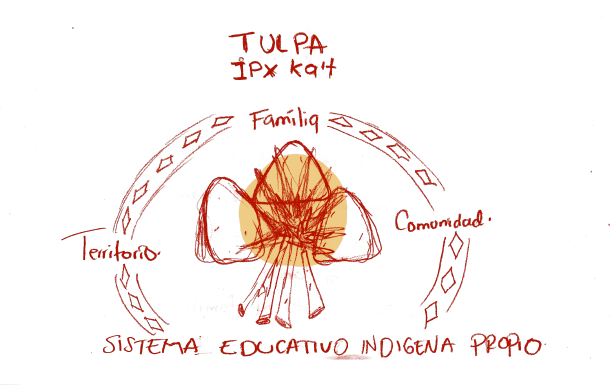
This concept of the Ipx ka'h or Tulpa (the communal hearth) is the architectural and social manifestation of the fire myth. It's the space where:
- Knowledge is shared: As we learned previously, fire is the spirit of dialogue.
- Family is unified: It's the center of the home.
- Community is strengthened: It's where communal decisions are made and rituals are performed.
The fire is the anchor point that holds the entire social system together. It's the physical location where the abstract principles of the cosmology are practiced daily.
Test your understanding!
Drawing on your background in product design and user experience, you are often tasked with creating intuitive systems and clear visual language.
Imagine you need to create a simple icon or symbol to represent the Ipx Fxicxanxi ritual for a cultural guide. Based on what you've learned about the creation myth and the ritual's purpose, what three key visual elements would you combine in your design, and what would each element signify?
Show answer
There are many possible answers, but a strong response would integrate the core concepts of creation, purification, and community. For example:
- A Central Flame: This is the most crucial element, representing
Ipx Ksxaw(Grandpa Fire). It signifies the sacred, creative, and transformative power at the heart of the ritual. - A Spiral or Ascending Smoke: Emerging from the flame, a spiral or wisp of smoke could represent the "bad energies" (
el sucio) being offered to the fire. Its upward movement would signify purification and transformation, not just destruction. This captures the "harmonization" aspect. - An Encircling Element (e.g., three stones or a circle): Surrounding the flame, a circle or a representation of three stones would be powerful. A circle symbolizes the community gathered around the hearth (
Ipx ka'h). Three stones could be a direct reference to the creation myth, whereIsxkwe Sxlapunrubbed stones to create the first fire, connecting the ritual back to its mythic origin.
Together, these elements would tell a story: the community (circle/stones) gathers around the sacred fire (flame) to offer up and transform negative energy (spiral), thus restoring harmony.
Conclusion
In this lesson, we have traced the journey of a single, powerful concept—fire—through the Nasa worldview. We began with its mythic origin as a generative force of creation and saw how this story imbues fire with a sacred status. We then connected this belief to the Ipx Fxicxanxi ritual, a practical application of fire's purifying power to maintain community harmony. Finally, we saw how fire is institutionalized as the Ipx ka'h, the social and structural heart of Nasa life.
Key Takeaways:
- Myth of Origin: The Nasa creation myth establishes fire as a primordial, life-giving force, born from the creator
Isxkwe Sxlapunrubbing stones together. - Cultural Significance: This myth gives fire a sacred identity as a wise, transformative elder (
Ipx Ksxaworabuelo fuego). - Ritual Practice: The
Ipx Fxicxanxi("Extinguishing of the Hearth") is an annual ritual where the community offers negative energies to the fire for cleansing and harmonization. - Social Center: The concept of the
Ipx ka'hor Tulpa places the hearth at the physical and symbolic center of the family, community, and territory, acting as a unifying anchor for Nasa society.
This concludes our module on the Pasto and Nasa peoples of the southern highlands. We have seen how their unique, high-altitude environment has shaped equally unique and profound ways of understanding the world.
Preview of the Next Lesson:
We now leave the Andean peaks and journey into a completely different environment: the vast, biodiverse world of the Amazon and Orinoco basins. In our next module, we will begin by exploring the cosmology of the U'wa people and their powerful concept of 'Ruwa'—the world as a living body, and their sacred duty as its guardians.
Can't find a good explanation? Sign up and we'll make it for you
Sign up