
Introduction
Welcome back! In our last lesson, we explored the dramatic high-altitude world of the southern Colombian Andes and delved into the Pasto myth of the moon's origin—a story of cosmic conflict and the birth of duality. We saw how the use of volcanic ash in that myth powerfully connected it to the local environment.
Today, we shift our focus to the Nasa people, who share this same potent landscape. We'll move from a single narrative myth to a broader worldview to address our learning outcome: to describe the Nasa cosmology and their spiritual relationship with volcanoes.
For the Nasa, the world is not a stage for the gods but a single, living, interconnected organism. This is a form of systems thinking, where every element—from a river to a star to a volcano—is an active participant. Your background in understanding complex systems and human experience will be a great asset here, as we map out the relationships and beliefs that define the Nasa worldview. We'll see how this cosmology isn't an abstract philosophy but a practical guide for living in harmony with one of the most powerful forces on Earth: the volcano.
What is a Cosmology?
Before we dive in, let's clarify our key term. In an anthropological sense, a cosmology is the complete body of knowledge, practices, and beliefs a culture uses to understand the world and their place within it. It’s their ultimate map of reality. For the Nasa, this map is not of an inert world but a sentient one.
The Living World of the Nasa
The foundational principle of Nasa cosmology is that everything is alive. There is no such thing as an inanimate object; the mountains, rivers, wind, and stars are all conscious beings with whom humans share existence.
To get a deeper understanding of this vibrant worldview, let's turn to a report from Oxfam that studied the resilience of the Nasa people in the face of natural disasters. This document provides a rare and authentic glimpse into their belief system.
Disaster is Nature Telling Us how to Live Resiliently
This reading from the report 'Disaster is Nature Telling Us how to Live Resiliently' will introduce you to the core components of the Nasa's living cosmos. It describes the key spiritual entities and the concept of 'coexistence' that underpins their entire worldview.
Please read the two sections starting with 'Deciphering Nasa cosmology is beyond the scope of this study...' and ending with '...any development program affecting indigenous people’s lands and environments.' Focus on identifying the different spiritual beings and their roles in the cosmos.
As you've just read, the Nasa world is populated by a family of powerful spirits that are manifestations of the natural world. Let’s summarize the key figures you'll want to have in your visual library:
- Kiwe Mama: Mother Earth, the foundation of all life. The rivers and creeks are her veins.
- Yu’Ksaw: The spirit of water. The great lagoon,
Sa´t Tama, is the womb from which the great guides of the world emerge. - Wejxa Ksaw: The spirit of the wind, representing the beginning of life and breath.
- Sek Ksxa`W: Father Sun, who illuminates existence.
- A
Te KsxaW: The Moon, who brings advice. - Ā Ksxa`W: The Stars, who fertilize the lagoons and guide humanity.
- Ipx Ksxaw: Grandpa Fire, the heart and protector of all beings, symbolizing dialogue.
This concept of a living world demands a specific way of being, which the Nasa call putx fxizeñxi yuwe`, or "coexistence." It's a mandate to live in a dynamic equilibrium with all other spirit beings. This is not a passive state but an active, ongoing process of maintaining balance.
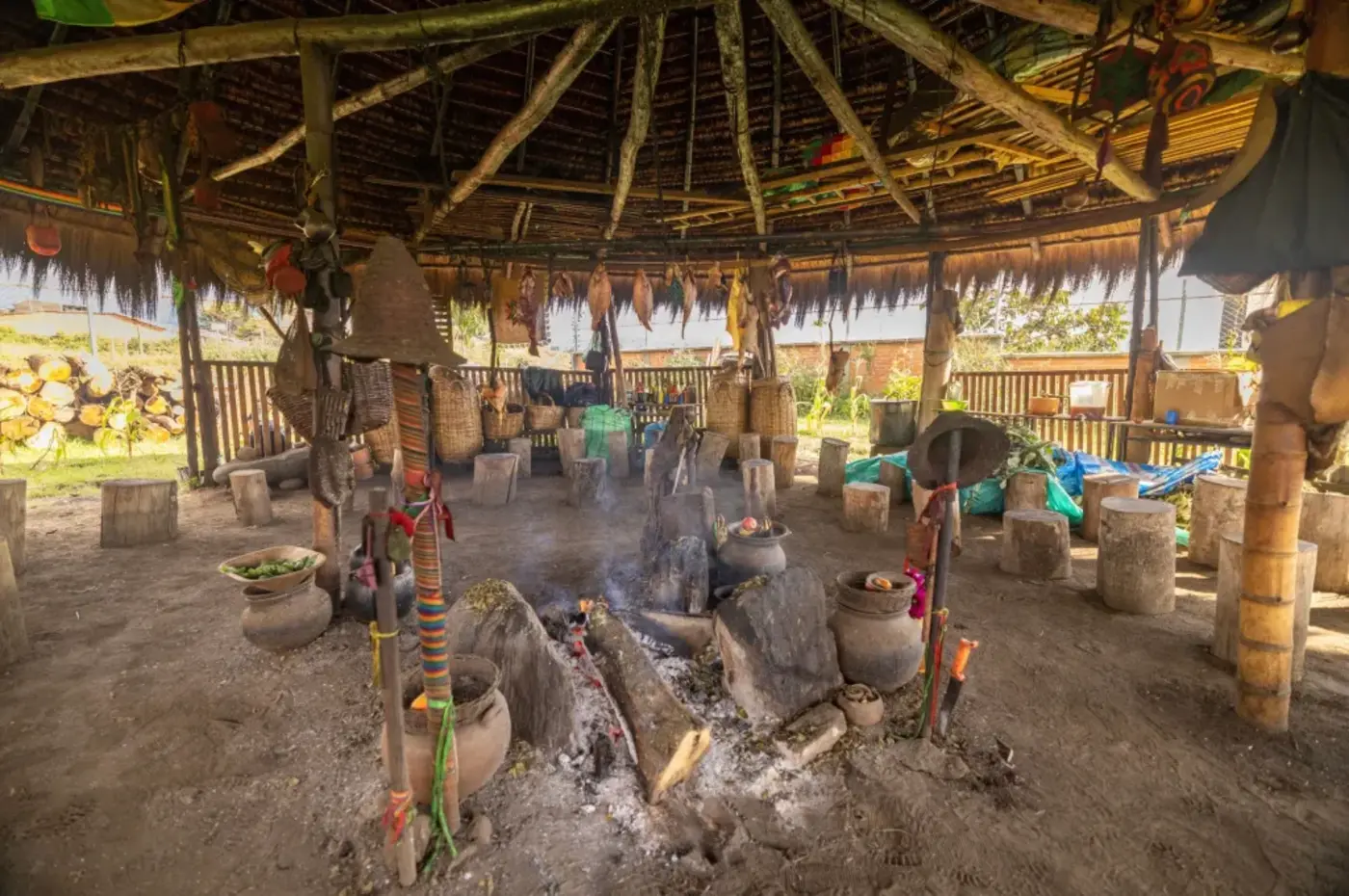
The Volcano: A Spiritual Teacher
Nowhere is this relationship of active coexistence more critical than with the volcanoes that dominate the Nasa territory, such as the Nevado del Huila. For the Nasa, a volcano is not a geological feature; it is an ancestor, a powerful elder they call îisx tuhme—the "white-haired old man."
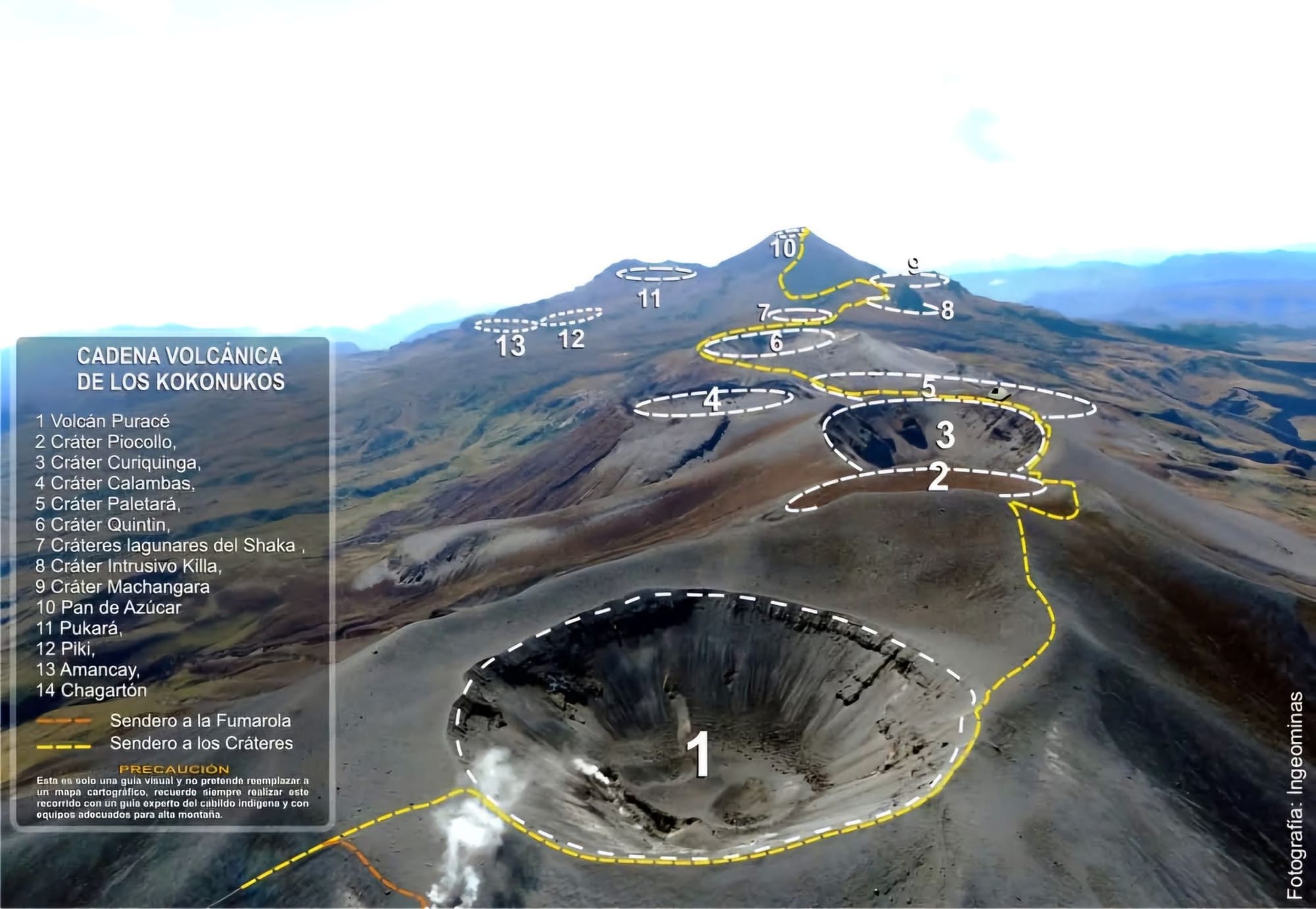
This elder communicates. Its moods and actions—from smoking fumaroles to devastating eruptions—are seen as direct messages to the community.
Let's return to the Oxfam report to see how the Nasa interpret these messages in the real world.
Disaster is Nature Telling Us how to Live Resiliently
The following section of the report details the 1994 Páez disaster, when an earthquake near the Nevado del Huila volcano caused a catastrophic mudflow. Pay close attention to how the Nasa survivors interpreted this event. It's a perfect example of their spiritual relationship with the volcano in action.
Please read the section titled 'Páez, 1994: “A loud warning from the white-haired old man”'. Focus on the quote from the local residents explaining why they believed the disaster happened.
The interpretation you just read is profound. The community did not see the volcano as a monster or the event as random. They saw it as a "friend" who intervened because they had "forgotten the old ways" and "lived detached from Mother Nature." The eruption was a painful but necessary communication—a "loud warning" to restore balance.
This communication flows both ways. The Nasa don't just wait for disaster; their spiritual leaders, the The Wälas, actively listen to the volcano and the spirit world, often through dreams, to anticipate events and guide their people. This active relationship is central to their resilience and their concept of wêtwêt fxi’zenxi—creating a "risk-free territory" through spiritual harmony, not just physical preparedness. Rituals are performed to "repair the broken relationship" and maintain the dialogue with the volcano and other spirits.
Test your understanding!
Given your experience with systems thinking and mapping complex interactions, create a simple "relationship map" of the Nasa cosmos based on what you've learned.
Your map should visually connect the following elements:
- The Nasa People
Kiwe Mama(Mother Earth)- The Volcano (
îisx tuhme) - The other key spirits (Water, Sun, Moon, etc.)
For each connection, briefly describe the nature of the relationship (e.g., "communication," "guidance," "respect," "harmony/balance"). How does this system work to maintain equilibrium?
Show answer
A possible relationship map could look something like this:
Central Element: Kiwe Mama (Mother Earth)
- All other elements exist within or upon her. She is the foundation.
Connections:
-
Nasa People <—> The Volcano (
îisx tuhme)- Nature of Relationship: Dialogue and Respect.
- Flow: The Volcano communicates warnings and guidance through its activity (eruptions, seismic signs). The Nasa people listen, interpret these signs (via dreams, shamans), and respond with rituals to restore harmony. This is a two-way feedback loop.
-
Nasa People <—> Key Spirits (Water, Sun, Moon, Fire)
- Nature of Relationship: Coexistence and Dependence.
- Flow: The spirits provide the essentials for life (water, light, guidance, warmth). The Nasa people show respect and perform rituals to ensure these spirits are honored, maintaining the flow of life-giving energy. For example, they must care for the rivers, the veins of
Kiwe Mama.
-
The Volcano & Key Spirits <—>
Kiwe Mama- Nature of Relationship: Embodiment.
- Flow: The Volcano, rivers (
Yu'Ksaw), etc., are not separate fromKiwe Mamabut are integral parts or organs of her living body. An unhealthy river meansKiwe Mamais unwell. An angry volcano signifies a deep imbalance within the entire system.
How the System Maintains Equilibrium:
The system is self-regulating through feedback. When the Nasa people's actions cause imbalance (e.g., "forgetting the old ways," environmental disrespect), the spiritual elements—especially the highly sensitive Volcano—provide strong feedback (a "warning"). This prompts the Nasa to take corrective action (rituals, changes in behavior) to restore harmony. The goal is not to control nature, but to live in a respectful, balanced dialogue with it.
Conclusion
In this lesson, we have moved beyond a single story to explore the complex and beautiful cosmology of the Nasa people. We've seen that for them, the world is a single, interconnected living system, and their relationship with the powerful volcanoes in their homeland is not one of fear, but of profound, active, and mutual respect.
Key Takeaways:
- Nasa Cosmology: A worldview where everything is alive and interconnected. The world is populated by spiritual beings like
Kiwe Mama(Mother Earth), and the spirits of water, wind, sun, moon, and fire. - The Volcano as an Elder: Volcanoes are not just mountains; they are spiritual teachers and ancestors (
îisx tuhme) who communicate with the community. - A Relationship of Dialogue: Natural disasters, like volcanic eruptions, are interpreted as communications—warnings that the community has fallen out of balance with the natural/spiritual world.
- Coexistence and Harmony: The Nasa believe their role is to maintain cosmic balance through rituals, respect, and actively listening to the spirit world, a practice essential for resilient living.
Preview of the Next Lesson:
We have just been introduced to Ipx Ksxaw, Grandpa Fire, as the heart of the community and the spirit of dialogue. In our next and final lesson for this module, we will explore a specific Nasa narrative: the myth of the sacred fire and its cultural significance. This will give us a concrete story that builds directly upon the cosmological foundations we've laid today.
Can't find a good explanation? Sign up and we'll make it for you
Sign up