
Hello! Welcome to the first lesson in our course on deflation.
Given your extensive background in economics and statistical science, we can dive deep into the mechanics of these phenomena. This course is designed to move beyond textbook definitions and engage with the complexities of real-world case studies, starting with the most famous one: Japan.
Introduction
This lesson addresses the first learning outcome for our module on Japan: "Describe the macroeconomic conditions in Japan leading up to its 'lost decades,' focusing on the asset price bubble of the late 1980s."
We will dissect the anatomy of this infamous bubble, exploring the unique structural features of Japan's post-war economy, the international pressures that acted as a catalyst, and the domestic policy decisions that inflated asset prices to unsustainable heights. Understanding this "boom" is the essential prerequisite for analyzing the subsequent "bust" and the long period of deflation that followed.
- Estimated time to complete: 60 minutes.
- Recap: As this is our first lesson, there is no prior content to review. We will build our entire framework from the ground up, starting today.
1. The Foundation: Japan's Post-War "Miracle" Economy
To understand why the bubble of the 1980s became so enormous, we first need to appreciate the unique economic structure Japan built in the decades after World War II. It was not a pure market economy in the Western sense; it was a "developmental state" with specific features that profoundly influenced corporate finance and investment.
To get a rich historical and structural overview, please watch the following segment from a lecture by historian William Tsutsui.
As you watch (approx. 20 minutes), focus on these key structural features he describes:
- State Industrial Policy: The role of ministries like the Ministry of International Trade and Industry (MITI) in guiding economic development.
- The Keiretsu System: The nature of these industrial/financial conglomerates, typically centered around a main bank.
- Bank-Centered Corporate Finance: How, unlike in the US or UK, corporate financing relied heavily on bank loans rather than equity or bond markets. This gave the government and the Bank of Japan immense indirect control over the economy.
- The Social Consensus: The widespread societal agreement to prioritize economic growth above all else.
This system, characterized by close ties between the government, banks, and corporations, was incredibly effective at mobilizing capital for industrial reconstruction and export-led growth. A key mechanism of this control was a policy known as "window guidance," where the Bank of Japan would give direct quotas to commercial banks on how much they should lend and to which industries. This is a crucial concept that we'll see reappear with dramatic consequences in the 1980s.
2. The Trigger: The Plaza Accord of 1985
By the early 1980s, Japan's export-driven model had become too successful. The country was running massive and growing trade surpluses, especially with the United States. This created significant political and economic friction. The US, facing its own economic challenges and a soaring dollar, pressured Japan and other major economies to act.
The result was a landmark agreement known as the Plaza Accord.
To understand the lead-up to the Accord and its immediate consequences, please watch the following segments from this video by Patrick Boyle. His finance-oriented perspective will likely resonate with your background.
This clip (approx. 4 minutes) explains:
- How Japan's undervalued currency was a deliberate policy to boost exports.
- How this led to trade imbalances and pressure from the US.
- The goal of the Plaza Accord: to devalue the US dollar and, conversely, appreciate the Japanese yen.
The Accord was successful. The yen appreciated dramatically, rising from ~240 JPY/USD in 1985 to ~120 JPY/USD by 1988. For a heavily export-reliant economy, a rapidly strengthening currency is a major headwind that can trigger a recession. The Bank of Japan's response to this threat is the single most important factor in the creation of the asset bubble.
3. The Bubble Inflates: Monetary Easing and "Euphoria"
Fearing that the strong yen would cripple the economy, the Bank of Japan (BoJ) embarked on one of the most aggressive monetary easing campaigns in modern history.
The Policy Response
The BoJ slashed its official discount rate from 5% in 1985 to a historic low of 2.5% by early 1987. Simultaneously, it used its "window guidance" mechanism not to restrict credit, but to actively encourage banks to lend more.
This next clip from Patrick Boyle's video explains precisely how this policy response ignited the bubble.
As you watch (approx. 4.5 minutes), note the key effects:
- The explosion in credit growth, with banks aggressively pursuing borrowers to meet quotas.
- How this cheap, plentiful money flooded into the stock market and real estate, rather than productive investment.
- The emergence of zaitech (financial engineering), where corporations found it more profitable to speculate on assets than to engage in their core business.
The Scale of the Bubble
The result was a speculative frenzy of unprecedented scale. Let's visualize it.
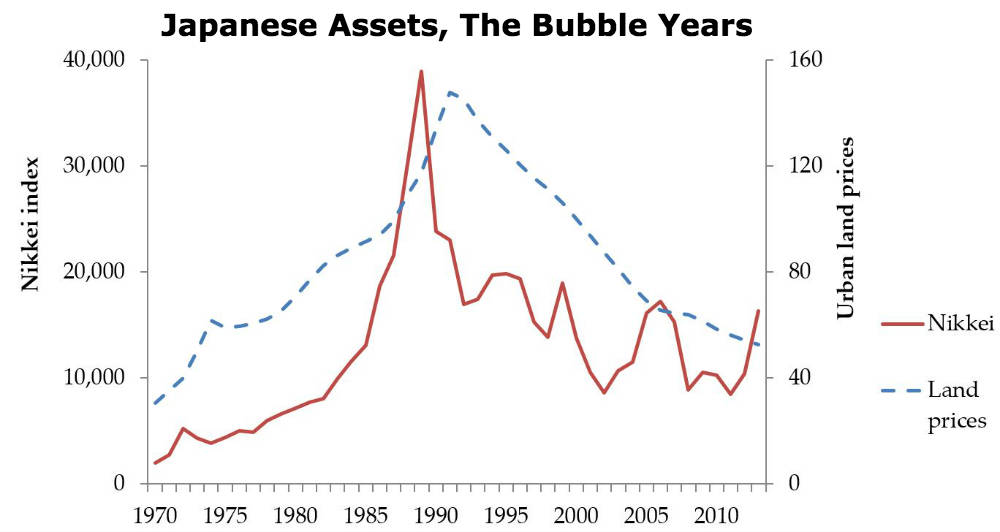
This graph shows the Nikkei stock index and urban land prices from 1970 to 2012. Notice the near-vertical ascent of both lines between 1985 and 1990, a classic visual signature of a speculative bubble.
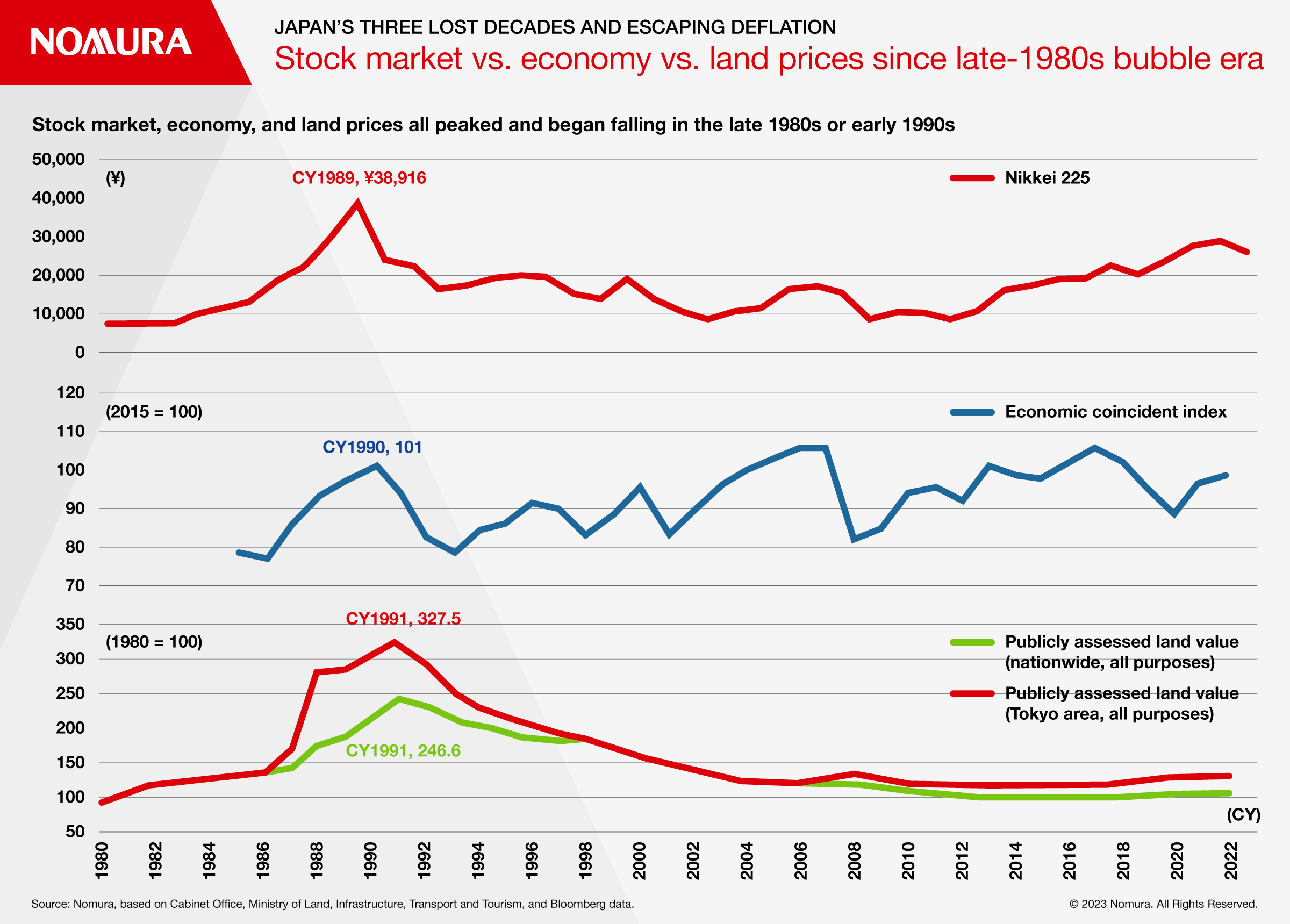
This set of graphs provides another view, showing the Nikkei 225, an economic activity index, and land values. The synchronized peaks around 1989-1990, followed by a dramatic crash and prolonged slump, clearly illustrate the bubble's formation and collapse.
At the peak in 1989, the grounds of the Imperial Palace in Tokyo were famously said to be worth more than all the real estate in California. The stock market's total capitalization was over 150% of GDP.
The Underlying Psychology and Structural Flaws
Why did it get so out of control? A simple monetary policy explanation is insufficient. It was a complex interaction of policy, deregulation, and human psychology. For a more rigorous, academic breakdown of these factors, please read the following section from a Bank for International Settlements (BIS) paper.
This section (a 5-minute read) details the interconnected factors behind the "intensified bullish expectations." As you read, consider how these elements created a powerful feedback loop:
- Aggressive Financial Institutions: With their traditional corporate clients financing themselves through capital markets, banks desperately sought new borrowers, lowering lending standards.
- Financial Deregulation: This increased competition without a commensurate increase in regulatory oversight.
- Protracted Monetary Easing: The BoJ kept interest rates low for too long, partly due to international pressure from the US to maintain stimulus.
- Overconfidence and Euphoria: A widespread belief, both domestically and internationally, that Japan's economic model was superior and that its asset prices were justified by a "new era" of growth. This is the "irrational exuberance" that Shiller talks about.
This combination of cheap money, lax lending, and a belief that "this time is different" created the perfect storm for the bubble economy.
4. The Seeds of Destruction
The bubble economy felt like a golden age, but it was built on a foundation of debt and malinvestment. The excesses of this period set the stage for the crisis that would follow.
To bridge the gap between the bubble and the subsequent "lost decades," please read the overview sections of this IMF paper. It provides a concise summary of how the bubble's collapse led to the prolonged stagnation of the 1990s.
Focus on these key points (a 5-minute read):
- The roots of the 1990s weakness lie in the overheating and asset price bubble of the late 1980s.
- The "post-bubble blues" were a direct result of working through the excessive investment and indebtedness built up during the bubble.
- The bursting of the bubble exposed more fundamental weaknesses in corporate governance and the banking sector that had been masked by the boom.
Conclusion
In this lesson, we have traced the origins of Japan's asset price bubble. We established a clear causal chain from the structural realities of the post-war economy to the deflationary crisis that would define the 1990s and 2000s.
Key Takeaways:
- Japan's post-war "miracle" was driven by a unique bank-centric economic model that gave the government significant control over credit allocation (keiretsu, "window guidance").
- The Plaza Accord of 1985, which caused a rapid appreciation of the yen, was the critical external shock.
- The Bank of Japan's response—aggressive monetary easing to counteract the strong yen—provided the fuel for the bubble.
- This cheap money, combined with financial deregulation, lax risk management, and widespread "euphoria," was channeled into a massive speculative bubble in the stock and real estate markets between 1985 and 1990.
- The bubble economy was characterized by extreme asset price inflation and significant malinvestment, creating a mountain of debt that would cripple the economy when it collapsed.
Next Lesson Preview:
In the next lesson, we will move from the boom to the bust. We will chart the timeline of Japan's deflation from 1990 to the present, identifying the distinct phases of the crisis using core CPI and real GDP data. We will analyze the moment the bubble popped and the long, slow decline that followed.
Can't find a good explanation? Sign up and we'll make it for you
Sign up