
Hello! Welcome to your lesson on strategic financial forecasting.
In our last session, we dove into marketing response curves, learning how to interpret them to find channel saturation points and growth opportunities. We established that the core of budget optimization is shifting funds from the flat part of a channel's curve (low marginal ROI) to the steep part (high marginal ROI).
Today, we'll put that theory into practice. We'll take the insights from those response curves and use them to power a forecasting tool. Your learning outcome is to construct a scenario model to forecast business outcomes based on different budget allocation plans.
This skill is a cornerstone of marketing leadership. It moves you from reacting to past performance to proactively shaping the future. It's the tool you'll use to build data-driven budget proposals, justify investment requests to the C-suite, and set clear, achievable targets for your team.
1. What is a Scenario Model?
A scenario model is a system (often built in Excel or as a feature in advanced analytics software) that connects your planned marketing activities (the inputs) to their expected results (the outputs). Its primary purpose is to let you ask "what-if" questions and see the likely outcomes before committing your budget.
For example:
- "What is the projected revenue if we increase our Meta Ads spend by 20% and decrease print by 10%?"
- "What is the minimum budget required to achieve a 15% growth in new customers next quarter?"
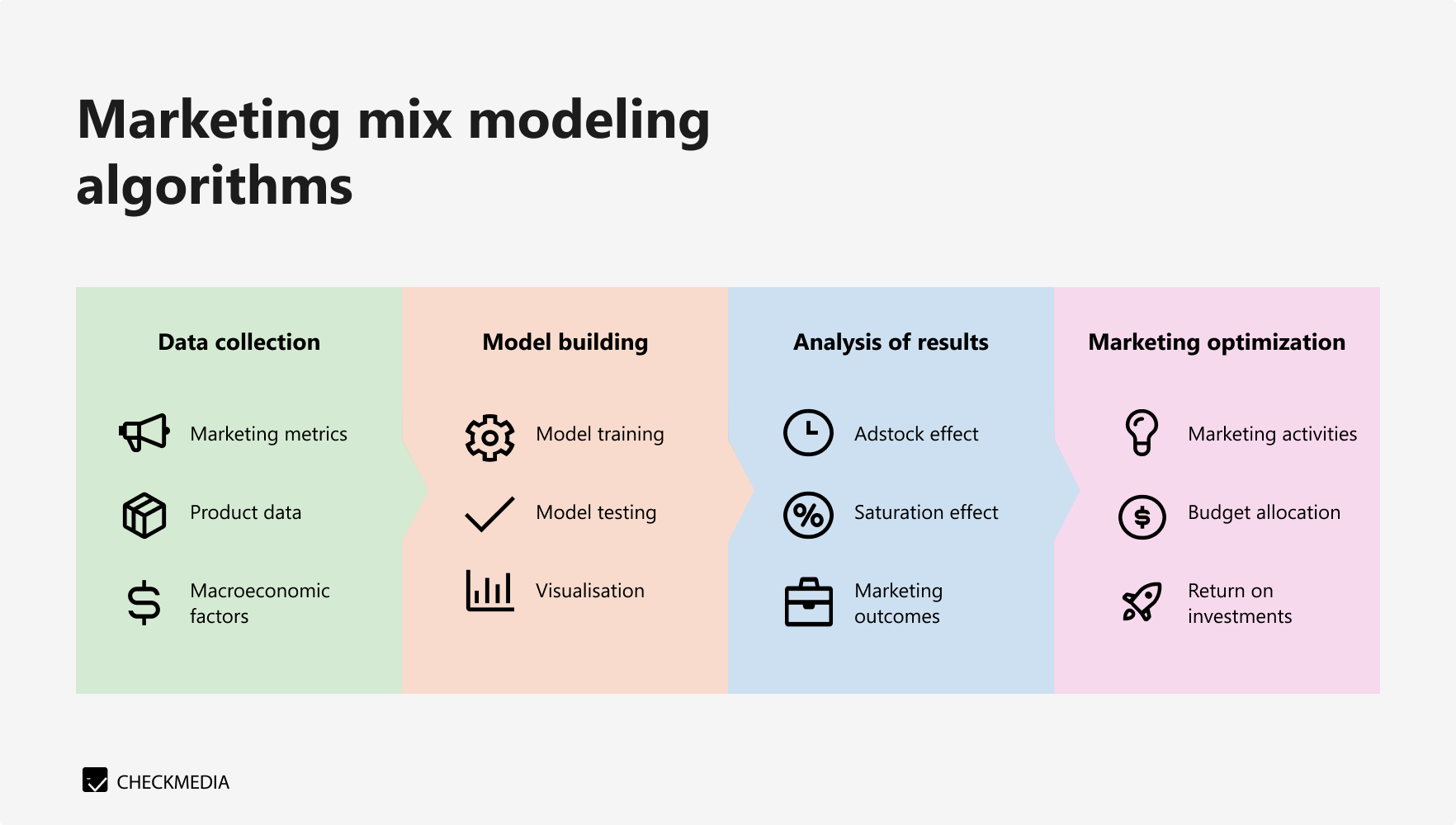
This process is the final, most strategic stage of the Marketing Mix Modeling (MMM) workflow, often called "Marketing Optimization."
Let's explore the two primary ways these models are constructed.
2. The Two Main Approaches to Scenario Modeling
There are two common methods for building a forecasting model: the top-down, MMM-driven approach and the bottom-up, first-principles approach.
Approach A: The MMM-Driven Model (Top-Down)
This is the most statistically sophisticated method. It uses the full power of a Marketing Mix Model, which you'll recall is a complex regression model that has learned the relationships between numerous variables (spend, seasonality, economic factors) and your main KPI (like sales).
The response curves we studied in the last lesson are the heart of this model. When you simulate a change in budget for a channel, the model calculates the new position on that channel's curve to predict the new outcome.
A complete guide to Marketing Mix Modeling and use cases
To understand the conceptual structure of this type of model, let's look at a guide from Latentview. It breaks down how an optimization problem is formally defined, which is exactly what a scenario model solves.
Please read the section 'Budget optimization', starting from 'Constructing a model'. Focus on the definitions of Objective, Variables, and Constraints. This is the formal language for what you're doing when you run a 'what-if' scenario.
As the guide explains, when you use an MMM-based scenario tool, you're essentially defining:
- Objective: What you want to maximize (e.g., incremental revenue, profit).
- Variables: The budget levers you can pull (e.g., spend on Google Ads, TV, Meta Ads).
- Constraints: The rules of the game (e.g., the total budget cannot exceed $5M; spend on Google Ads must be at least $500k).
The model then uses algorithms to find the optimal allocation based on your inputs.
Now, let's see a practical example of the kind of question this model can answer.
A complete guide to Marketing Mix Modeling and use cases
The same guide provides a concise case study demonstrating exactly this kind of scenario analysis.
Please read the 'MMM- Optimization Case Study' section. Pay close attention to the 'Objective' question being asked and the 'Result' that the model provides. This is a perfect example of a scenario forecast.
This top-down approach is powerful because it captures complex, non-linear effects discovered by the MMM. As a leader, you won't build the model, but you will be the one defining the objectives and constraints to test your strategic hypotheses.
Approach B: The First-Principles Model (Bottom-Up)
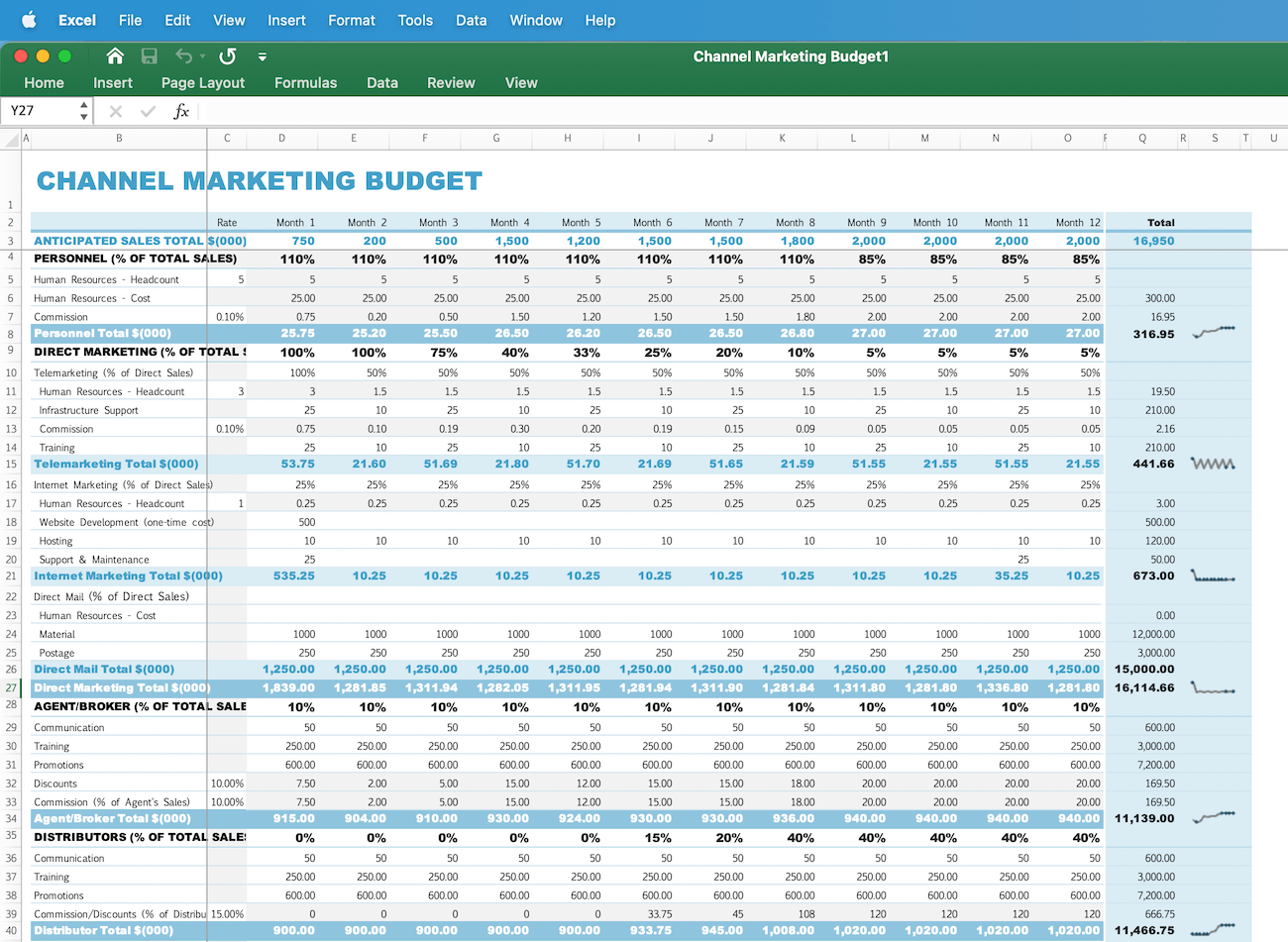
While MMM-driven models are powerful, you can also build highly effective scenario models from the ground up using key business metrics. This approach is often done in Excel and provides more transparency into the calculations. It's an excellent way to think through the fundamental drivers of your business.
This approach builds a chain of logic:Spend -> Cost per Acquisition (CPA) -> New Customers -> Revenue -> Costs -> Profit
The following tutorial provides a step-by-step guide to building exactly this kind of model. It is a practical and tangible way to understand the mechanics of forecasting.
How to Create a Marketing Investment Plan
This guide from ChallengeJP walks through creating a marketing investment plan in Excel. It's a perfect blueprint for a bottom-up scenario model. We'll focus on the structure and the flow of logic.
Please read Steps 1 through 5. Follow the logic of how the author moves from historical campaign data (Step 1) to a full annual forecast (Step 5). Notice how each step builds on the last.
This bottom-up method gives you a clear, auditable model where you can trace every calculation. The structure shown in the tutorial, with assumptions laid out clearly next to the outputs, is a best practice you should insist on from your teams.
3. Stress-Testing Your Plan with Scenarios
Once you have a model—whether MMM-driven or built from first principles—its true value comes from using it to compare different future possibilities. This is where you move from a single forecast to a strategic analysis.
You can create multiple versions of your budget to compare them:
- Base Case: Your most likely plan.
- Aggressive Growth Case: What happens if you get that extra 20% budget you asked for? Where would you put it? What's the projected return?
- Conservative Case: What if the budget is cut by 15%? What channels would you scale back? What's the impact on revenue?
This process of testing your assumptions is often called "stress-testing" or "sensitivity analysis."
How to Create a Marketing Investment Plan
Let's return to the ChallengeJP tutorial to see how this is done. This is the step that directly addresses our learning outcome.
Please read 'Step 8. Stress Test the Forecast Using Scenario Analysis'. The key takeaway is how changing input assumptions (like spend or CPA) allows you to see the impact on key output metrics like ROI and LTV.
By creating a data table like the one shown, you can present a clear, compelling case to stakeholders. Instead of just presenting one plan, you can show the trade-offs and potential outcomes of several different strategies, which is a hallmark of sophisticated leadership.
Test your understanding!
You have built a bottom-up scenario model for your e-commerce business. Your finance partner asks, "What's the risk to our revenue forecast if the upcoming privacy changes cause our social media CPA to increase by 25%?"
How would you use your scenario model to answer this question? What inputs would you change, and what outputs would you look at?
Show answer
- Isolate the Input: In your model's assumptions, you would find the variable for "Social Media CPA."
- Create the Scenario: You would create a copy of your "Base Case" forecast and label it "Increased CPA Scenario." In this new version, you would increase the Social Media CPA value by 25%.
- Analyze the Output: You would then compare the key outputs of the "Base Case" vs. the "Increased CPA Scenario." You would specifically look at:
- New Customers from Social Media: This will decrease because the same spend now acquires fewer customers.
- Total New Customers: This will also decrease.
- Total Revenue: This will decrease as a result of fewer customers.
- Overall CPA and ROI: You'd check how this specific channel's worsening performance impacts your portfolio-level efficiency metrics.
This allows you to quantify the financial risk of the privacy change and proactively discuss mitigation strategies (e.g., shifting budget away from social media in this scenario).
Conclusion
Today, we've bridged the gap between interpreting data and planning future strategy. You've learned how to construct and use scenario models to translate budget allocations into forecasted business outcomes.
Key Takeaways:
- Scenario models answer "what-if" questions about your marketing budget, allowing you to de-risk decisions and plan proactively.
- They can be built top-down using the outputs of a complex MMM, or bottom-up from first principles using core metrics like CPA and LTV.
- The true power of these models is in stress-testing and comparing scenarios to understand the potential impact of different strategies and external shocks.
- As a leader, your role is not necessarily to build the model, but to define the strategic questions, challenge the assumptions, and use the outputs to drive decisions and communicate with stakeholders.
Preview of the Next Lesson:
Our scenario models today focused primarily on quantifiable, often short-term, performance-driven outcomes. But what about the value of brand-building activities that don't have an immediate, easily measured CPA?
In our next lesson, we will address this directly by learning how to evaluate the investment trade-offs between short-term performance marketing and long-term brand building. We'll discuss how to think about, measure, and incorporate the value of brand into your strategic financial planning.