
Hello and welcome back to our course on advanced performance marketing.
In our last lesson, we tackled the crucial balance between entrusting your budget to platform automation and maintaining strategic control. We established that your role as a leader is to "program the algorithm" by setting clear goals and guardrails, effectively optimizing performance within a specific channel like Google or Meta.
Now, we're going to zoom out. Once you've optimized within the walled gardens, how do you decide how much budget each of those gardens should get in the first place? How do you compare the value of a dollar spent on Google Search versus a dollar spent on TikTok or a TV ad? This lesson moves us from single-channel tactics to portfolio-level strategy.
Our learning outcome is to apply the principle of marginal ROI to optimize budget allocation across a diverse marketing mix. This concept is one of the most powerful tools in a marketing leader's arsenal. It provides a data-driven answer to the fundamental question: "Where should we spend our next marketing dollar to get the highest possible return?" Mastering this will enable you to justify budget shifts, make a case for increases, and drive overall business growth more efficiently.
1. The Foundation: The Law of Diminishing Returns
Before we talk about marketing metrics, let's start with a foundational economic principle that governs almost any investment: the law of diminishing returns. You've likely encountered this concept before, but a quick refresher will solidify the "why" behind our budget allocation strategy. In simple terms, the more you invest in something while keeping other factors fixed, the less additional output you'll eventually get from each new unit of investment.
Diminishing Returns and the Production Function- Micro Topic 3.1
To understand this intuitively, let's watch a short video from Jacob Clifford's economics course. It uses the classic example of a pizza shop hiring workers to explain this core idea.
Please watch from 01:38 to 04:01. Focus on how the 'marginal product' (the number of extra pizzas made by each new worker) first increases due to specialization, but then inevitably starts to decrease. This is the law of diminishing marginal returns in action.
As the video illustrates, there are three key stages:
- Increasing Returns: The first few workers (or marketing dollars) create disproportionately high returns. They cover the basics and work together efficiently.
- Diminishing Returns: After a certain point, each new worker still adds to the total output, but they add less than the person before them. The kitchen gets crowded. This is the most important stage for our purposes.
- Negative Returns: Eventually, adding more workers is counterproductive. They get in each other's way, and total output falls.
In marketing, this is a perfect analogy. Your first ad dollars in a new channel might capture the most eager, high-intent customers. As you spend more, you have to reach broader, less-interested audiences. Your cost per acquisition rises, and the return from each additional dollar—the marginal return—begins to fall.
2. Defining Marginal ROI
The concept of "marginal product" from the video has a direct equivalent in marketing: Marginal Return on Investment (Marginal ROI).
While average ROI tells you the overall return for all your spending in a channel, Marginal ROI answers a more specific and actionable question:
If I spend one additional dollar on this channel, how much additional revenue will I get back?
It's the ROI of your next dollar, not your average dollar. This metric is derived from a channel's response curve (or diminishing returns curve), which is simply a graph of how sales respond to increased investment.
Marginal Return On Investment (Marginal ROI)
The article 'Marginal Return On Investment (Marginal ROI)' from the analytics platform Sellforte provides a clear, concise definition and visual explanation of this concept.
Please read the 'Introduction' and 'Calculating Marginal ROI' sections. Pay close attention to the graphs showing the response curve. Notice how Marginal ROI is the slope (or steepness) of the curve at a given point of investment.
As the article explains, at low investment levels (Point A in their example), the curve is steep, meaning marginal ROI is high. Each new dollar has a big impact. At high investment levels (Point B), the curve flattens out. The channel is becoming saturated, and the marginal ROI is low. Spending more here yields very little additional return.
3. The Most Important Distinction: Marginal ROI vs. Average ROI
This is the central strategic insight of this lesson. As a leader, you will constantly be presented with reports showing average ROI. Your ability to ask about marginal ROI is what will set your strategy apart. A high average ROI does not automatically mean a channel deserves more investment.
Marginal Return On Investment (Marginal ROI)
Let's continue with the Sellforte article, which has a fantastic section explaining this exact distinction with a simple but powerful example.
Please read the section titled 'How is "Marginal ROI" different from "ROI"?'. Study the graph comparing Channel A and Channel B. This is the core concept for this lesson.
Let's break down the scenario in that article:
- Channel B has a higher average ROI. For the same amount of money spent, it has generated more total sales. If you were only looking at a standard performance report, you might conclude Channel B is your "best" channel.
- Channel A, however, has a higher Marginal ROI. Its response curve is steeper at the current spending level. This means it has more room to grow efficiently.
The Strategic Question: If you get an additional $50,000 in your budget, where should you invest it?
The answer is Channel A. Even though its average ROI is lower, the next $50,000 spent there will generate more revenue than if you spent it on the already-saturating Channel B.
This is the principle in action. You use marginal ROI to guide future investment decisions, not just to report on past performance.
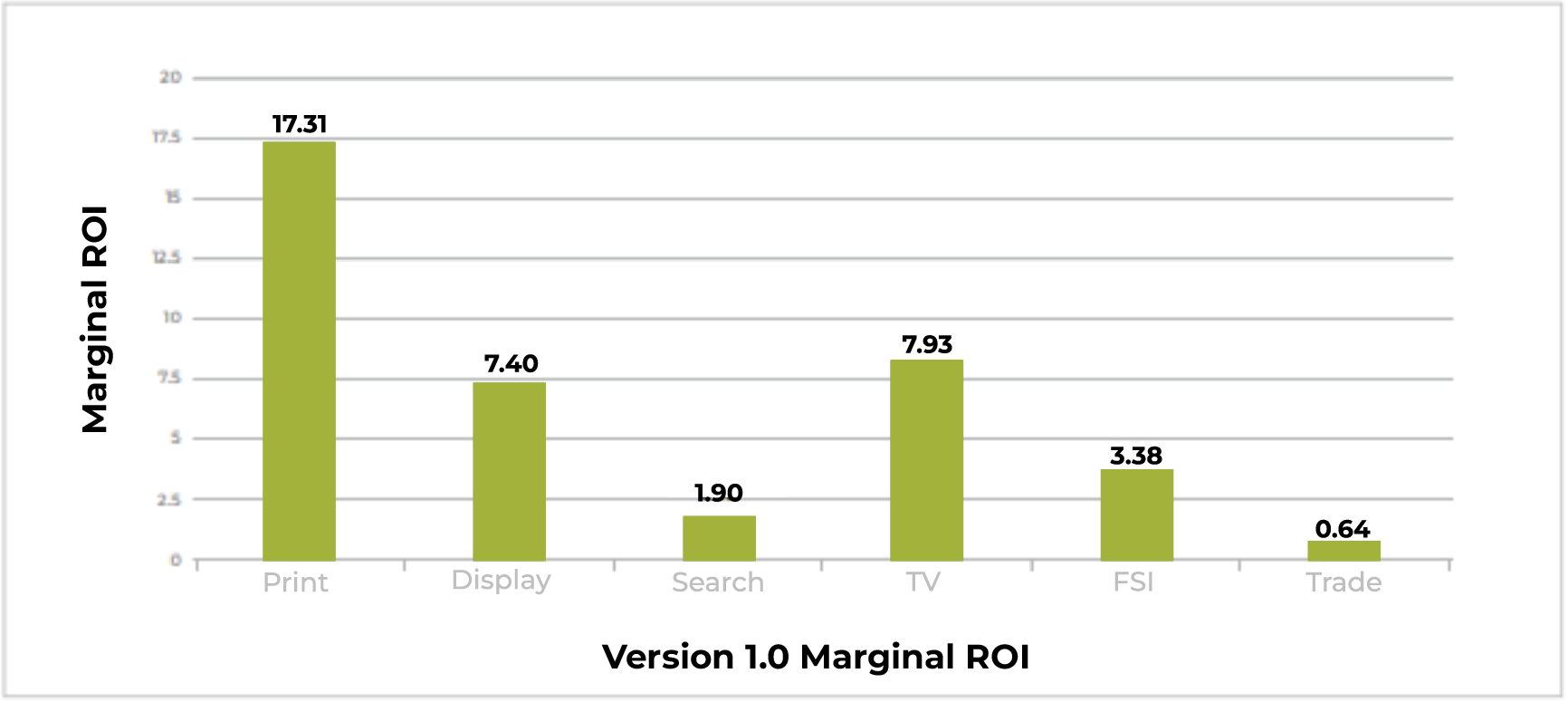
Here is an example of what the output of a marginal ROI analysis from a Marketing Mix Model might look like:
Test your understanding!
Your team presents you with the following data:
- Paid Social: Budget $200k/month, Average ROAS is 5:1. Marginal ROAS is 1.5:1.
- YouTube Ads: Budget $50k/month, Average ROAS is 3:1. Marginal ROAS is 4:1.
Your team lead for social media argues that because their channel has the highest average ROAS, it should receive any additional budget. How do you respond, and what decision do you make?
Show answer
You should explain to the team that while Paid Social has an excellent average ROAS, its low marginal ROAS of 1.5:1 indicates it is nearing its saturation point at the current budget level. Spending more there would be inefficient.
In contrast, YouTube Ads has a very high marginal ROAS of 4:1. This means it has significant room to absorb more budget efficiently.
Decision: You should reallocate budget from Paid Social to YouTube Ads. The next dollar spent on YouTube is projected to return $4, while the last dollar spent on Paid Social only returned $1.50. This reallocation will increase the total portfolio's overall return.
4. The Optimization Principle: Equalize Marginal ROI
So, how do you use this principle to build a truly optimized budget? The theoretical ideal is to allocate your budget in such a way that the marginal ROI of every channel is equal.
Think about it:
- If Channel A's marginal ROI is 4 and Channel B's is 2, you are getting more "bang for your buck" from the next dollar spent in A.
- It makes sense to move a dollar from B to A. You lose $2 of return from B but gain $4 from A, for a net gain of $2.
- You should continue shifting budget from low marginal ROI channels to high marginal ROI channels until the point where you can no longer find such an opportunity. This equilibrium point occurs when their marginal ROIs are all equal.
This is the core of modern, data-driven budget allocation. Marketing Mix Modeling (MMM), which we covered in a previous module, is the primary tool used to generate the response curves needed to calculate these marginal ROIs.
Marketing budget allocation: Optimizing ROI across channels ...
The article 'Marketing budget allocation: Optimizing ROI across channels' from Analytical Alley lays out a practical framework for putting this principle into practice. It connects the dots between modeling, insight, and action.
Please read the section 'The practical budget allocation framework'. Focus on steps 2 ('Identify optimization opportunities') and 3 ('Build reallocation scenarios'). Note the explicit mention of 'Equalize marginal ROI across channels' as the ideal allocation.
As the article describes, the process isn't just a mathematical exercise. It's a strategic framework:
- Establish Baseline: Use a model (like MMM) to calculate the current average and marginal ROI for each channel.
- Identify Opportunities: Pinpoint channels with "saturation waste" (low marginal ROI) and those that are "underinvested" (high marginal ROI).
- Build Scenarios: Model the impact of shifting budget from saturated channels to underinvested ones, aiming to equalize their marginal ROIs.
- Implement & Test: Roll out the new allocation, often with controlled tests (like geo-lift experiments) to validate the model's predictions in the real world.
Conclusion
Today, we've elevated our perspective from optimizing a single channel to optimizing an entire marketing portfolio. By moving beyond simple average ROI and applying the principle of marginal ROI, you can make smarter, more defensible, and ultimately more profitable budget allocation decisions.
Key Takeaways:
- Diminishing Returns are Universal: All marketing channels eventually become less efficient as you pour more money into them.
- Focus on the Margin: Marginal ROI tells you the value of your next dollar, which is the key to making forward-looking budget decisions.
- High Average ROI Can Be Deceiving: A channel with a high average ROI might already be saturated. The channel with the highest marginal ROI is the one that deserves more investment.
- The Goal is Equilibrium: The optimal budget allocation is achieved when the marginal ROI is equal across all your active channels. Your job is to shift resources continuously to move closer to this ideal state.
Preview of the Next Lesson:
We've established that calculating marginal ROI depends on understanding a channel's response curve. In our next lesson, we will do a deep dive into these curves. We will learn how to interpret marketing response curves to identify channel saturation points and opportunities for growth, turning the theoretical graphs from today's lesson into a practical tool for strategic planning.