
Hello! Welcome to the sixth lesson of our module on strategic budget allocation.
In our last lesson, we focused on the synthesis of data from Marketing Mix Modeling (MMM), incrementality tests, and Lifetime Value (LTV) analysis to construct a robust, data-driven annual budget. You learned how to triangulate these different sources to create a plan that balances risk, growth, and profitability.
Now that you have the plan, the next critical step is to get it approved. This lesson focuses on turning your analytical work into a persuasive business case. Your learning outcome is to build a data-driven business case to justify a request for a budget increase or reallocation. This skill is central to your transition into a strategic marketing leader, as it involves translating complex data into a clear, compelling argument that resonates with financial stakeholders like the CFO.
We will cover how to shift your framing from a cost center to an investment partner, speak the language of finance, and structure your proposal for maximum impact.
1. The Mindset Shift: From Budget Request to Capital Allocation
The single most important step in building a successful business case is to change how you frame the conversation. You are not asking for money to spend; you are presenting an investment opportunity designed to generate a profitable return for the business. This reframes marketing from a cost center into a capital partner.
To do this effectively, you need to speak the language of finance. While your team might focus on metrics like click-through rates or cost-per-lead, a CFO is primarily concerned with growth, profitability, cash flow, and risk.
How to Build a Marketing Budget the CFO Will Actually ...
The article 'How to Build a Marketing Budget the CFO Will Actually Approve' from The Insight Collective provides an excellent overview of the financial mindset. It outlines the key principles that govern how finance leaders evaluate investment decisions.
Please read the introduction and the section 'How to speak the language of finance leaders'. Focus on the four key financial principles mentioned: ROI, Breakeven point, Marginal ROI, and Customer lifetime value (CLTV). Notice how these are framed from a finance perspective, focusing on forecasting and risk.
As you read, note the subtle but crucial differences in perspective:
- Return on Investment (ROI): For a CFO, past ROI is less interesting than forecasted ROI. Your case should use historical data to project future returns.
- Breakeven Point: This directly addresses cash flow. A shorter payback period means the business recoups its investment faster, reducing risk.
- Marginal ROI (mROI): This is a concept we explored with MMM. For a CFO, it's the most critical metric for budget increases, as it answers the question: "What return will we get on the next dollar we spend?"
- Customer Lifetime Value (CLTV): This justifies your Customer Acquisition Cost (CAC) by showing that you're acquiring customers who will deliver long-term profit, not just a one-time conversion.
Mastering this language is the foundation for building a credible and compelling case.
2. The One-Page Capital Brief: A Framework for Your Business Case
Now, let's move from theory to a practical structure. Instead of a long, slide-heavy presentation, a concise and data-packed one-page brief is often most effective for a financial audience. It demonstrates clarity and forces you to focus on what truly matters.
The article we just looked at provides a powerful template for this.
How to Build a Marketing Budget the CFO Will Actually ...
Let's return to the same article to study its core framework: the one-page capital brief. This template provides a clear, logical structure for presenting your investment case.
Please read the section 'Building your one-page capital brief'. Study each of the six components and the examples provided. This is the blueprint for the document you will build.
Here is a summary of the six key sections of the capital brief. This is the structure you should use to justify any budget increase or reallocation.
- Segment Overview by Revenue Potential: Start by showing you’re focused on the most valuable customer segments. This immediately signals that your plan is rooted in profitability.
- Recommended Budget Allocation: This is your "ask." For each segment or channel, detail the proposed spend and, crucially, the projected marginal ROI. This shows you are allocating capital where it will be most productive.
- Forecasted Pipeline Impact: Translate your budget into tangible business outcomes. Go beyond marketing metrics and forecast the revenue-weighted pipeline value you expect to generate.
- Breakeven and Payback Timing: Directly address the CFO's concerns about cash flow and risk. Show how quickly the investment will pay for itself.
- Confidence Rating and Risk Commentary: This is a sign of a mature leader. Acknowledge that forecasts are not certain. Providing a confidence score (based on data quality, historical accuracy, etc.) and noting potential risks builds credibility.
- Closing Summary: This is your executive summary or "elevator pitch." In two or three sentences, state the total investment, the expected return, and the strategic rationale.
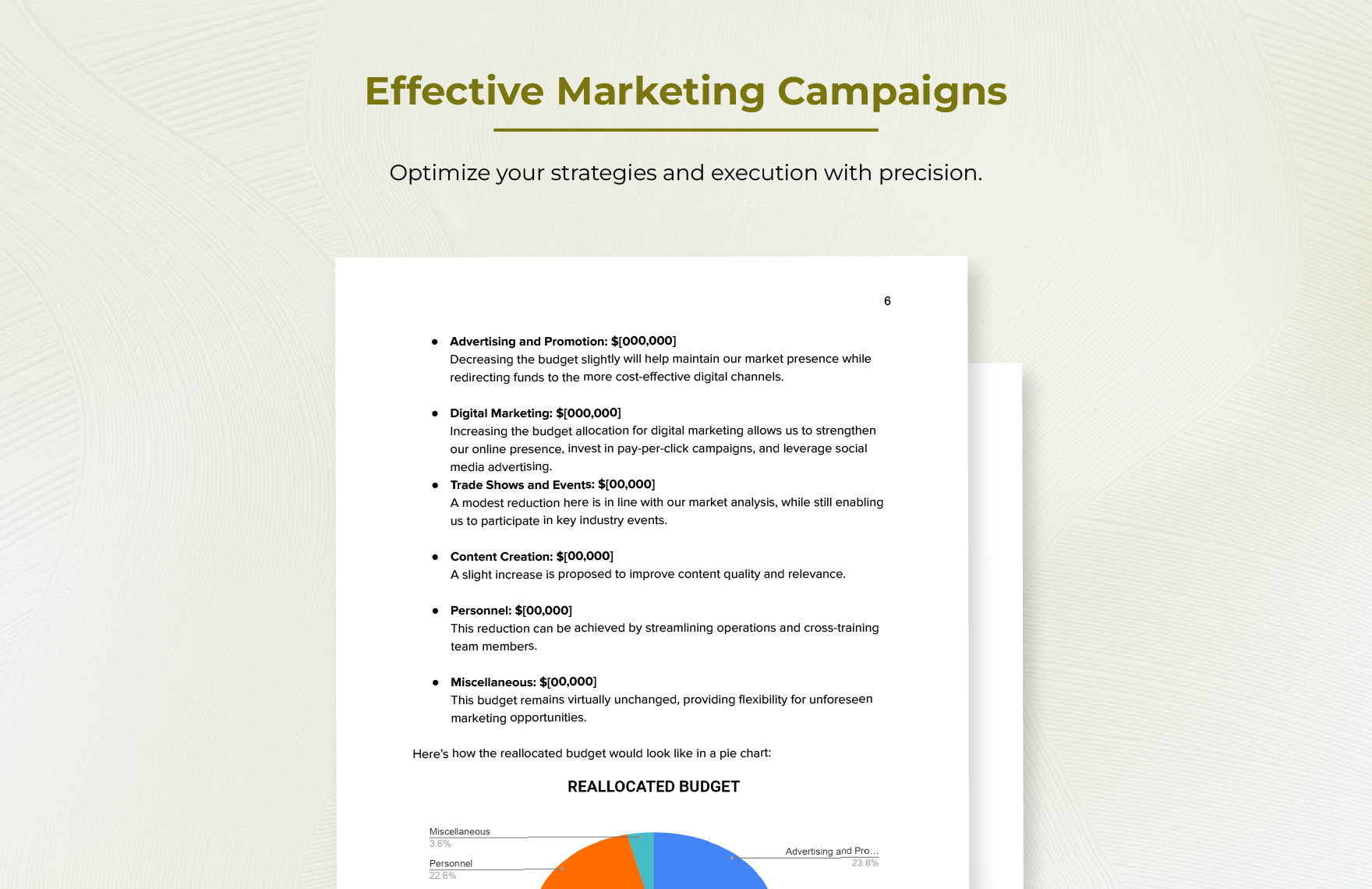
This is an example of what a budget reallocation proposal might look like, highlighting the justification for each change.
3. Telling a Story with Your Data
A structured brief provides the logic, but a narrative provides the persuasive power. The most effective business cases tell a simple story. A great framework for this is Setup, Conflict, Resolution.
Let's watch a short video from Harvard Business Review that explains this simple but powerful concept.
Telling Stories with Data in 3 Steps (Quick Study)
This video, 'Telling Stories with Data in 3 Steps', will show you how to structure any data presentation as a compelling story. This will help you frame your business case in a way that is easy for any stakeholder to understand and remember.
Watch the video from the beginning until the 4:16 mark. Pay close attention to how the presenter identifies the 'Setup', 'Conflict', and 'Resolution' in a seemingly complex data chart and then uses titles and visual emphasis to tell that story clearly.
How do you apply this to your budget proposal?
- Setup (The Current Reality): "For the past year, our marketing efforts have driven consistent results, achieving a 2.5x ROAS, primarily driven by our $2M investment in Google Search."
- Conflict (The Challenge or Opportunity): "However, our MMM shows that Google Search is reaching saturation, with a marginal ROI of only 1.2x. Meanwhile, the business has set a 30% growth target for next year, which our current plan cannot meet. Our incrementality tests on Meta, however, show a significant opportunity with a causal iROAS of 4.1x and access to a high-LTV audience segment."
- Resolution (Your Proposed Solution): "Therefore, we propose reallocating $500k from Google Search to Meta and increasing the total marketing budget by $250k to fully fund this opportunity. This $750k investment in Meta is projected to generate $10M in incremental pipeline with a 7-month payback period, enabling us to hit the company's growth target."
This narrative transforms your request from a list of numbers into a strategic plot: here's where we are, here's the problem/opportunity, and here's my clear, data-backed plan to win.
4. Presenting Your Case and Securing Buy-In
With your one-page brief structured and your narrative crafted, the final step is the presentation itself. Your goal is to build trust and confidence.
Your Data-Driven Marketing Budget: Forecasting, Planning ...
The article 'Your Data-Driven Marketing Budget' from Right Side Up offers practical tips on the final step: presenting your budget to leadership.
Please read the section 'Present Your Budget to Leadership and Finance Teams With Gusto'. Focus on the three key actions: clarifying assumptions, providing data-driven justifications, and maintaining communication.
Key takeaways for your presentation:
- Be explicit about your assumptions. Clearly state the conversion rates, payback periods, and growth rates you used in your forecast. This shows transparency and invites a constructive conversation.
- Lead with data, supported by visuals. Use the charts from your MMM (response curves) and clear tables (like the one-page brief) to substantiate every claim.
- Proactively address risks. Acknowledging risks doesn't weaken your case; it strengthens it by showing you've thought critically about potential downsides.
- Establish a communication cadence. Propose a plan for how you will report on performance against the forecast (e.g., a shared dashboard, monthly KPI reviews). This shows accountability.
Test your understanding!
You are proposing a budget reallocation. You want to shift $200,000 from your brand awareness campaigns on Connected TV (CTV) to your performance-focused YouTube campaigns.
Your MMM indicates that the marginal ROI for CTV is now low (1.5x), while YouTube still has room to scale with a projected marginal ROI of 4.0x.
Using the one-page capital brief framework, draft the "Recommended Budget Allocation" and "Closing Summary" sections of your proposal to the CFO.
Show answer
Here is a sample answer:
2. Recommended Budget Allocation
| Channel | Proposed Budget Change | Current mROI | Projected mROI | Justification |
|---|---|---|---|---|
| CTV | -$200,000 | 1.5x | 1.5x | Reallocate from saturated channel. |
| YouTube | +$200,000 | 4.0x | 4.0x | Invest in high-growth, proven channel. |
6. Closing Summary
We recommend a budget-neutral reallocation of $200,000 from CTV, which has hit diminishing returns, to YouTube, where we project a 4.0x marginal ROI. This strategic shift is forecasted to increase overall marketing-generated revenue by $500,000 in the next six months without requiring net new investment, improving capital efficiency and accelerating pipeline growth.
This response is effective because it's concise, uses the language of finance (marginal ROI, capital efficiency), quantifies the impact ($500k revenue increase), and frames the request as a smart, risk-adjusted business decision rather than a simple marketing preference.
Conclusion
You now have a comprehensive framework for building and presenting a data-driven business case. By moving beyond a simple budget request and framing your plan as a strategic investment, you can build credibility and secure the resources needed to drive growth.
Key Takeaways:
- Reframe your ask: You are a capital partner presenting an investment, not a cost center requesting a budget.
- Speak the language of finance: Center your arguments around forecasted ROI, payback periods, marginal ROI, and LTV.
- Use a structured brief: The one-page capital brief provides a clear, logical, and CFO-friendly format for your proposal.
- Tell a compelling story: Use the Setup, Conflict, Resolution framework to create a narrative that is easy to understand and act upon.
- Be transparent and proactive: Clearly state your assumptions, acknowledge risks, and propose a plan for ongoing communication to build trust.
Preview of the Next Lesson:
Today, we applied the principles of data storytelling to the specific task of building a business case for a budget. This is such a critical skill for a marketing leader that our next module, "Data Storytelling and Stakeholder Influence," is dedicated entirely to it.
In our next lesson, we will kick off that module by learning how to structure a compelling narrative that connects analytical findings to specific business outcomes for a wide variety of audiences, from your own team to the C-suite.