
Hello! Welcome to the final lesson of the "Strategic Budget Allocation and Financial Forecasting" module.
Throughout this course, you've built a powerful analytical toolkit. We started with statistical foundations, moved through advanced measurement like incrementality and MMM, and in our last lesson, you learned to model the financial impact of budget changes using response curves.
Now, it's time to synthesize these skills into a core leadership deliverable. Your learning outcome for this lesson is to draft a section of an annual marketing plan that outlines channel strategy, budget, and forecasted KPIs. This document is where your analytical insights become an actionable strategy that drives investment and aligns your team. It's the bridge between data analysis and business execution.
1. The Anatomy of a CMO-Ready Marketing Plan
Before you start writing, it's crucial to understand the structure of a modern, data-driven marketing plan. This isn't just a list of activities; it's a strategic argument designed to secure investment and set clear expectations with leadership.
The image below provides a great high-level overview of the key components of an annual plan. We will focus on creating the content for the "Goal Summary," "Forecast Budget Headcount," and parts of the "Vision & Strategy Overview."
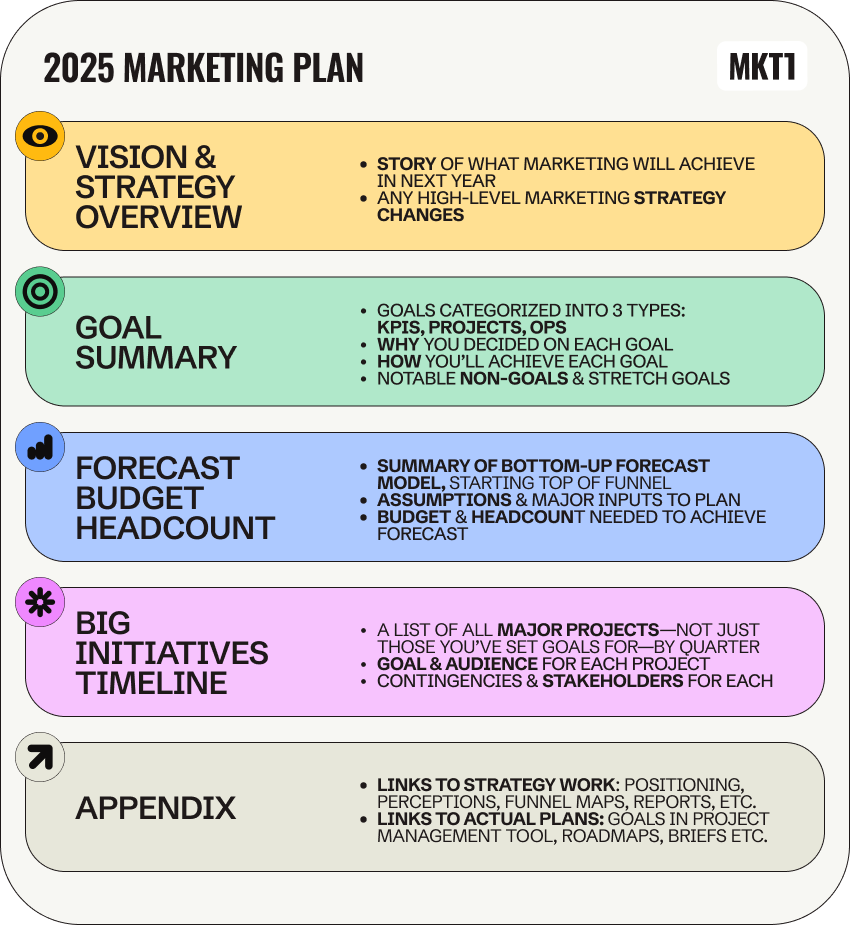
A truly effective plan section must contain four core elements, which we'll build step-by-step:
- Strategic Objectives: What are the specific, measurable business goals marketing will achieve?
- Channel Strategy: Which channels will you use and, more importantly, why? How will they work together?
- Budget Allocation: How much will you invest in each channel, and what data justifies this allocation?
- Forecasted KPIs: What specific outcomes do you project from this investment?
2. Step 1: Set Your Goals and Strategic Narrative
Your plan should not begin with a list of channels. It must start by answering the "why" for your leadership team. What business problem are you solving or opportunity are you capturing?
Marketing plan templates and strategies for driving growth
The article 'Marketing plan templates and strategies for driving growth' from Adobe Business provides an excellent framework for creating a CMO-approved plan. We'll start by focusing on how to frame your objectives.
Please read the sections titled 'Executive summary' and 'Mission and strategic objectives'. Pay close attention to how the sample executive summary frames a business challenge and proposes a marketing solution with clear financial outcomes. This is the narrative you need to build.
As you read, notice the emphasis on SMART goals (Specific, Measurable, Attainable, Relevant, Time-oriented) that are tied directly to revenue and pipeline, not just activity metrics like clicks or impressions.
For your plan section, start by writing 1-2 paragraphs that:
- State the business context: Are you fighting rising CAC? Entering a new market? Trying to increase market share?
- Define your high-level strategy: How will marketing address this? (e.g., "By shifting focus from broad-based acquisition to high-LTV customer segments...")
- List 2-3 top-line objectives: These should be SMART goals like "Increase marketing-sourced revenue from the e-commerce channel by 25% in FY2025" or "Reduce blended CAC by 15% by Q4."
3. Step 2: Develop and Justify Your Channel Strategy
With your objectives set, you can now outline how you'll achieve them through your channel mix. Your deep experience with channels like Google Ads and Meta Ads is invaluable here, but as a leader, you must justify your choices with a strategic rationale.
A helpful way to think about your channel mix is to balance long-term growth with short-term results.
How to Plan Your Marketing Budget
The video 'How to Plan Your Marketing Budget' by Exposure Ninja offers a practical way to categorize channels. This will help you articulate a balanced portfolio strategy.
Watch from 02:20 to 04:46 and then from 08:13 to 11:15. Focus on two key concepts: Analyzing current performance to find opportunities (what's working, what's not). The distinction between 'large flywheel' channels (like SEO, content) that build long-term value and 'small flywheel' channels (like paid search, paid social) that offer quick scalability.
In your plan, don't just list channels. Group them strategically and explain their roles:
- Large Flywheel (Brand & Asset Building):
- Channels: SEO, Content Marketing, Organic Social Community
- Role: Drive sustainable, long-term growth; lower future CAC; build brand equity.
- Justification: "Our MMM shows that organic search has a high baseline contribution and is not yet saturated, representing a cost-effective growth lever."
- Small Flywheel (Performance & Activation):
- Channels: Google Ads, Meta Ads, other paid media.
- Role: Capture existing demand; drive immediate conversions and revenue; scale spend up or down based on market conditions.
- Justification: "Incrementality tests show a 3x iROAS for our non-brand search campaigns, confirming their causal impact on sales."
4. Step 3: Allocate the Budget with Data-Driven Confidence
This is where you connect your strategy to the financial plan, using the analytical models from previous lessons. You are no longer just assigning a budget; you are making a calculated investment based on predicted returns.
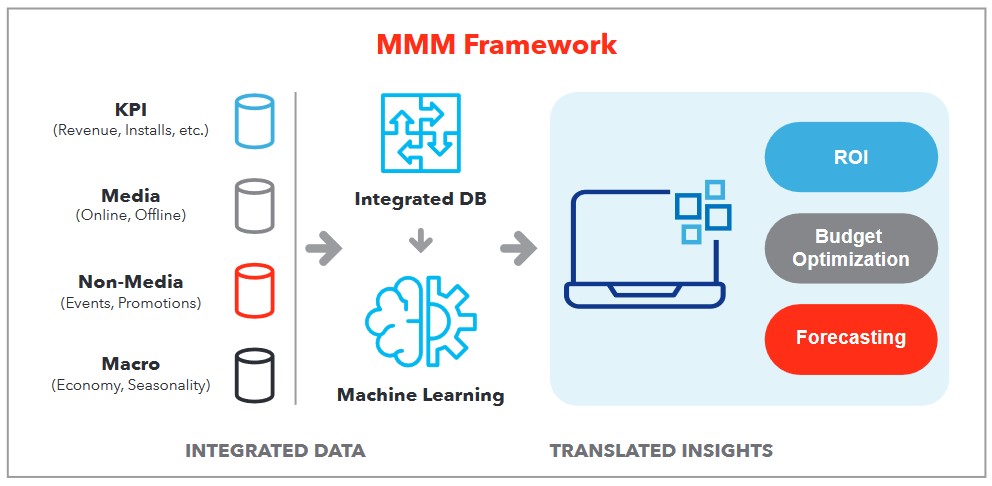
Your primary tools for this justification are the concepts of marginal ROI and response curves that we covered in detail.
How to present a marketing plan that wins stakeholder buy-in
The article 'How to present a marketing plan that wins stakeholder buy-in' from Keen provides a great structure for presenting your budget. We'll use this structure to draft the budget section of our plan.
Read section 5, 'Introduce channel mix and budget with ROI framing'. Notice the critical advice: 'Never show a budget without explaining what the business gets in return.' This is the core principle for your budget allocation section.
For each major channel or strategic initiative in your plan, create a small table or a few bullet points that state:
- Proposed Budget: The total investment for the period (e.g., quarter or year).
- Justification: The data-driven reason for this specific amount. This is your most important column.
- For budget increases: "MMM response curves show we are in the 'profitable zone' with a high marginal ROI. Modeling predicts a 15% budget increase will yield a 10% increase in incremental revenue."
- For budget decreases: "This channel is in the 'overspending zone' with a marginal ROI below our 1.5x target. Cutting spend by 20% allows us to reallocate $100k to higher-growth channels with only an estimated 2% loss in revenue from this channel."
- For flat budgets: "This channel is performing efficiently but nearing saturation. We will maintain current spend to maximize volume without sacrificing efficiency, holding marginal ROI at a healthy 2.5x."
5. Step 4: Forecast Your KPIs
The final step is to translate your budget allocation into a clear forecast of the results you will deliver. This closes the loop and makes your plan fully accountable. Your KPIs should be a mix of high-level business outcomes and supporting marketing metrics.
A strong plan prioritizes KPIs that matter to the C-suite.
Marketing plan templates and strategies for driving growth
Let's revisit the Adobe article, which provides a list of business-impact KPIs.
Read the section 'Measurement, attribution, and ROI'. Focus on the four prioritized KPIs: Customer Acquisition Cost (CAC), Customer Lifetime Value (CLV), Marketing-Sourced Pipeline, and Marketing’s Contribution to Revenue.
For each of your main objectives, list the primary and secondary KPIs you will use to measure success. Your forecast is the output of the modeling you learned in the previous lesson.
Example Forecast Section:
Objective 1: Drive $15M in New Mid-Market Pipeline
- Forecasted Outcome: We project this plan will generate $15M - $17M in marketing-sourced pipeline.
- Primary KPI: Marketing-Sourced Pipeline Value.
- Secondary KPIs:
- Number of Marketing Qualified Leads (MQLs): ~4,000
- MQL-to-Opportunity Conversion Rate: 25%
- Average Deal Size: $15,000
Test your understanding!
You are drafting the marketing plan for your e-commerce company. Your MMM outputs show the following:
- Google Ads (Brand Search): Current Spend: $50k/month. Average ROAS: 10x. Marginal ROAS: 1.2x. The response curve is nearly flat.
- Meta Ads (Prospecting): Current Spend: $100k/month. Average ROAS: 3.5x. Marginal ROAS: 2.8x. The response curve is still steep.
You have an extra $20k/month to allocate. Draft a short paragraph for your marketing plan justifying your decision to allocate the additional funds to Meta Ads, not Google Ads. Mention the channels, the budget decision, the data-driven justification, and the expected outcome.
Show answer
Here's one possible answer:
"For the upcoming quarter, we will increase our investment in Meta Ads prospecting campaigns by $20,000 per month, bringing the total monthly spend to $120,000. This decision is based on MMM analysis showing Meta Ads has a strong marginal ROAS of 2.8x, indicating significant headroom for efficient growth. In contrast, our Google Brand Search campaigns, despite a high average ROAS, are heavily saturated with a marginal ROAS of only 1.2x. By allocating this incremental budget to Meta, we forecast an additional $56,000 in monthly incremental revenue (2.8 x $20,000), maximizing the impact of our new investment."
Conclusion
You now have a complete framework for drafting a defensible, data-driven marketing plan section. This document is the ultimate expression of your strategic leadership, demonstrating that you can not only manage channels but also allocate capital intelligently to drive business growth.
Key Takeaways:
- Start with the "Why": Frame your plan around business objectives and a strategic narrative before discussing channels and tactics.
- Justify Your Channel Mix: Explain the role of each channel, using frameworks like "large vs. small flywheel" to articulate a balanced strategy.
- Let Data Drive the Budget: Use outputs from MMM and incrementality tests—especially marginal ROI and response curves—to justify every dollar of spend.
- Forecast Business Outcomes: Connect your investment directly to high-level KPIs like pipeline, revenue, and CAC to demonstrate marketing's value.
Preview of the Next Module:
You've done the analysis and drafted the plan. What's next? Getting buy-in. A brilliant plan that sits in a folder is worthless. In our next module, Data Storytelling and Stakeholder Influence, we will begin by learning how to structure a compelling narrative that connects analytical findings to specific business outcomes. You'll learn how to take the plan you just designed and present it in a way that is clear, persuasive, and inspires action from the C-suite.