
Hello again. In the previous lesson, you used BIDMAS to solve multi-step calculations carefully and showed each line of working. That same habit matters here: number-property questions can look like riddles, but each clue rules out some answers.
This lesson is questions 7–12 of your 50-question hard SATs challenge. You will work with factors, multiples, primes, squares, cubes, common factors, common multiples, and missing digits. The aim is not just to get an answer, but to prove why it must be the answer.
The number-property toolkit
A factor divides a number exactly, with no remainder.
For example, the factors of are:
Factors come in pairs:
A multiple is found by multiplying a number by a whole number. Multiples of include:
The language is easy to mix up, so use a full sentence to check yourself:
- is a factor of , because .
- is a multiple of , because .
A common factor divides both numbers exactly. A common multiple belongs in the times tables of both numbers.
| Situation | What you need | Example |
|---|---|---|
| Making the greatest possible number of identical groups | Greatest common factor | Greatest number of identical packs |
| Finding when repeating events next happen together | Lowest common multiple | First time two timetables match |
| A number is divisible by two numbers | Common multiple | A number in both times tables |
Here are useful divisibility tests for SATs questions:
| Divisible by | Quick check |
|---|---|
| Last digit is even | |
| Digits add to a multiple of | |
| Last two digits make a multiple of | |
| Last digit is or | |
| Divisible by both and | |
| Last three digits make a multiple of | |
| Digits add to a multiple of | |
| Last digit is |
For example, is divisible by because:
and is a multiple of . It is divisible by because is divisible by .
[PDF] Addition, subtraction, multiplication and division - White Rose Maths
Read the relevant Year 6 guidance from White Rose Maths. It explains the exact distinctions and checking methods needed for the challenge, especially common factors, divisibility rules, primes, squares and cubes.
In Step 2, “Common factors”, read the notes and guidance on finding factor pairs systematically, beginning with systematic factors. Then look at Step 4, “Rules of divisibility”, focusing on the divisibility tests. Finish with the notes in Step 5, “Primes to 100”, on what makes a prime, and Step 6, “Square and cube numbers”, beginning at squares and cubes.
Primes, squares and cubes: three different ideas
A prime number has exactly two factors: and itself.
The first prime numbers are:
Two important facts often tested in SATs:
- is not prime because it has only one factor.
- is the only even prime number.
A number with more than two factors is composite. For example:
so is composite.
Math Antics - Prime Factorization
Watch “Math Antics – Prime Factorization” by mathantics for a quick, clear reminder of why primes are special and how composite numbers are built from primes.
Watch prime numbers for the definition, the primes below 20, and why 1 is excluded. Then watch composite numbers to see how numbers such as 4, 6, 8, and 9 can be made by multiplying primes.
A square number is an integer multiplied by itself:
A cube number is an integer multiplied by itself three times:
Do not confuse “squared” with “multiplied by ”, or “cubed” with “multiplied by .”
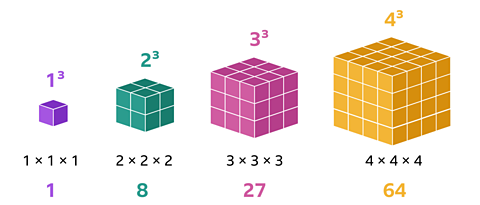
Useful values to know:
| Square numbers up to | Cube numbers up to |
|---|---|
Notice that is both:
and
A method for “number riddle” questions
Hard SATs questions often give several clues. Do not grab the first number that fits one clue. Instead:
-
Translate each clue into maths language.
“Divisible by ” means the last two digits must form a multiple of . -
Start with the most restrictive clue.
“It is a cube number” is usually more restrictive than “it is even.” -
List possible answers neatly if there are only a few.
-
Check every clue at the end.
One correct-looking clue is not enough.
This is particularly important when a question says “use each number once.” A number may fit more than one statement, but using it too early may make the rest impossible.
Six-question hard SATs challenge
Try all six before looking at the worked solutions. Write a reason beside each answer: a calculation, factor pair, divisibility test, or list.
Question 1
Use each card once: .
Complete the statements.
- ______ is a square number.
- ______ is a cube number.
- ______ is a common multiple of and .
- ______ is a common factor of and .
Question 2
The number is divisible by both and .
What digit belongs in the box? Write the complete number.
Question 3
A school has red counters and blue counters.
They are placed into the greatest possible number of identical packs. Each pack must contain the same number of red counters and the same number of blue counters, with none left over.
How many packs can be made? How many counters of each colour are in each pack?
Question 4
Find the smallest square number greater than that is also a common multiple of and .
Question 5
A number is:
- a factor of ;
- a multiple of ;
- less than ;
- made from exactly three different prime factors.
Find the number.
Question 6
Find the positive number that is:
- greater than ;
- less than ;
- both a square number and a cube number.
Self-marking: worked solutions
Check the first line where your method differs, rather than only comparing final answers.
Question 1
The square numbers on the cards are and .
The cube number is only , because:
So must be used for the cube statement. Then is the square number:
A common factor of and must divide both numbers:
So is a common factor. This leaves as the common multiple of and :
Answers:
- is a square number.
- is a cube number.
- is a common multiple of and .
- is a common factor of and .
The key tactic was not to put in the square space too soon.
Question 2
For divisibility by , the digits must add to a multiple of .
The only possible digit that makes this total a multiple of is :
Now check divisibility by . The final two digits are :
So the complete number is:
Question 3
We need the greatest common factor of and .
Use prime factors:
The prime factors shared by both are , , and :
So identical packs can be made.
Red counters per pack:
Blue counters per pack:
Answer: packs, each with red counters and blue counters.
Question 4
List common multiples of and :
Now check square numbers greater than :
The first number in both lists is:
Check:
Answer: .
Question 5
Start with factors of that are multiples of :
Only and are less than .
Now compare their prime factors:
This has two different prime factors.
This has exactly three different prime factors.
Question 6
The cube numbers below are:
The square numbers below include:
The number in both lists that is greater than is:
Check both properties:
SATs question strategy in action
Question 1 is modelled on the kind of careful number-property matching seen in the 2024 Year 6 reasoning paper. After attempting it yourself, watch the walkthrough below to see why delaying a choice can prevent a mistake.
2024 Year 6 SATs Maths Paper 2 'Reasoning 1' Walkthrough (VERY TRICKY)
Watch TD Tutoring’s “2024 Year 6 SATs Maths Paper 2 ‘Reasoning 1’ Walkthrough” for a worked example involving a square number, cube number, common multiple, and common factor.
Watch the card strategy. Focus on the method: identify the option that has only one possible place first, then use the remaining clues to decide between numbers that initially appear to fit more than one statement.
Key takeaways
You have now completed questions 7–12 of the challenge. The main ideas are:
- A factor divides exactly; a multiple is in a times table.
- “Greatest number of identical groups” usually means find a greatest common factor.
- “First time two patterns match” or a number divisible by two values means find a common multiple.
- A prime has exactly two factors. is not prime, and is the only even prime.
- Learn key square and cube numbers, especially:
- For missing-digit and number-riddle questions, use the most restrictive clue first and check every condition.
Next, you will move from whole numbers to hard SATs questions involving fractions, decimals, and percentages.
Can't find a good explanation? Sign up and we'll make it for you
Sign up