
Hello, and welcome to the first part of your 50-question Year 6 SATs Mathematics Challenge. This course will build the habits that help in SATs, Year 7 maths, and later exams: reading carefully, choosing a method, showing clear steps, and checking whether an answer makes sense.
This lesson focuses on six demanding whole-number calculations. You will use BIDMAS to decide the order of operations, including brackets and square or cube numbers. You will also practise turning a short real-life situation into a calculation.
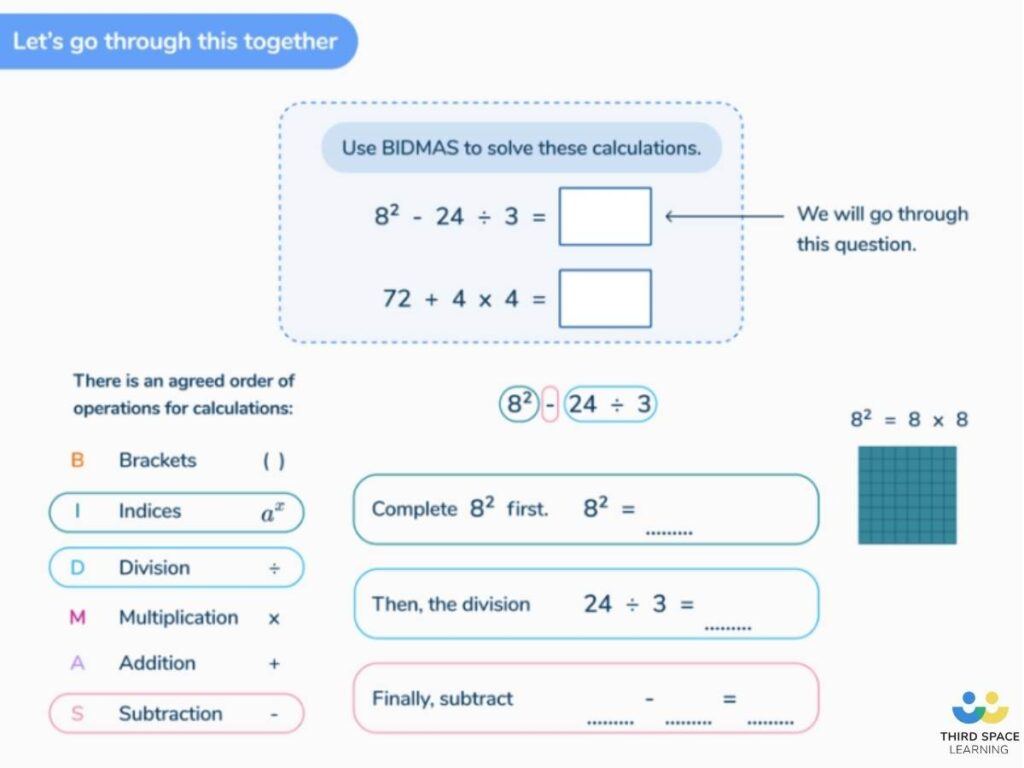
BIDMAS: the calculation rules everyone shares
A calculation such as
cannot be worked out simply from left to right. If different people used different orders, they could get different answers. BIDMAS gives everyone the same agreed order.
| Priority | BIDMAS letter | Meaning |
|---|---|---|
| 1 | B | Brackets |
| 2 | I | Indices: powers such as squares and cubes |
| 3 | D and M | Division and multiplication, from left to right |
| 4 | A and S | Addition and subtraction, from left to right |
A few important facts:
- A square means a number multiplied by itself twice. For example,
- A cube means a number multiplied by itself three times. For example,
- Division and multiplication have equal priority. Do whichever appears first when reading left to right.
- Addition and subtraction also have equal priority. Again, work left to right.
For instance,
means first calculate , then multiply the result by :
It does not mean divide by the whole of .
How to use BODMAS (Order of Operations)
Watch “How to use BODMAS (Order of Operations)” from Cognito. It uses BODMAS rather than BIDMAS, but the rule is the same and it clearly explains why calculations need an agreed order.
Watch the BIDMAS rule to identify what each letter means. Then watch the worked example. Pay special attention to the explanation that operations with equal priority are completed from left to right.
A reliable method for difficult calculations
When a question is long, trying to hold every number in your head is risky. Instead, rewrite the calculation after every important step. Replace only the part you have completed.
Consider:
Start with the innermost brackets:
Still inside the square brackets, calculate the index and division:
Now finish those brackets:
Multiplication comes before addition:
So,
Use this four-part checking routine in every question:
- Circle brackets and identify any powers.
- Complete brackets, remembering BIDMAS inside them too.
- Do division and multiplication from left to right.
- Do addition and subtraction from left to right.
A small but powerful exam habit: do not write the next line until you can point to the exact part of the previous line that you have changed. This makes errors easier to spot.
Choosing operations from words
Some SATs questions give you a calculation directly. Others describe a situation, so you must decide what operations are needed.
Look for the meaning:
| Words or situation | Likely operation |
|---|---|
| total, altogether, combined | addition |
| difference, how many left, decrease | subtraction |
| equal groups, each, lots of | multiplication |
| shared equally, per group | division |
For example:
A library has 12 shelves with 35 books on each shelf. It sends 48 books equally to 6 classrooms. How many books remain after one classroom receives its share?
First find the number of books:
Then find the number sent to one classroom:
The question asks for what remains, so subtract the second amount from the first:
Apply BIDMAS:
The answer is 412 books.
Notice that the words happen in a story order, but you must still use the correct calculation order. Multiplication and division are completed before subtraction.
Six-question SATs challenge
Try these without looking at the solutions. Aim to write at least one clear line of working for each question. These are deliberately harder than most one-step arithmetic questions.
Question 1
Question 2
Question 3
Question 4
Question 5
Question 6
Self-marking: clear solutions
Only check each solution after you have made a serious attempt.
Question 1
Answer:
Question 2
Answer:
Question 3
Answer:
Question 4
Answer:
Question 5
Answer:
Question 6
Answer:
If you made an error, do not just correct the final answer. Find the first line where your working differs from the solution. That tells you whether the mistake was with brackets, indices, left-to-right order, or an ordinary arithmetic fact.
Building SATs exam practice
For official past-paper practice, use the 2024 KS2 arithmetic paper after this lesson. Do not worry about completing it all at once; first look for questions that include more than one operation and apply the same line-by-line method.
Key stage 2 tests: 2024 mathematics test materials - GOV.UK
The official GOV.UK materials include a real Key Stage 2 Paper 1 arithmetic test. It is useful for becoming familiar with the wording and layout of SATs-style calculations.
On the page, find the “Documents” section and open “2024 key stage 2 mathematics Paper 1: arithmetic.” The link is located in the arithmetic-paper listing. Follow the instructions printed in the paper, choose a few multi-step calculations, and use a new line for each BIDMAS step.
Key takeaways
BIDMAS is not a trick to memorise once. It is a routine to use every time a calculation has more than one operation:
- Complete brackets first.
- Work out indices, such as squares and cubes.
- Complete division and multiplication from left to right.
- Complete addition and subtraction from left to right.
- Rewrite carefully after each step and estimate whether the final answer is sensible.
You have now completed the first six questions of the 50-question challenge. Next, you will tackle difficult number-property problems involving factors, multiples, prime numbers, square numbers, cube numbers, and missing values.
Can't find a good explanation? Sign up and we'll make it for you
Sign up