
Good to see you again. In the last lesson, you solved Questions 33–38 by making units match, choosing the right measurement formula, and checking whether an answer made sense in a real situation.
Now you will complete Questions 39–44 of the challenge. Geometry questions can look like drawing questions, but they are really reasoning questions: use a shape’s properties, record what stays the same, and work one step at a time. You will handle angles, coordinates, translations, reflections, and 3-D shape properties.
A reliable geometry routine
Before calculating, identify the facts the diagram or wording gives you. These are the most useful facts for today:
| Shape or situation | Fact to use |
|---|---|
| Full turn around a point | |
| Straight line | |
| Triangle | Angles total |
| Rectangle | Every corner is |
| Isosceles triangle | Two angles are equal |
| Translation | Shape slides; size, angles, and orientation stay the same |
| Reflection | Shape is flipped in a mirror line; each point stays the same distance from the line |
| Prism | Has two matching, parallel ends |
A diagram may not be drawn accurately. Trust the labelled information and shape properties, not what “looks about right.”
Angles: build the total from facts
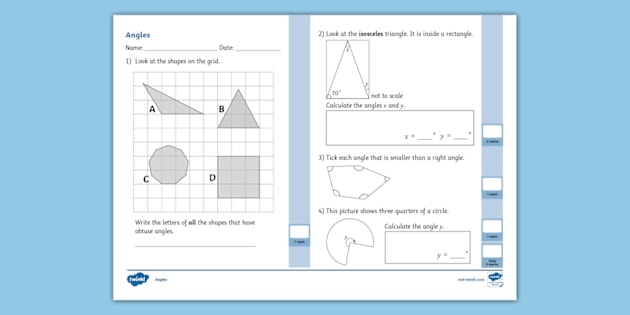
2025 SATs Maths Revision: Geometry (Problem Solving)
Watch the angle problem from “2025 SATs Maths Revision: Geometry (Problem Solving)” by TD Tutoring. It models how facts about an isosceles triangle and a rectangle can be joined in one SATs question.
Watch the triangle problem. Pause before the solution if possible. Focus on the order of reasoning: find the equal triangle angles first, then use the rectangle's right angle to find the final angle.
Question 39: Isosceles triangle inside a rectangle
Rectangle has at the bottom left and at the bottom right. An isosceles triangle is drawn inside it, with . Angle is .
Find:
- , the angle at the top of the triangle;
- , the angle between and side of the rectangle.
Because , triangle is isosceles. Its two base angles are equal:
The three angles in a triangle total , so:
Now look at corner of the rectangle. It is a right angle:
That right angle has been split into and :
The important habit is to label the angle you have found immediately. It makes the next fact much easier to see.
Question 40: Equal angles around a point
Five angles meet at point . Their sizes are:
Find .
Angles around one point make one complete turn:
Collect the equal angles:
Subtract :
Divide by :
Check it:
The check works. Notice that writing is just a quick way of writing three equal angles.
Coordinates: position first, shape property second
A coordinate is written in the order .
- Read the -coordinate first: move left or right.
- Read the -coordinate second: move down or up.
For example, means units left and units up from .
Year 6 SATs revision 2022 (Coordinates)
Watch “Year 6 SATs revision 2022 (Coordinates)” by Teachers That Tutor for a focused reminder that coordinate questions often depend on knowing the properties of squares and rectangles.
Watch the square example, then the rectangle example. Focus on how points that are horizontally level share a y-coordinate, while points vertically above one another share an x-coordinate.
Question 41: Find a missing vertex of a parallelogram
The vertices of parallelogram are given in order:
Find the coordinates of .
In a parallelogram, opposite sides are equal and parallel. Start by looking at the movement from to :
- The -coordinate changes from to : move units right.
- The -coordinate changes from to : move units up.
To get from to , make exactly the same movement:
A useful check is that and should lie on the same horizontal line. They do: both have .
Transformations: change position without changing the shape
A translation slides a shape. Every vertex moves the same number of squares in the same direction.
A reflection flips a shape across a mirror line. Each original point and its reflected point must be:
- the same perpendicular distance from the mirror line;
- at the same height if the mirror line is vertical;
- at the same left-right position if the mirror line is horizontal.
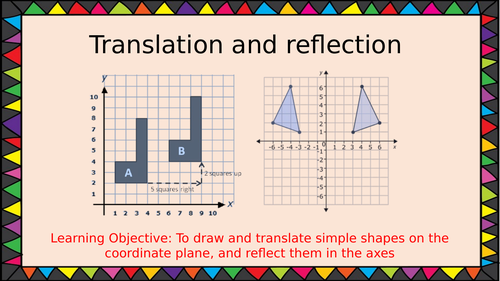
Question 42: Translate, then reflect
Triangle has these vertices:
First, translate the triangle units right and units down. Then reflect the new triangle in the -axis.
Find the final coordinates of , , and .
For the translation:
- units right means add to each -coordinate.
- units down means subtract from each -coordinate.
| Vertex | Original coordinate | After translation |
|---|---|---|
Now reflect in the -axis. A reflection in the -axis changes the sign of the -coordinate, while the -coordinate stays unchanged.
| Vertex | Before reflection | Final coordinate |
|---|---|---|
Point did not move during the reflection because it lies on the -axis. Points on a mirror line always remain where they are.
Question 43: Reflect in a line that is not an axis
Triangle has vertices:
Reflect it in the vertical mirror line . Find the new coordinates.
Do not simply change the signs of the -coordinates: that method works only when the mirror line is the -axis. Instead, count each point’s distance from .
For :
- is units right of the mirror line because .
- Its reflection must be units left of .
- .
So the reflection of is:
For :
- is units right of the mirror line.
- Its reflection is units left of the mirror line.
For :
- is units right of the mirror line.
- Its reflection is units left of the mirror line.
The -coordinates stayed the same because the mirror line was vertical. The reflected triangle has exactly the same side lengths and angles as the original one.
[PDF] 2024 key stage 2 mathematics Paper 2: reasoning - GOV.UK
Try an official SATs reflection question from the Department for Education. It is short, but use it to practise the exam habit of reflecting one vertex at a time and drawing accurately with a ruler.
On page 4, complete Question 1. Read the reflection question from the instruction through to the ruler reminder. Before drawing, count each original vertex's distance from the mirror line; then plot the matching point on the other side and join the points in the same order.
Properties of 3-D shapes
A 3-D shape has:
- faces: its flat surfaces;
- edges: the line segments where faces meet;
- vertices: its corners.
A prism has two matching bases. A pyramid has one base and an apex, so do not count its faces, edges, and vertices in the same way.
Question 44: A hexagonal prism
A solid has two matching hexagonal faces. These are joined by six rectangular faces. It is a hexagonal prism.
How many faces, vertices, and edges does it have?
Start with the faces:
- hexagonal faces;
- rectangular faces.
So it has:
Each hexagonal end has vertices. There are two ends:
So it has:
Now count edges carefully:
- edges around the first hexagon;
- edges around the second hexagon;
- joining edges between the two hexagons.
A simple way to check is to imagine making the frame from sticks: you would need sticks.
[PDF] 2024 key stage 2 mathematics Paper 2: reasoning - GOV.UK
Use the official paper again for a quick check of 3-D shape vocabulary. The question asks you to match solids to their numbers of vertices, so it tests whether you can visualise a shape rather than rely on a picture alone.
On page 12, attempt Question 13. Read the matching task. Treat the numbers as a mixed list: work out each shape's vertices independently before matching.
Key takeaways
Geometry becomes manageable when you turn each diagram into a set of facts.
- Use for triangles and straight lines, around a point, and at each rectangle corner.
- In an isosceles triangle, the two equal sides face the two equal angles.
- Coordinates are always written first, then .
- In a parallelogram, opposite sides have the same movement across the grid.
- For a translation, move every vertex by the same amount.
- For a reflection, every vertex must end the same distance from the mirror line.
- For 3-D shapes, count faces, vertices, and edges systematically rather than guessing from a drawing.
Next, you will finish the 50-question challenge with Questions 45–50, combining data handling with mixed multi-step reasoning.
Can't find a good explanation? Sign up and we'll make it for you
Sign up