
Hello again. In the previous lesson, you used ratios and scale factors to keep quantities in the same relationship. Algebra is another way to describe a relationship precisely, but now we use letters such as , , or for numbers that can change or are not yet known.
These are Questions 27–32 of your hard Year 6 SATs and early Year 7 challenge. You will spot sequence rules, write general rules, use a formula in both directions, solve unknown values, and explain a number machine. These skills help when a question looks unfamiliar: instead of guessing, you can show exactly why an answer works.
Algebra means finding and describing unknowns
A letter in maths is a placeholder for a number. For example:
means “a number plus equals .” The letter does not stand for a special mystery number forever; it has the value that makes the equation true.
What is algebra? - KS2 Maths - Year 6 - BBC Bitesize
Read BBC Bitesize’s introduction to algebra to see missing-number questions written with letters, balance ideas, and a number-machine rule.
In the section “What is algebra?”, read the “Missing number problems” explanation. Start with the main idea. Focus on why both sides of an equals sign must stay equal. Then find “Example 3”, the number-machine example. Read the machine rule. Notice that the same rule must work for every row, not just one row.
Think of the equals sign as a balanced scale. If you subtract from one side of an equation, you must subtract from the other side too. That is what keeps the statement true.
Two key habits will make algebra questions much easier:
- Write the rule clearly. Do not rely only on a pattern “looking right.”
- Check by substitution. Put your answer back into the original sequence, formula, or equation.
Sequences: find what changes each time
A sequence is an ordered list of numbers. In SATs-style questions, the first thing to inspect is how one term changes to the next.
Watch “Math Antics – Number Patterns” by mathantics for a clear way to distinguish adding or subtracting patterns from multiplying or dividing patterns.
Watch addition patterns to see how a fixed amount creates a sequence. Then watch multiplication patterns, which grow much more quickly. Finish with checking rules: test neighbouring terms for a common difference first, then a common ratio if the differences are not equal.
Question 27: A general rule for a growing sequence
A sequence begins:
Each term is more than the term before it. A simple rule for continuing it is “add .” But a general rule lets you jump straight to any term.
The first term is . To reach term , there are jumps of :
Simplify it:
So the general rule is:
For the term, substitute :
Check the rule with term 1:
It gives the correct first term, so the rule passes a useful check.
A common mistake is writing . That would give when , so it starts in the wrong place.
Question 28: Addition or multiplication?
Here is another sequence:
The differences are not equal:
So it is not an “add the same amount” pattern. Instead, each term is multiplied by :
Continue carefully:
The missing terms are:
When numbers become much bigger very quickly, check whether the rule could be multiplication rather than addition.
From a picture to a formula
Growing-pattern questions are algebra in disguise. Instead of starting with numbers, you start with a diagram and work out what changes when changes.
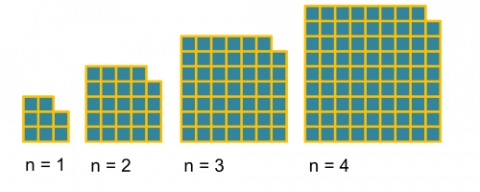
Question 29: Find the rule for the tile pattern
Count the tiles in the first few figures:
| Figure number | Number of tiles |
|---|---|
Looking only at the differences gives:
The difference itself is changing, so this is not a simple “add the same number” sequence.
Instead, look at the shape. Figure would make a square that is tiles wide and tiles high, except that one top-right tile is missing.
The full square contains:
tiles. Remove the missing tile:
Here, means .
For figure :
So figure has:
The important idea is that a formula is not random symbols. Every part represents something in the diagram:
- : the side length;
- : all tiles in the complete square;
- : the missing corner tile.
Formulas and unknown values
A formula is a rule that connects quantities. It can be used forwards to calculate an output and backwards to find an input.
[PDF] 2024 key stage 2 mathematics Paper 3: reasoning - GOV.UK
Look at a genuine KS2 SATs formula question. It is short, but it tests an important skill: using the same formula in both directions.
On page 21, find Question 22, beginning the bead formula. First cover the answer spaces and decide which operation you would undo when working backwards from the number of black beads.
Question 30: Use a formula in both directions
The bead rule is:
If Sarah uses white beads:
She uses:
Now work backwards. If Sarah has black beads, the rule says that was added only after the number of white beads was multiplied by .
So undo the operations in reverse order:
She uses:
A reliable backwards-formula method is:
- Find the last operation in the formula.
- Undo it first.
- Keep undoing operations until the unknown is alone.
- Put the answer back into the formula to check.
Question 31: Keep an equation balanced
Solve:
The aim is to get on its own. First undo the addition of by subtracting from both sides:
The letter is multiplied by . Undo this by dividing both sides by :
Check in the original equation:
The check works.
It is tempting to do straight away, but the is still attached to the . Undo addition or subtraction before undoing multiplication or division in a two-step equation like this one.
Question 32: Discover a number-machine rule
A number machine has this table:
| Input | Output |
|---|---|
Compare the first two rows. The input increases by :
The output increases by :
So each increase of in the input makes the output increase by . This suggests “multiply by .”
Test it using input :
But the output is , which is more. The complete rule is:
Check it with input :
Now find the missing input when the output is . Work backwards:
The missing input is:
Always test a discovered rule using at least one other row. A rule that works for only one pair of numbers may be a coincidence.
Key takeaways
Early algebra questions become much more manageable when you focus on the relationship rather than trying to guess.
- In a sequence, check whether there is a common difference or a common multiplier.
- A general rule uses for the term number and should work when you test .
- In a growing pattern, explain what each part of the formula represents in the picture.
- Use a formula forwards by substituting a value; use it backwards by undoing operations in reverse order.
- In an equation, do the same operation to both sides so it stays balanced.
- For a number machine, the rule must work for every input-output pair.
- Finish by checking your answer in the original question.
Next you will tackle Questions 33–38, which are difficult measurement problems involving conversions, perimeter, area, volume, time, and money.
Can't find a good explanation? Sign up and we'll make it for you
Sign up