
Hello again. In the previous lesson, fractions, decimals and percentages described parts of a whole. This lesson develops a closely related idea: ratio compares quantities, while proportion tells us that a relationship stays in the same balance as quantities change.
These are questions 21–26 of your hard Year 6 SATs challenge. You will learn how to split totals in a ratio, find missing values, spot wording traps, scale recipes and rates, convert units, and enlarge similar shapes. These methods also appear regularly in Year 7 maths.
Keep the relationship balanced
A ratio compares quantities in a particular order. For example:
means that every group has red items for every blue items. The order matters:
When a ratio is scaled, every part is multiplied or divided by the same number. So these are equivalent ratios:
The key SATs question is usually: What number has this part been multiplied or divided by?
How To Solve Year 6 RATIO Reasoning Maths SATs Questions! [2025 SATs Prep]
Watch How To Solve Year 6 RATIO Reasoning Maths SATs Questions! from TD Tutoring. It shows the two most common ratio structures and then explains an important wording trap involving seeds.
Watch missing values to see how the same multiplier must be used for both sides of a ratio. Then watch splitting totals for the bar-model idea: add the ratio parts before dividing a total. Finish with the seed trap; focus on why “planted” and “grew” do not automatically form the ratio written in the question.
Model 1: one part of a ratio is known
A craft club uses red and black card in the ratio:
It uses black sheets. Since black corresponds to parts, find the scale factor:
So each ratio part represents sheets. The number of red sheets is:
The complete ratio is:
A quick check is to divide both numbers by :
The check works.
Model 2: a total must be shared in a ratio
A school receives books. Fiction books and non-fiction books are shared in the ratio:
First find the total number of ratio parts:
Each part is:
Now multiply by the correct number of parts:
The answer is fiction books and non-fiction books.
A reliable way to set this out is:
| Quantity | Ratio parts | Actual amount |
|---|---|---|
| Fiction | ||
| Non-fiction | ||
| Total |
Do not divide by or first. The represents all eight parts together.
Read the words before writing the ratio
Hard SATs questions often contain a sentence that looks like a ratio but is actually describing a part and a whole.
Model 3: the “out of every” trap
“Out of every seeds planted, grow into plants. If seeds grow, how many seeds were planted?”
The statement does not mean planted : grown is , because the seeds that grow are included within the seeds planted.
Instead, each group of contains:
- seeds that grow;
- seeds that do not grow.
So the ratio of growing to not growing seeds is:
We know that parts represent growing seeds:
One group is scaled by , so the number planted is:
Therefore, seeds were planted.
The useful habit is to ask: What does each number count? In this example, “planted” is the total of both outcomes.
Another version of this trap occurs in queues. If there are children in a queue including Maya, and there are twice as many children ahead of Maya as behind her, do not use as the total for the ratio. Maya is neither ahead nor behind herself.
You would first remove Maya:
Then split in the ratio:
There are parts, so each part is:
There are parts ahead:
So children are ahead of Maya.
Proportion: scaling a complete situation
A proportional situation keeps the same rate or recipe. If you make three times as much paint, you need three times as much of every ingredient. If a machine runs for fifteen times as long, it produces fifteen times as much output at the same rate.
How To Solve Year 6 RATIO Reasoning Maths SATs Questions! [2025 SATs Prep]
Return to TD Tutoring’s ratio-reasoning video for two realistic scaling questions. These are particularly useful because they combine ratio with time, capacity, and unit conversion.
Watch scaling a rate. Notice how the scale factor is found from the time first, and how millilitres are changed into litres only at the end. Then watch recipe conversion, focusing on the final check that the requested unit is kilograms rather than grams.
Model 4: scale a rate, then convert the unit
A juice machine pours every seconds. How many litres does it pour in minute?
One minute is:
Find how many lots of seconds fit into seconds:
The machine pours equal batches, so the total volume is:
The question asks for litres. Since:
we calculate:
The machine pours:
A frequent exam mistake is stopping at . The calculation is correct, but the unit is not what the question requested.
Model 5: scale a price in pence, then write pounds
Cheese costs per . What does cost?
First find the scale factor:
So costs six lots of :
Now change pence to pounds:
So the cost is:
This works because the price is proportional to the mass: twice as much cheese costs twice as much, provided the rate stays the same.
Scale factors for similar shapes
A scale factor tells you how much every corresponding length changes.
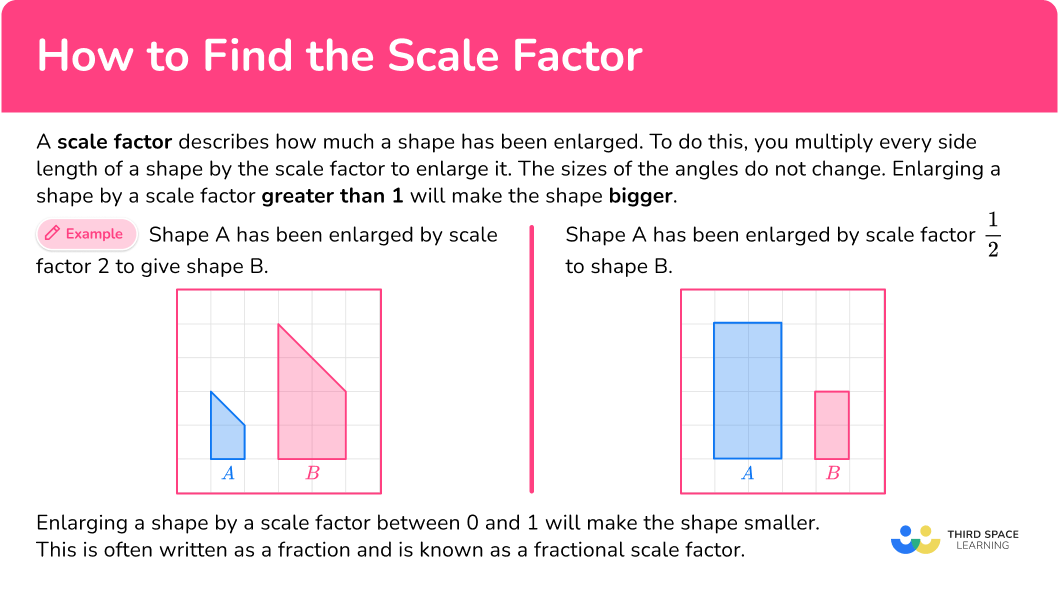
To find a scale factor from an original shape to a new shape, use corresponding lengths:
A scale factor:
- greater than makes a shape larger;
- between and makes a shape smaller;
- equal to leaves the shape unchanged.
When shapes are similar, their corresponding angles are equal and their corresponding side lengths have the same scale factor.
Model 6: find a scale factor and use the perimeter
A small triangular sign has side lengths:
A similar larger sign has a side corresponding to the side that measures .
First find the scale factor:
Every side length is multiplied by :
So the larger triangle has side lengths:
Its perimeter is:
Therefore, the perimeter is:
You could also scale the original perimeter. The small perimeter is:
Then:
Both methods agree.
Be precise with the phrase “scale factor .” It means every length is multiplied by . It does not mean the area is multiplied by . If both length and width are multiplied by , the area is multiplied by:
For a scale factor :
Your SATs method for unfamiliar ratio questions
When a question has lots of information, use this order:
-
Underline what is being asked. Is it one missing amount, a total, a cost, a time, a perimeter, or a measurement in a different unit?
-
Label the quantities. Write, for example, “red : blue,” not just . This prevents reversing the answer.
-
Decide which structure you have.
- One ratio part is known: divide to find the scale factor.
- A total is known: add the parts, divide the total, then multiply.
- A rate or recipe changes: find how many equal batches are needed.
- Similar shapes are involved: find the scale factor from matching lengths.
-
Deal with units at the end. Common conversions include:
-
Check the relationship. For a ratio, simplify your final amounts. For a scaled quantity, check that both quantities changed by the same factor.
Key takeaways
Ratio and proportion questions become manageable when you identify what each number represents.
- A ratio compares quantities in a fixed order.
- Equivalent ratios are made by multiplying or dividing every part by the same factor.
- To split a total, add the ratio parts before dividing.
- Read “out of every” wording carefully: one number may be part of the other total.
- In proportional situations, all linked quantities scale by the same factor.
- Convert into the requested unit only after completing the calculation.
- For similar shapes, all side lengths and perimeters scale by the scale factor; areas scale by the square of it.
Next, you will move into early algebra: using sequences, rules, symbols, and missing values to describe patterns and solve problems efficiently.
Can't find a good explanation? Sign up and we'll make it for you
Sign up