
Hello! Welcome to the first lesson in our exploration of the self-directed learner's journey.
Given your goal of informing a new product design, our focus today is to build a practical mental model of how self-directed learning works. We will move beyond abstract ideas to create a structured framework you can directly apply in your work. We will break down the learning process into distinct phases, similar to how you would map a customer journey in product design. For each phase, we'll identify the common challenges and pain points that learners encounter. This will provide the foundation for identifying product opportunities, which we will explore in our next lesson.
The Self-Directed Learning Process
To begin, let's establish a high-level view of the self-directed learning process. The flowchart below provides a clear, process-oriented overview. It places the learner at the center and outlines the key steps they take, from identifying their needs to reflecting on their progress.
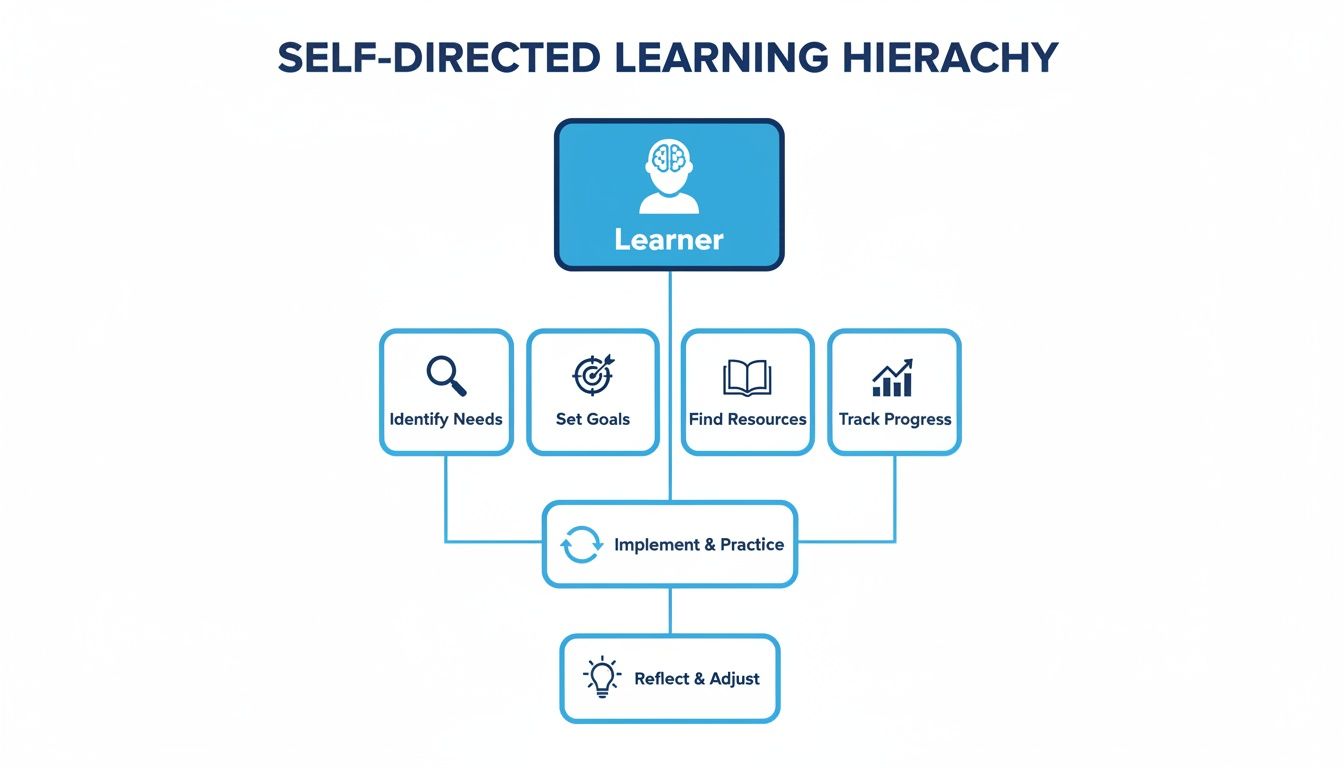
While this flowchart is a great start, for product design purposes, it's helpful to group these steps into broader, more distinct phases. This approach allows us to structure our analysis in a way that aligns with familiar journey mapping practices. We can consolidate the seven steps in the diagram into four core phases:
-
Goal Setting & Planning: This initial phase covers identifying needs and setting goals. Here, the learner recognizes a knowledge gap or a desire to learn something new and then defines what success looks like. This could range from a vague intention ("I want to get better at data analysis") to a specific, measurable objective ("I will complete a SQL fundamentals course and build a simple dashboard in three months").
-
Discovery & Curation: This phase corresponds to finding resources. The learner actively searches for courses, articles, videos, books, mentors, or any other materials that will help them achieve their goals. A crucial part of this phase is not just finding information but also vetting it for quality, relevance, and trustworthiness.
-
Execution & Practice: This is the implement & practice stage. The learner consumes the content, works through exercises, and, most importantly, attempts to apply their new knowledge in a practical context. This is where the core "work" of learning happens.
-
Reflection & Adjustment: This final phase combines tracking progress and reflecting & adjusting. The learner assesses how well they are advancing toward their goals, evaluates whether their methods and resources are effective, and makes changes to their plan as needed. This is a continuous feedback loop.
Identifying User Pain Points in the Learner Journey
Now that we have a phased map, we can begin to populate it with the most critical element for product discovery: user pain points. Each phase of the learning journey is fraught with specific challenges that can cause a learner to lose momentum, get frustrated, or give up entirely.
The following reading provides an excellent summary of these common hurdles. As you read, focus on how each challenge could manifest as a specific pain point for a user of a learning product.
7 Self-Directed Learning Challenges (and How to Fix Them)
This article from Easy-LMS details seven common challenges faced by self-directed learners. These challenges are, in essence, a list of well-defined user pain points.
Please read the section titled "7 challenges that make self-directed learning hard." Pay close attention to the examples provided for each challenge, such as motivation fading, the difficulty of setting clear goals, the problem of information overload, the lack of feedback loops, and the issues of isolation and ineffective reflection.
From Learning Process to Learner Journey Map
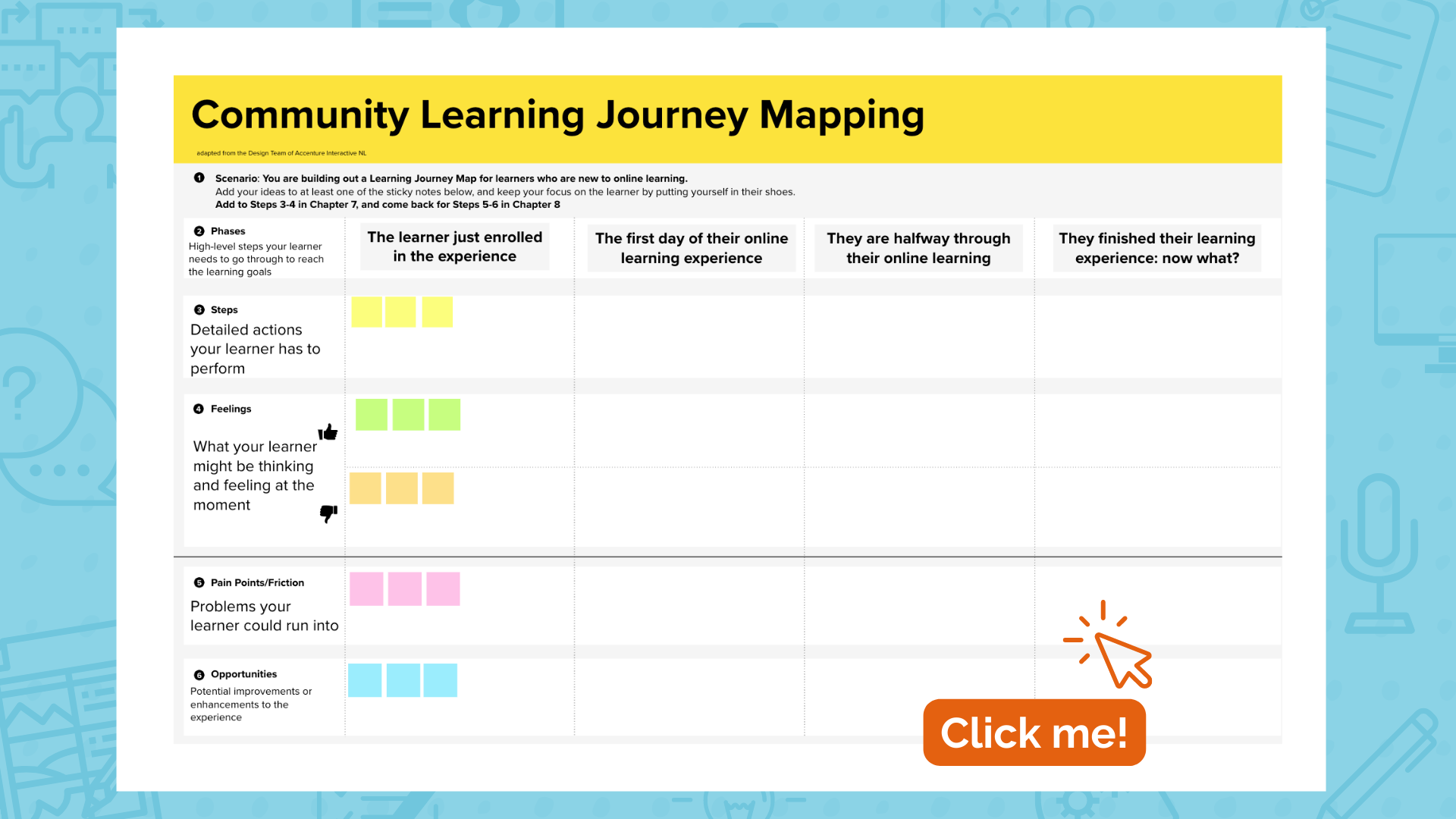
Your expertise lies in translating user needs and pain points into product solutions, often using tools like journey maps. The framework we are building is designed to be a direct input for that process. While you are already an expert in creating journey maps, it's useful to quickly formalize how our learning phases and pain points fit into that structure.
The Nielsen Norman Group provides a concise definition of the core components of any journey map.
This short clip from the Nielsen Norman Group, a leader in UX research, breaks down the five essential components of a customer journey map.
Watch the segment from the five components of a journey map. Notice how the "Journey Phases" and "Insights/Opportunities" components align with the structure we are building today.
As the video highlights, the "journey phases" form the backbone of the map. The pain points we identified from the reading become the critical "insights" that fuel the "opportunities" row of the map—the space where product innovation begins.
A Framework for the Self-Directed Learner
To bring everything together, here is a table that synthesizes our four phases with the corresponding pain points from the reading. I've also added a column that frames these challenges from a product perspective, using concepts like "Guidance," "Encouragement," and "Feedback" which are pillars of successful EdTech UX design.
| Phase | Key Activities | Common Pain Points | Product Perspective |
|---|---|---|---|
| Goal Setting & Planning | Learner identifies knowledge gaps, defines objectives, and creates a plan. | Setting vague or unrealistic goals; uncertainty about where to even start. | Learners need Guidance to articulate clear, actionable, and achievable goals. |
| Discovery & Curation | Learner searches for articles, videos, courses, and other learning materials. | Information overload; difficulty vetting the quality and relevance of content. | Learners need Guidance through curated paths and trusted resources to reduce cognitive load. |
| Execution & Practice | Learner consumes content, completes exercises, and applies new skills. | Fading motivation, poor time management, feeling isolated and unsupported. | Learners need Encouragement through milestones and community, and Flexibility to fit learning into their lives. |
| Reflection & Adjustment | Learner assesses their progress, identifies sticking points, and refines their plan. | No feedback or way to track progress; not reflecting on what works and what doesn't. | Learners need clear and consistent Feedback to understand their performance and adjust their strategy. |
This table provides a structured, actionable framework. You can use it as a starting point to empathize with your target users, anticipate their struggles, and begin thinking about where a product could intervene to make their learning journey more effective and engaging.
Conclusion
In this lesson, we have transformed the abstract concept of self-directed learning into a concrete, four-phase journey map: Goal Setting & Planning, Discovery & Curation, Execution & Practice, and Reflection & Adjustment. By mapping specific, research-backed user pain points to each phase, we have created a robust foundation for product discovery.
Key Takeaways:
- The self-directed learning journey can be structured into four key phases.
- Each phase has predictable and common pain points, such as setting vague goals, information overload, fading motivation, and a lack of feedback.
- Framing these phases and pain points as a journey map provides a powerful tool for identifying opportunities for product intervention.
In our next and final lesson, we will put this framework into action. You will choose one of the pain points we've identified, reframe it as a "How Might We" statement, and brainstorm a corresponding product feature concept designed to solve it.
Can't find a good explanation? Sign up and we'll make it for you
Sign up