
Welcome to the second and final lesson of our course. Last time, we built a practical framework for the self-directed learner's journey, breaking it down into four key phases: Goal Setting, Discovery, Execution, and Reflection. We also identified the common pain points learners face in each phase, creating a foundation for product discovery.
Today, we'll bridge the gap between identifying those problems and designing solutions. You will learn how to use "How Might We" (HMW) statements—a classic tool in the product discovery and design thinking toolkit—to reframe a user pain point as an opportunity for innovation. We will then take that opportunity and translate it into a tangible product feature concept, completing the cycle from user insight to a potential solution.
From Problem to Opportunity: "How Might We" Statements
Your work as a product designer constantly involves translating user problems into actionable design challenges. "How Might We" (HMW) statements provide a structured and optimistic way to do exactly that. They transform a stated problem into a question that invites a broad range of creative solutions.
To start, let's watch a brief video from the Nielsen Norman Group that defines user need statements—a category that HMW statements belong to—and their core components.
User Need Statements in Design Thinking
This video introduces the concept of user need statements and their role in the design thinking process.
Watch the full video. Pay close attention to the three core components it outlines—user, need, and goal—and the critical distinction it makes between focusing on what a user needs to do (a verb) versus a pre-determined solution like a button (verbs vs. nouns).
The video emphasizes framing the user's need as a verb. This is the essence of a good HMW statement: it focuses on the user's goal, not on a specific feature. Another helpful way to structure this is by thinking about Action, Subject, and Outcome.
The image below provides a clear, formulaic representation of the HMW structure.
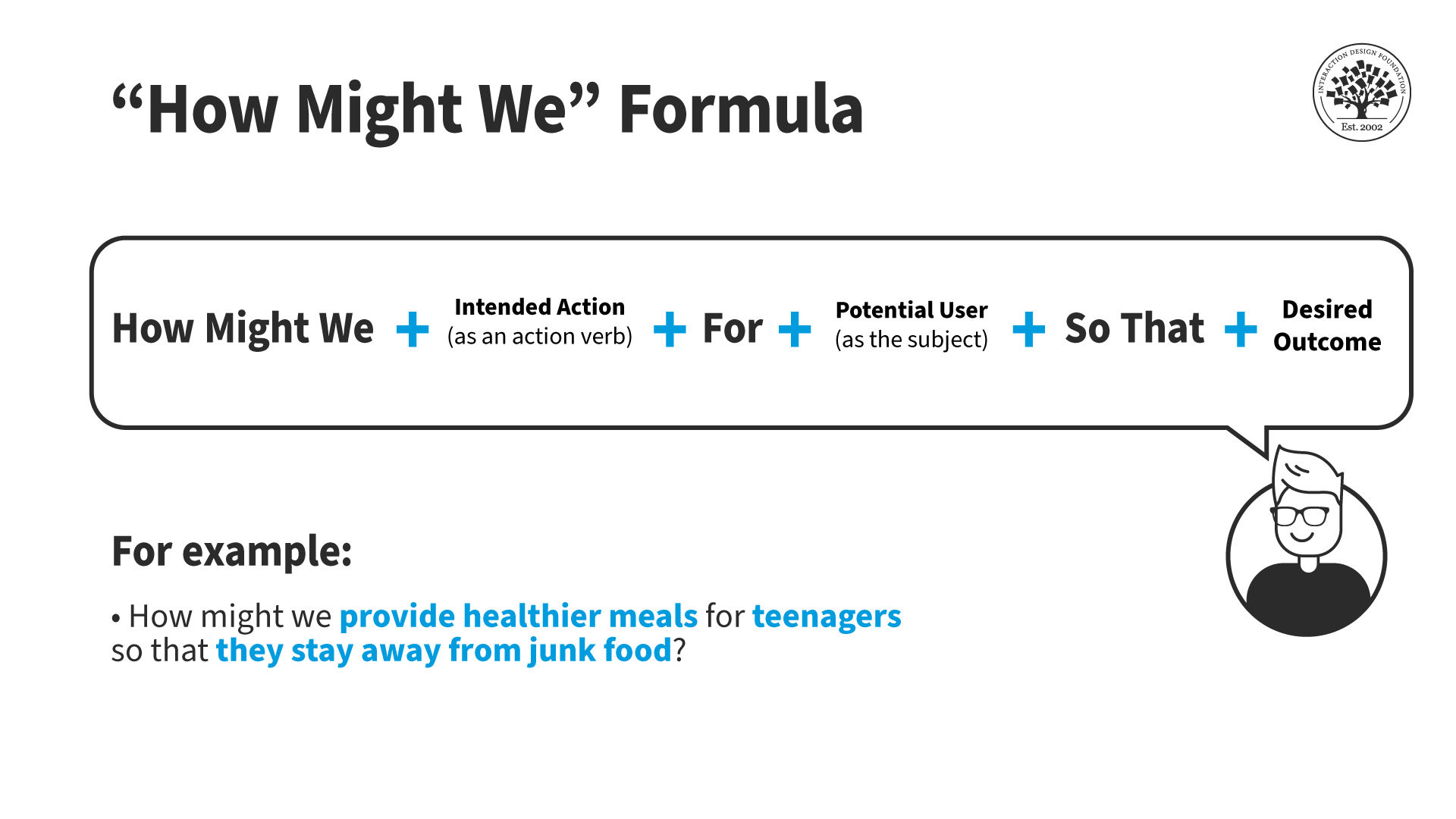
This structure helps ensure you are focused on the right user and a measurable outcome, while leaving the "how" open for creative exploration.
Crafting an Effective HMW Statement
Knowing the structure of an HMW statement is one thing; writing one that genuinely sparks innovation is another. An effective HMW needs to strike a delicate balance—it must be broad enough to allow for creativity but specific enough to guide the ideation process toward a relevant solution.
The following guide is an excellent resource for mastering this skill. It covers the characteristics of strong HMWs and provides a step-by-step process for writing them.
A Guide to How Might We Statements - by Nikki Anderson
This article by Nikki Anderson, a user research strategist, offers a deep dive into the art and science of writing effective HMW statements.
Please read the following sections: Start with "Characteristics of How Might We Statements". This section outlines six key qualities, such as being user-centric and action-oriented. Next, read the section "Writing How Might We Statements". Focus on the step-by-step process, which shows how to move from a general problem to a refined HMW statement. Pay special attention to the guidance on avoiding statements that are too broad or too narrow. Finally, review the side-by-side examples under "Examples of Effective vs. Ineffective How Might We Statements". These provide concrete illustrations of the principles in action.
The key takeaway is that an HMW statement is a hypothesis about where a valuable solution might lie. It's the launchpad for brainstorming, not the final destination.
A Real-World Example: From Pain Point to Product Feature
Let's walk through a complete example from a UI/UX case study to see how this process plays out in practice. This will connect the dots from user research to the final product concept.
This case study, titled "Crafting personalized learning," documents the design of a new learning platform.
Crafting personalized learning: a UI/UX case study
This case study by Gaurav Sinha details the end-to-end design process for a personalized learning app called LearnFlow.
First, familiarize yourself with the problem space by reading the "Interviews", "Surveys", and "Heuristic Evaluation" sections. Focus on the pain points discovered during the research. Notice findings like the "overwhelming array of course options," the "lack of personalized guidance," and the "absence of personalization" on existing platforms.
The research in the case study uncovered several clear pain points. Let's pick one that you likely recognized from our first lesson: "navigating through an overwhelming array of course options," a classic pain point in the Discovery & Curation phase.
Using the HMW formula, we can translate this pain point into a design opportunity:
How might we (action) provide personalized guidance (outcome) for professionals (user) so that they can navigate the overwhelming array of learning options and find relevant content?
This question is broad enough not to dictate a solution but specific enough to focus brainstorming. Now, let's see how the designer's final concept answers this HMW.
Crafting personalized learning: a UI/UX case study
Now, examine the proposed solution.
Please review the "Final Design" section of the case study. Pay attention to the features in the "Onboarding", "Skill Assessment", "Learning Journey", and "Newsfeed" mockups.
Notice how features like the simplified goal-setting in onboarding, the skill assessments, the curated Kanban-style learning journey, and the personalized newsfeed directly address our HMW statement. The "Newsfeed" feature, for example, doesn't just show random content; it's explicitly described as "carefully curated to align with your skills, goals & learning journey." This is a tangible product concept born from the opportunity identified in the HMW statement.
Your Turn: Apply the Framework
Now it's time for you to apply this framework. In our last lesson, we identified several pain points across the four phases of the self-directed learning journey.
| Phase | Common Pain Points |
|---|---|
| Goal Setting & Planning | Setting vague or unrealistic goals; uncertainty about where to even start. |
| Discovery & Curation | Information overload; difficulty vetting the quality and relevance of content. |
| Execution & Practice | Fading motivation, poor time management, feeling isolated and unsupported. |
| Reflection & Adjustment | No feedback or way to track progress; not reflecting on what works and what doesn't. |
Your task:
- Choose one pain point from the table above that you find particularly interesting from a product design perspective.
- Formulate a "How Might We" statement that reframes this pain point into a design opportunity. Remember to focus on the user, their need, and the desired outcome.
- Propose a product feature concept that could address your HMW statement. You don't need a full mockup—a brief description of the feature and how it would help the user is sufficient.
You can think of this last step through the lens of a tool you know well, the Value Proposition Canvas. Your feature concept should act as a "Pain Reliever" for the pain point you chose.

Take about 10 minutes to work through this. This exercise simulates the exact creative leap you would make in the early stages of product discovery.
Conclusion
This brings us to the end of our short course. We began by structuring the complex world of self-directed learning into a clear, four-phase journey map. Today, we've equipped you with a powerful technique to act on the insights from that map. By using "How Might We" statements, you can systematically translate learner pain points into focused, human-centered design challenges, paving the way for innovative and valuable product features.
Key Takeaways:
- "How Might We" (HMW) statements are a core design thinking tool for reframing problems as opportunities.
- An effective HMW statement focuses on a specific user and their desired outcome (the what), leaving the solution (the how) open to creative exploration.
- This process provides a repeatable method to move from user research and pain point identification to concrete product feature concepts.
As you move forward with your own product development, this two-part framework—mapping the learner journey and using HMW statements to drive ideation—can serve as a foundational element of your discovery process. It will help you and your team stay focused on solving the most critical problems for self-directed learners.
Can't find a good explanation? Sign up and we'll make it for you
Sign up