
Hello! Welcome to the second lesson in our module on the foundations of Jain philosophy.
In our last lesson, we established the fundamental Jain concept of the soul, or jiva. We learned that its true, intrinsic nature is the Ananta Chatushtaya: Infinite Knowledge, Infinite Perception, Infinite Bliss, and Infinite Energy. This raised a crucial question: if this is our true nature, why do we experience a life of limited knowledge, suffering, and weakness?
Today, we will answer that question directly. The answer, in Jain philosophy, is karma. This lesson is dedicated to fulfilling our learning outcome: to describe the eight types of karma and their effects on the soul. We will explore what these karmas are, how they are categorized, and precisely how each one veils the pure qualities of the jiva.
1. What is Karma in Jainism?
Before we explore the types, it's vital to be clear about what karma is in the Jain tradition. It is not an abstract metaphysical law of cause and effect. Instead, karma is understood to be a form of extremely subtle, physical matter (pudgala) that is drawn to and sticks to the soul, much like dust sticks to an oily surface. Our thoughts, words, and actions, when driven by passions, create the "stickiness" that binds these karmic particles to the jiva.
This bondage obscures the soul's true nature, creating the conditions of our worldly existence.
2. The Two Major Categories of Karma
The vast array of karmic influences is organized into eight primary types, which are first divided into two main categories. This classification is based on the way they affect the soul.
-
Ghātiyā Karmas (घाति कर्म): The "Harming" Karmas. These are the destructive karmas that directly attack and obscure the soul's intrinsic qualities of knowledge, perception, bliss, and energy. They are the primary cause of the soul's bondage and spiritual ignorance.
-
Aghātiyā Karmas (अघाति कर्म): The "Non-Harming" Karmas. These non-destructive karmas do not affect the soul's core attributes directly. Instead, they determine the physical body, lifespan, social standing, and the experiences of pleasure and pain that the embodied soul undergoes. They shape the "scenery" of our life, while the ghātiyā karmas affect the "seer."
This hierarchical structure is a key concept. The following diagram provides an excellent visual overview of the eight karmas and their classification, which you can refer to throughout this lesson.
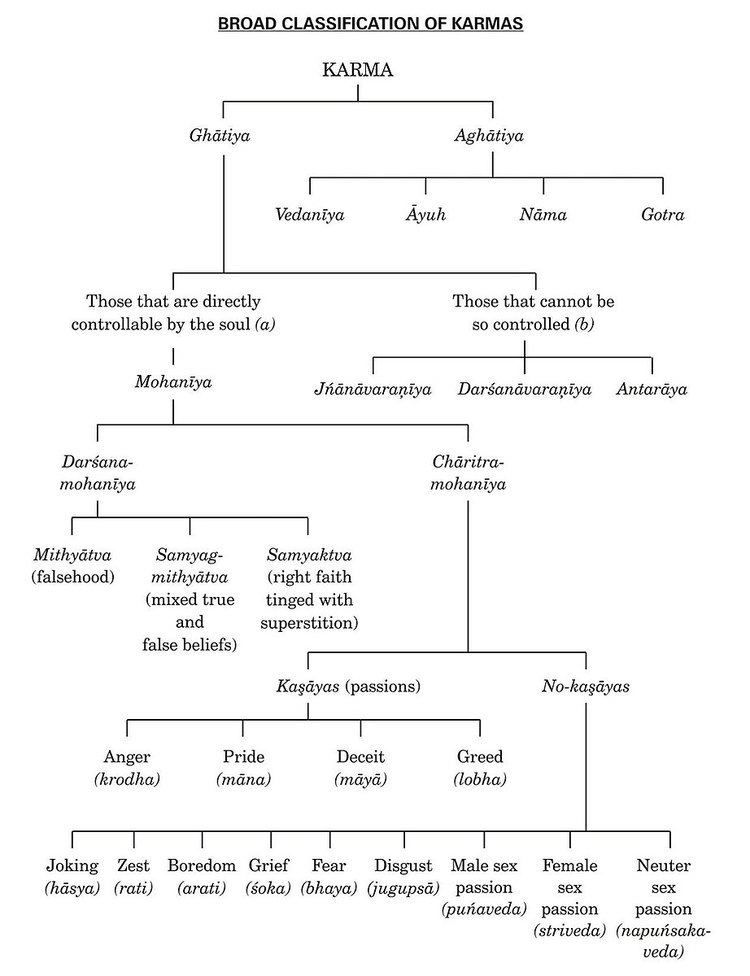
To begin, let's read a short passage that introduces these two main categories and lists the four karmas within each.
The Wikipedia article on 'Types of Karma (Jainism)' offers a concise introduction to the eight karmas and their primary grouping. This will give us a solid foundation before we dive into each one.
Please read the introductory section of the article, which starts with 'In Jainism, the principle of karma...' and ends just before the 'Ghatiya karmas' heading. Focus on understanding the distinction between 'harming' (ghātiyā) and 'non-harming' (aghātiyā) karmas.
Now that you have an overview, we will explore each of the eight karmas in detail, starting with the four ghātiyā karmas that directly impact the soul's nature.
3. The Four Ghātiyā (Harming) Karmas
These four karmas are considered the most significant obstacles to spiritual liberation because they directly veil the Ananta Chatushtaya.
Let's return to the Wikipedia article to learn about the four harming karmas. We will then connect each one to the specific attribute of the soul it obstructs.
Read the section titled 'Ghatiya karmas'. Pay attention to the name and the primary function of each of the four karmas listed: Knowledge-obscuring, Perception-obscuring, Deluding, and Obstructing.
Now let's break down each one and explicitly link it to the soul's pure attributes we discussed in the last lesson.
1. Jñānāvaraṇīya Karma (ज्ञानावरणीय कर्म) – Knowledge-Obscuring Karma
This karma acts like a veil or a curtain drawn over the soul's Infinite Knowledge (Ananta Jnana). It prevents us from knowing things directly and perfectly. Instead, it forces us to rely on limited, indirect means of knowing, such as through our senses and intellect. Its effects range from minor forgetfulness to the complete inability to learn. The ultimate goal is to destroy this karma completely to attain omniscience (Kevala Jnana).
2. Darśhanāvaraṇīya Karma (दर्शनावरणीय कर्म) – Perception-Obscuring Karma
This karma obscures the soul's Infinite Perception (Ananta Darshana). While Jñānāvaraṇīya karma obscures specific knowledge, this karma obstructs general perception or intuition. It's like having a faulty lens on a camera. It affects our ability to perceive through our senses (e.g., blindness, deafness) and, more importantly, it blocks the soul's innate, direct perception.
A Crucial Link to Sleep:
This is where our study of sleep and Jain philosophy make their first direct connection. Jain texts classify different states of sleep as sub-types of Darśhanāvaraṇīya karma.
The Wikipedia article you're familiar with details these sub-types. This is a very important section for our course goals.
Navigate to the sub-section 'Darshanavaraniya karma'. Read the list of the five 'nidra karmas' (sleep karmas), from 'Nidra-karma' to 'Styanagriddhi karma'. Note how they describe different depths and types of sleep, including sleepwalking.
As you can see, from a Jain perspective, sleep is not merely a biological state of rest. It is an active obscuration of perception caused by a specific karmic influence. This understanding is foundational to your goal of transforming unconscious sleep into a state of conscious awareness.
3. Mohanīya Karma (मोहनीय कर्म) – Deluding Karma
This is considered the most dangerous and difficult karma to overcome. It doesn't directly obscure knowledge or perception, but rather corrupts the soul's faith and conduct. It is the root cause of attachment (rāga) and aversion (dveṣa), which in turn hinders the soul's ability to experience its own Infinite Bliss (Ananta Sukha).
- Darśhana Mohanīya (Faith-Deluding): This subtype creates false beliefs and prevents the soul from recognizing the true path to liberation.
- Chāritra Mohanīya (Conduct-Deluding): This gives rise to the passions (kaṣāya), such as anger, ego, deceit, and greed, which poison the soul and lead to unrighteous conduct.
4. Antarāya Karma (अंतराय कर्म) – Obstructing Karma
This karma obstructs the soul's Infinite Energy (Ananta Virya). It creates obstacles and prevents the soul from utilizing its full power. When this karma is active, we may have the desire and the means to do something good (like give charity, learn, or exert effort), but find ourselves unable to do so. It is the source of feelings of helplessness and weakness.
4. The Four Aghātiyā (Non-Harming) Karmas
These karmas determine the external circumstances of our embodied existence. While they don't corrupt the soul's nature, their destruction is still necessary for final liberation (moksha), as they are what keep the soul in a physical body.
Jainism Simplified Chapter 8 - Theory of Karma
The 'Jainism Simplified' article provides a very clear explanation of how these aghātiyā karmas, and the ghātiyā karmas, relate to the eight attributes of a pure, liberated soul.
Please read the final section of this article, starting from the line 'Karmas obstruct these eight attributes of a pure soul:'. Notice how each karma is directly linked to an attribute it obscures. This perfectly summarizes the 'effects on the soul'.
Let's summarize these four karmas, integrating the insights from the reading:
5. Vedanīya Karma (वेदनीय कर्म) – Feeling-Producing Karma
This karma is responsible for our experiences of pleasure (sāta vedanīya) and pain (asāta vedanīya) in the worldly sense. It dictates whether our interactions with the world result in pleasant or unpleasant sensations. By keeping the soul attached to external sources of happiness and preoccupied with avoiding pain, it prevents the realization of the soul's own intrinsic, unshakeable Ananta Sukha.
6. Āyuṣya Karma (आयुष्य कर्म) – Lifespan-Determining Karma
This karma determines the lifespan and the realm of existence for the soul's next birth. It dictates whether the soul will be born as a celestial being (deva), a human (manuṣya), an animal/plant (tiryancha), or an infernal being (naraki), and for how long that life will last. It obscures the soul's natural quality of being deathless (Ajaramar).
7. Nāma Karma (नाम कर्म) – Body-Determining Karma
This is the most complex karma, with 93 sub-types. It is the "blueprint" for the embodied soul. It determines everything about the body and identity: the species, the type of body (gross, subtle), its appearance, qualities, senses, and so on. It obscures the soul's true nature as being formless (Arupi).
8. Gotra Karma (गोत्र कर्म) – Status-Determining Karma
This karma determines the family, social status, and environment into which a soul is born. It can result in a high-status birth (uccair gotra), which may provide favorable conditions for spiritual practice, or a low-status birth (nīcair gotra). It obscures the soul's intrinsic quality of being equal to all other pure souls (Agurulaghu).
Test your understanding!
An individual is a gifted musician with a beautiful voice (subha nāma karma) but often gets debilitating stage fright that prevents them from performing (antarāya karma). At a concert, they feel immense joy from the audience's applause (sāta vedanīya karma).
Which of these karmas are ghātiyā (harming) and which are aghātiyā (non-harming)? Explain your reasoning.
Show answer
-
Ghātiyā Karma: The Antarāya karma (obstructing) that causes stage fright is a ghātiyā karma. It directly attacks the soul's intrinsic quality of Ananta Virya (Infinite Energy), creating an obstacle that prevents the musician from using their abilities.
-
Aghātiyā Karmas: The Nāma karma (body-determining) that gives a beautiful voice and the Vedanīya karma (feeling-producing) that causes the feeling of joy are both aghātiyā karmas. They don't corrupt the soul's fundamental nature. Instead, they determine the physical attributes (the voice) and the worldly experiences of pleasure/pain (the joy from applause).
Conclusion
Today, we have systematically unpacked the eight types of karma that, according to Jain philosophy, are responsible for the soul's worldly existence and the veiling of its true, magnificent nature.
Key Takeaways:
- Karma in Jainism is a physical substance that binds to the soul.
- The eight karmas are divided into two categories:
- Ghātiyā (Harming): Obscuring knowledge (Jñānāvaraṇīya), perception (Darśhanāvaraṇīya), energy (Antarāya), and creating delusion (Mohanīya). These directly veil the soul's pure attributes.
- Aghātiyā (Non-Harming): Determining feelings (Vedanīya), lifespan (Āyuṣya), body-type (Nāma), and status (Gotra). These dictate the conditions of our physical life.
- Each of the eight intrinsic qualities of a pure soul is obscured by a specific corresponding karma.
- Critically for our course, states of sleep are understood as a direct effect of Darśhanāvaraṇīya karma, providing a philosophical basis for our goal of conscious rest.
Preview of the Next Lesson:
We now know what the eight karmas are and what they do. The logical next question is: How do they get attached to the soul? In the next lesson, we will explore the dynamics of karmic bondage. We'll learn about the concepts of āsrava (the inflow of karma) and bandha (the binding of karma), and discover how our own intentions and passions are the critical factors in this process. Understanding this mechanism is the first step toward learning how to stop it.