
Hello! Welcome to the final lesson of our module on dream interpretation.
Over the past few lessons, we've built a strong foundation. You've learned how to improve your dream recall and keep a dream journal, how to spot recurring themes, why dreams communicate in symbols rather than literal language, and how dreaming serves as a vital form of "overnight therapy" for processing our emotions.
Today, we will integrate all of these pieces. Our goal is to apply a structured method for extracting personal insights from a recorded dream. We will move from theory to practice, equipping you with a step-by-step process you can use to work with your own dreams. The method we'll learn is largely based on the work of the Swiss psychiatrist Carl Jung, who saw dreams as direct, honest messages from the unconscious, offering wisdom that our conscious mind has overlooked.
1. The Guiding Principles of Dream Work
Before diving into the steps, it's important to understand the philosophy behind this approach. Jung believed that dreams are not trying to trick or confuse us. Instead, they are a natural product of our psyche, communicating a truth about our inner state.
To get a feel for this perspective, let's start with a video that outlines the fundamental assumptions of Jungian dream analysis.
Jungian DREAM ANALYSIS - The Basics
This video from the Nexus Void channel introduces the core ideas behind Jungian dream analysis. It explains that dreams are symbolic, not hidden, and that they often serve to 'compensate' for our conscious viewpoint.
Please watch from 01:12 to 09:46. As you watch, focus on these key ideas: Dreams as symbolic communication from the unconscious. The idea of 'compensation': how dreams show you what your conscious mind is repressing, ignoring, or hasn't yet realized. The role of emotions in dreams for processing things the conscious mind hasn't dealt with.
As the video explained, the core tenets are:
- Dreams are Symbolic: They use images and metaphors because they are expressing concepts and feelings that are often difficult to put into words. The message isn't hidden, we just need to learn the language.
- Dreams are Compensatory: They provide balance. If your conscious attitude is too one-sided (e.g., overly optimistic, ignoring a problem), the dream will bring up the other side of the story. Marie-Louise von Franz, a close colleague of Jung, famously said, "dreams don't waste much telling us what we know already."
- Dreams are about You: Even when they feature other people, they are primarily reflecting your own inner world. A dream character often symbolizes an aspect of your own personality.
With these principles in mind, let's outline a structured process for analysis.
2. A Six-Step Method for Dream Interpretation
Working with a dream is like having a conversation with a part of yourself. It requires patience, honesty, and a willingness to sit with uncertainty. The following method, synthesized from the work of several Jungian analysts, provides a reliable framework for this conversation.
The resource below, from the website Dream Sanctuary, provides an excellent and concise template that we will use as our guide.
A Template For Dream Analysis With Examples
This article, 'A Template For Dream Analysis With Examples,' lays out a clear, six-step process for interpreting dreams from a Jungian perspective. We will use this as the backbone of our method.
First, please read the introductory sections, 'The Guidelines – Introduction' and 'Step 1'. Then, scroll to the end and read the 'Summary' section, which lists all six steps. This will give you a complete overview of the process before we break it down.
Now, let's walk through each of these six steps in more detail.
Step 1: Write Down the Dream and Its Context
As we covered in a previous lesson, write down the dream as soon as you wake up, capturing as much detail as possible without censoring anything. Then, add the context.
- What happened in the 24-48 hours before the dream? Note any significant events, conversations, or strong emotions you felt.
- What major life themes are you grappling with? Are you facing a big decision, a relationship issue, or a work project?
Dreams are a reaction to your conscious life. This context is the key that unlocks the dream's relevance.
Step 2: Identify Key Symbols and Your Personal Associations
Read through the dream and underline the key symbols—the people, objects, places, and actions that feel most important. Now, for each symbol, jot down your personal associations. This is the most crucial step. Don't think about what a symbol "should" mean. Ask yourself:
- What are my immediate thoughts, feelings, and memories about this symbol?
- If it's a person, what three words describe them to me? What is my relationship with them?
- If it's a place, what does that place mean to me? What memories do I have there?
This is about your unique, personal connection to the image. A horse might mean freedom to one person, hard work to another, and a childhood pet to a third. There are no "correct" answers, only your answers.
The following worksheet provides a great visual for this process.
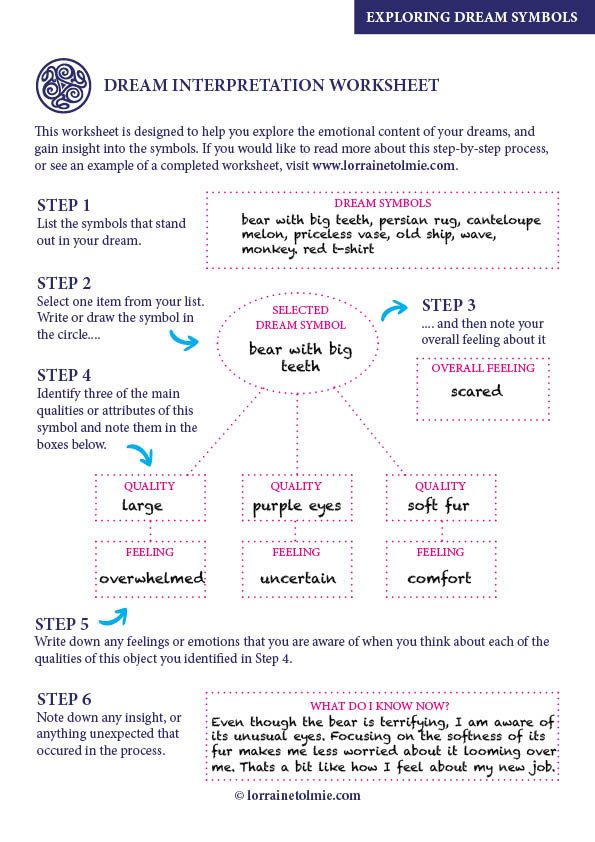
Step 3: Analyze the Dream's Inner Dynamics & Structure
Dreams often have a narrative structure, like a play in three acts:
- Exposition: The beginning sets the scene and introduces the main characters. This often represents your current psychological situation or the problem the dream is addressing.
- Development/Crisis: The middle part is where the action happens. Tensions build, and a conflict or problem unfolds. This shows the dynamics of the issue.
- Lysis/Resolution: The end of the dream shows the outcome. It might be a solution, a catastrophe, or an open question. This is the unconscious mind's "suggestion" for where things are heading or how the problem might be resolved.
Look at your dream's plot. Where is the tension? How does it resolve, or fail to resolve? This structure reveals the psychological process the dream is illustrating.
Step 4: Connect Symbols to Your Inner World (Subjective Level)
While a dream can sometimes comment on external events (the objective level), its primary focus is usually your inner landscape (the subjective level).
Treat every element of the dream as a part of yourself.
- If you dream of an angry friend, ask: "What part of me is angry?"
- If you dream of a crumbling house, ask: "What structure in my life or personality is falling apart?"
- If a hero appears to fight a monster, see them as two parts of yourself in conflict: the heroic part of you wrestling with a monstrous or chaotic part.
This shift in perspective is what turns a strange story into a profound insight about your own psyche.
Test your understanding!
You dream that your boss gives you a complicated, broken machine and tells you to fix it, but you have no tools. Applying the 'subjective level' of interpretation, what might this dream be saying about you, rather than your actual boss or job?
Show answer
On a subjective level, the 'boss' could represent the demanding, authoritative part of yourself—perhaps your inner critic or ambition. The 'broken machine' could symbolize a problem in your own life or personality that feels overwhelmingly complex. The lack of 'tools' could represent a feeling that you lack the skills, resources, or emotional capacity to deal with this internal problem that you are demanding yourself to fix. The dream is showing an inner dynamic: one part of you is putting immense pressure on another part to solve something without the necessary support.
Step 5: Formulate an Interpretation
Now, synthesize everything: the context, the personal associations, the narrative structure, and the subjective viewpoint. Ask yourself the single most important question:
What is this dream trying to tell me that I don't already know?
A good interpretation will often have an "aha!" moment, a feeling of resonance. According to the dreamsanctuary.net guide, it usually has two qualities:
- It teaches you something new or shows you a perspective you hadn't considered.
- It has a humbling effect on the ego. It rarely says, "You're great, keep it up." More often, it points out a blind spot or a needed change.
Remember, you are the final authority on your dream's meaning. If an interpretation doesn't feel right to you, it probably isn't, no matter how clever it sounds.
Step 6: Make the Insight Concrete
A dream's wisdom is useless if it stays abstract. The final step is to ground the insight in your waking life. This doesn't have to be a drastic life change. It can be:
- An Incremental Change: If the dream suggests you are neglecting your creativity, try spending 15 minutes a day on a creative hobby.
- A Decisive Action: If the dream makes it clear that a relationship is unhealthy, the action might be to have an honest conversation.
- A Symbolic Ritual: If the dream has a powerful, deep feel, you might create a small ritual to honor its message. For instance, if you dream of burying an old identity, you might write down the qualities of that identity on a piece of paper and bury it in your garden.
This final step builds a bridge between your conscious ego and your unconscious mind, creating a collaborative relationship.
3. Putting it all Together: An Example
Let's see how this works in practice. The following example is from the dreamsanctuary.net article.
A Template For Dream Analysis With Examples
This section provides a powerful, real-life example of the six-step method in action. Pay attention to how the dreamer connects the terrifying dream image to their physical and emotional state in waking life.
Please read the first example, 'Dream 1 – The Sick and Dying Horse.' Notice how each of the six steps we've discussed is applied to move from the dream narrative to a life-changing decision.
As you can see, the process led the dreamer from a disturbing image of a dying horse to a critical insight about their health.
- Dream/Context: The dream of the horse vomiting occurred while the dreamer was in a stressful coding bootcamp and experiencing health issues.
- Symbols/Associations: The dreamer associated "horse" with "the thing that carries me from A to B." Vomiting was associated with collapse.
- Dynamics: The dynamic is one of collapse. The thing that is supposed to carry the dreamer forward is deathly sick.
- Subjective Level: The horse isn't a literal horse; it's the dreamer's own energy, their body, their vitality. It's the "vehicle" carrying them through life.
- Interpretation: The dream was a terrifyingly clear message that the dreamer's "vehicle" (their body and energy) was on the verge of complete collapse due to the bootcamp.
- Action: The dreamer heeded the warning, quit the bootcamp, and was diagnosed with burnout a week later. The dream provided a critical, life-saving insight that their conscious mind was trying to ignore.
Conclusion
You now have a powerful, structured method for engaging with your inner world. This is not about finding "the" single correct meaning of a dream, but about using the dream as a starting point for self-reflection and personal discovery.
Key Takeaways:
- Dream interpretation is a skill that combines a structured method with personal intuition.
- The six-step process provides a reliable framework: Record & Contextualize -> Associate with Symbols -> Analyze Structure -> Interpret Subjectively -> Synthesize Meaning -> Integrate with Action.
- The most important associations are your own. The meaning of a symbol comes from your life, memories, and feelings.
- Treating dream elements as parts of yourself (the subjective level) is key to unlocking personal insights.
- The goal is to discover what the dream is telling you that you don't consciously know, and then to honor that insight with a concrete action.
Preview of the Next Lesson:
This lesson concludes our module on understanding and interpreting dreams. You've learned to listen to the messages from your unconscious. In our next module, we will take a significant step further. We'll explore Lucid Dreaming, the fascinating state of becoming consciously aware while you are dreaming. This will be our first major step in bridging the worlds of modern sleep science and the contemplative practices you are interested in, moving from passive interpretation to active participation within the dream state itself.