
Hello! Welcome to our fourth lesson on the science of dreaming.
In our previous lesson, we made a critical distinction between the literal and symbolic language of dreams. We saw how psychoanalysts like Freud and Jung moved dream interpretation away from fixed "dream dictionaries" and toward a deeply personal and psychological exploration. You learned that a dream's bizarre narrative is not a disguise, but rather the psyche's native, symbolic language for expressing an inner truth.
Today, we will build directly on that foundation. We're going to explore the powerful emotional landscape of our dreams. The learning outcome for this lesson is to explain how emotions in dreams relate to waking emotional processing. We'll move from the 'what' (dreams are symbolic) to the 'how' and 'why' of their emotional content. We will delve into the neuroscience to understand the fascinating process that many researchers call "overnight therapy," and see how the feelings we experience in dreams have a direct and measurable impact on our emotional stability when we are awake.
1. The Emotional Brain Unleashed
One of the most striking features of dreams is their intense emotionality. We can feel profound joy, terror, or grief that feels just as real as any waking emotion. At the same time, the events causing these feelings are often bizarre and illogical. Why is this?
The answer lies in how your brain operates during REM sleep, the stage where most vivid dreaming occurs. To begin, let's watch a short explanation of this unique brain state.
How To Transform Your Mental Health: The Hidden Power of Dreams
Dr. Tracey Marks, a psychiatrist, provides a clear overview of what happens in the brain during REM sleep. This will help you understand why dreams are so emotional yet so illogical.
Please watch from 00:43 to 01:52. Pay close attention to which two parts of the brain have their activity levels changed and what their functions are.
As Dr. Marks explained, during REM sleep:
- The limbic system, which includes our core emotional centers like the amygdala, becomes highly active—even more so than when we're awake. This is the source of the intense emotions in dreams.
- The prefrontal cortex, responsible for rational thought, logic, and impulse control, becomes less active. This is why dream narratives can be disjointed, strange, and free from the rules of waking reality.
Essentially, your brain creates a space where emotion is amplified and logic is dialed down. This isn't a malfunction; it's a feature. This unique state allows the brain to do some of its most important emotional work.
2. Dreaming as "Overnight Therapy"
Scientists now believe that this unique brain state allows dreaming to function as a form of emotional regulation. It's a way for the brain to process the difficult, painful, or emotionally charged events of the day in a safe environment.
Let's hear from sleep scientist Dr. Matt Walker, who describes this process as a kind of "emotional first aid."
Why we dream during sleep | Matt Walker and Lex Fridman
In this clip, Dr. Matt Walker uses a powerful analogy to explain the therapeutic function of dreaming. He distinguishes between time healing wounds and a specific process that happens during dream sleep.
Watch from 02:20 to 03:20. Focus on his concept of the 'nocturnal soothing balm' and what it does to difficult experiences.
Dreaming, in this view, is how we "take the sharp edges off" painful memories. But it goes deeper than that. Research suggests that it is not just the act of dreaming, but the content of the dreams that matters. In one study of individuals going through a painful divorce, those who dreamt about the difficult experience itself showed greater resolution of their depression a year later compared to those who did not.
This suggests that dreams are not for escaping our problems, but for confronting and processing them. This is why Dr. Marks refers to it as your brain's "internal therapy session."
How To Transform Your Mental Health: The Hidden Power of Dreams
Let's return to Dr. Marks' video, where she expands on the idea of the 'internal therapy session' and explains how nightmares and recurring dreams fit into this picture.
Watch from 01:52 to 03:00. Note her explanation of recurring dreams and nightmares as the brain's attempt to flag unresolved issues or process threats.
3. The Core Mechanism: Sleep to Forget, Sleep to Remember
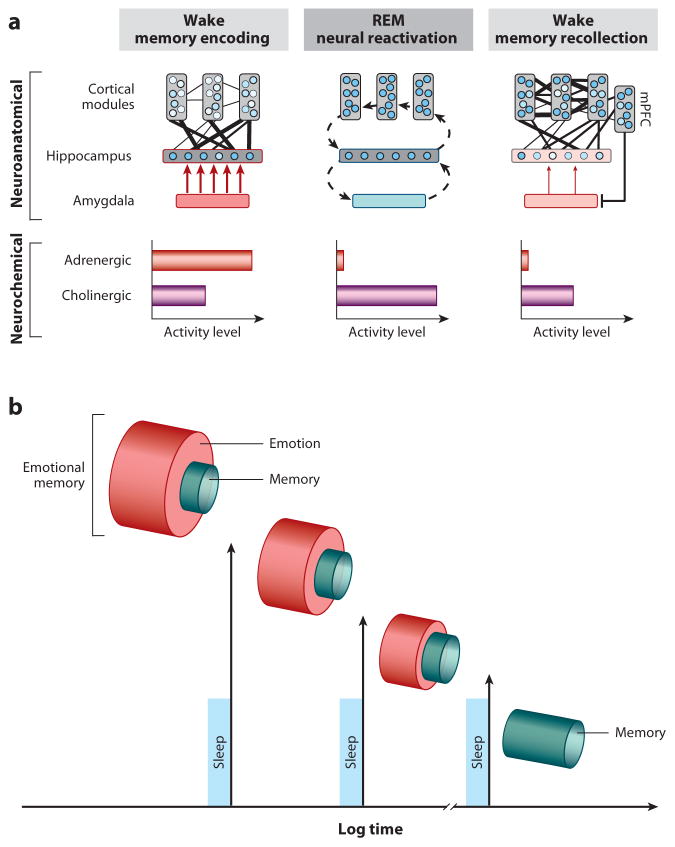
So, how does the brain accomplish this "overnight therapy"? How can it revisit a painful memory without simply re-traumatizing us? The answer lies in a specific neurochemical change that happens only during REM sleep. This has led to a powerful theory known as the "Sleep to Forget, Sleep to Remember" (SFSR) hypothesis.
The core idea is that REM sleep allows the brain to:
- Remember the useful information and lessons from an experience.
- Forget the painful, visceral emotional charge attached to that experience.
To understand this mechanism, we'll first hear Dr. Walker explain the crucial role of a neurotransmitter called noradrenaline (also known as norepinephrine).
Why we dream during sleep | Matt Walker and Lex Fridman
This clip from Dr. Matt Walker is key to understanding the SFSR hypothesis. He explains the unique chemical environment in the brain during REM sleep that makes emotional processing possible.
Watch from 11:09 to 12:40. Focus on his description of noradrenaline and what happens to the brain when it is completely shut off during REM sleep.
This is the critical piece of the puzzle. Noradrenaline is the brain's equivalent of adrenaline—it's linked to stress, anxiety, and our "fight-or-flight" response. REM sleep is the only time during the 24-hour day when the brain is completely devoid of this chemical.
This creates a perfect therapeutic environment. The brain can reactivate emotional memories (via the active limbic system) but without the stressful chemical reaction. It allows you to process the memory without the pain.
The following text delves into the specifics of this hypothesis. It is from a foundational scientific paper on the topic co-authored by Dr. Walker.
Overnight Therapy? The Role of Sleep in Emotional Brain ...
This selection from the paper 'Overnight Therapy?' formally introduces the 'Sleep to Forget, Sleep to Remember' (SFSR) hypothesis. It explains how sleep works to decouple the emotional tone from a memory.
Please read the two subsections under the heading 'Emotional-memory processing: A sleep to forget and sleep to remember (SFSR) hypothesis'. Don't worry about understanding every technical detail. Focus on the main idea: how over time, the emotional 'blanket' is removed from a memory while the information itself remains.
To visualize this process, look at the following diagram from the same paper.
Test your understanding!
Based on what you've just learned, why is the absence of noradrenaline during REM sleep so crucial for processing emotional memories?
Show answer
The absence of noradrenaline is crucial because it allows the brain to re-experience or "replay" an emotional memory without triggering the associated stress, anxiety, and "fight-or-flight" response that noradrenaline causes. It creates a neurochemically "safe" environment to process the memory, effectively stripping away its painful emotional charge while retaining the informational content of the memory itself.
4. Waking Up: The Result of Emotional Processing
The final step is to connect this nightly process to our waking lives. What happens if this "overnight therapy" is disrupted?
When we are sleep-deprived, we miss out on this crucial REM sleep function. The emotional charge from our daily experiences is not properly processed and stripped away. The result is a direct impact on our mood and emotional regulation the next day.
The scientific paper we referenced earlier provides a clear explanation based on fMRI studies.
Overnight Therapy? The Role of Sleep in Emotional Brain ...
This final reading selection explains what happens to our emotional brain when we don't get enough sleep. It provides the direct link between sleep-based emotional processing and our waking emotional stability.
Please read the subsection titled 'Sleep loss, mood stability and emotional brain (re)activity'. Focus on the results of the fMRI study by Yoo and colleagues, specifically what happened to the amygdala's reactivity in sleep-deprived individuals.
As the study shows, without sleep, the amygdala becomes hyper-reactive—over 60% more responsive to negative stimuli. At the same time, the connection to the rational prefrontal cortex is weakened. This is the neurological basis for why we feel more irritable, emotionally volatile, and irrational after a poor night's sleep.
Your brain didn't get the chance to "reset" its emotional sensitivity. It's like turning the volume knob on your emotions all the way up, while simultaneously breaking the dial that helps you control that volume.
Conclusion
Today we have uncovered the profound connection between the emotions in our dreams and our emotional well-being in waking life. Far from being random noise, the emotional narratives of our dreams are a vital part of our mental health toolkit.
Key Takeaways:
- Dreaming acts as a form of "overnight therapy," helping us process emotionally charged experiences.
- This is possible because during REM sleep, the brain's emotional centers are highly active while the stress chemical noradrenaline is completely absent.
- This unique state allows the "Sleep to Forget, Sleep to Remember" process: the brain strips away the painful emotional charge from a memory while consolidating the useful information.
- This nightly processing is essential for our waking emotional regulation. Without it, our emotional brain becomes hyper-reactive and unstable.
Preview of the Next Lesson:
We have now explored how to journal dreams, identify themes, understand their symbolic language, and finally, appreciate their role in emotional processing. You have all the foundational pieces. In our next lesson, we will put it all together and apply a structured method for extracting personal insights from a recorded dream. We will walk through a step-by-step process you can use with your own dream journal to translate a dream's narrative into actionable wisdom.