
Good to see you again. In the previous lesson, you translated word descriptions into balanced equations and saw that coefficients represent fixed particle and mole ratios. This lesson focuses on the numerical language that sits underneath those equations: the mole.
By the end, you should be able to move confidently between a measurable mass in grams, an amount in moles, a relative formula mass, and a number of atoms, molecules, ions, or formula units. These are routine but high-mark calculations, so the emphasis is on a method that remains reliable under exam pressure.
The mole: the bridge between grams and particles
Chemists cannot count individual atoms or molecules directly, but they can measure a substance’s mass. The mole connects these two scales.
One mole of any substance contains Avogadro’s constant:
So:
- mol of magnesium contains magnesium atoms.
- mol of water contains water molecules.
- mol of sodium chloride contains sodium chloride formula units.
- mol of chloride ions contains chloride ions.
The number is huge because particles are extremely small. The essential idea is simple: a mole is a counting unit, just as a dozen means 12 items — but a mole means items.
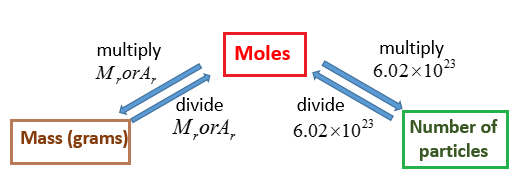
The diagram gives the overall route, but do not learn it as disconnected arrows. Instead, treat moles as the central checkpoint:
If a question begins with mass and asks for particles, it must pass through moles. If it begins with particles and asks for mass, it must also pass through moles.
Mass, molar mass, and amount in moles
The relationship between mass and amount of substance is:
where:
- is amount in moles, in ;
- is mass, in ;
- is molar mass, in .
You may also see this written as:
at A-level. Strictly, is relative formula mass and has no unit, whereas molar mass has units of . Numerically, however, they have the same value:
For an element, calculate from its . For a compound, add the relative atomic masses of every atom shown in its formula.
Calculating relative formula mass accurately
For magnesium nitrate:
The brackets matter. There are two nitrate ions, meaning two nitrogen atoms and six oxygen atoms. This is one point where the formula-writing skills from the previous lesson directly protect calculation marks.
Worked example: mass to moles
Calculate the amount in of water.
First calculate :
Then use the mole equation:
The full answer is:
Worked example: moles to mass
Calculate the mass of of calcium carbonate, .
First find the molar mass:
Rearrange the equation:
To three significant figures:
A useful sense check: if you have less than one mole, your mass should be less than the molar mass. Here, mol is one quarter of a mole, so a mass near one quarter of is sensible.
Units: an easy mark to protect
The mole equation expects mass in grams. Convert before substituting values.
Therefore:
Do the unit conversion as a separate first line in your answer. It makes your method clear to the examiner and avoids a factor-of-1000 error.
Worked example: milligrams to moles
Calculate the amount in of magnesium hydroxide, .
Convert the mass first:
Calculate the molar mass:
Now calculate moles:
Avogadro’s constant: moles to particles
The equation connecting amount and particle number is:
where:
- is the number of particles;
- is the amount in moles;
- is Avogadro’s constant, .
To go in the opposite direction:
Watch this section of Mole Conversions Tutorial by Crash Chemistry Academy. It reinforces the central idea that conversion factors should be arranged so unwanted units cancel, then combines mass–mole and mole–particle calculations.
Mole Conversions Tutorial: how to convert mole - mass, mole - particle, mass - particle problems
In Mole Conversions Tutorial, Crash Chemistry Academy models the exact conversion routes used in A-level calculations. Watch for the unit logic: it is a reliable way to decide whether to multiply or divide rather than relying on memory alone.
Watch mass and moles for molar mass and the two directions between grams and moles. Then watch moles and particles for Avogadro’s constant, followed by two step conversions for mass-to-particle and particle-to-mass questions. Finish with the conversion map; compare it with the conversion map above.
Worked example: moles to molecules
Calculate the number of water molecules in of water.
To three significant figures:
The wording matters. The calculation has found the number of water molecules, not the total number of atoms.
Identify the particle before calculating
Many questions are designed to check whether you distinguish between molecules, atoms, ions, and formula units. Avogadro’s constant gives the number of particles specified by the question — but you may need an additional multiplication based on the chemical formula.
For water:
Every molecule contains:
- hydrogen atoms;
- oxygen atom;
- atoms in total.
If mol of water contains:
then it contains:
and:
These are different answers to different questions.
Particle-language checklist
| If the question asks for… | First calculate… | Then… |
|---|---|---|
| molecules of | number of molecules | stop |
| oxygen atoms in | number of molecules | multiply by |
| total atoms in | number of molecules | multiply by |
| formula units of | number of formula units | stop |
| chloride ions in | number of formula units | multiply by |
For ionic compounds, use formula units, not molecules. Sodium chloride is an extended ionic lattice, not a collection of individual NaCl molecules. In most calculation questions, the numerical method is identical; the correct scientific label earns and protects marks.
Two-step calculations: mass to particles
When mass is given but the question asks for particles, use two equations in sequence:
Worked example: number of molecules from mass
Calculate the number of carbon dioxide molecules in of carbon dioxide.
First find :
Calculate moles:
Convert moles to molecules:
Write the calculation in stages, even if you could combine it on a calculator. In a multi-mark question, the intermediate mole value is a clear method mark and makes errors much easier to spot.
Worked example: total atoms from mass
Calculate the total number of atoms in of water.
First calculate moles of water:
Find the number of water molecules:
Each water molecule contains three atoms, so:
The final multiplication by 3 is the step commonly omitted in exams. Before calculating, underline the exact particle named in the question.
The reverse route: particles to mass
For a particles-to-mass question, reverse the pathway:
Worked example: number of molecules to mass
Calculate the mass of carbon dioxide molecules.
First convert molecules to moles:
Then convert moles to mass. Since :
Notice the powers of ten:
Your answer must be less than one mole because the given number of molecules is less than Avogadro’s constant. That provides a quick plausibility check.
A dependable exam routine
For every mole-conversion calculation, follow this sequence:
-
Write what you have and what you need.
For example: “ to molecules.” -
Identify the route.
- mass to moles: use ;
- moles to mass: use ;
- moles to particles: use ;
- particles to moles: use .
-
Convert mass units to grams first, if necessary.
-
Calculate explicitly when it is not given.
-
Use moles as the middle step for mass-to-particles or particles-to-mass questions.
-
Check the particle wording.
Does the question want molecules, formula units, a particular atom, a particular ion, or total atoms? -
Round only at the end.
Keep extra calculator digits during intermediate steps, then give your final answer to an appropriate number of significant figures.
A compact answer layout might look like this:
This is concise, logical, and easy for a marker to award full credit.
Errors to eliminate from now on
| Error | Why it is wrong | Fix |
|---|---|---|
| Using mass in mg directly | The mole equation uses grams | Convert units before substitution |
| Forgetting brackets in | This gives the wrong number of atoms | Count atoms from the full formula, including brackets |
| Multiplying by when finding moles | This creates an impossibly large answer | Particles to moles means divide by |
| Giving “atoms” when you calculated molecules | The particle type is scientifically incorrect | Copy the particle label from the question |
| Forgetting the formula multiplier | Molecules and atoms are not the same count | Inspect subscripts before your final answer |
| Rounding too early | It can change a final multi-step answer | Keep calculator values until the final line |
For your calculation-error log, use four headings this time: formula mass, unit conversion, route, and particle count. When you check marked work, record which category caused any lost mark rather than simply copying the correct answer.
Key takeaways
The mole is the central link between measurable mass and invisible particles.
Remember:
- calculate carefully from the full formula;
- use grams in mass–mole calculations;
- use ;
- go through moles for every mass-to-particle or particle-to-mass problem;
- state whether your answer is atoms, molecules, ions, or formula units.
Next, you will use the same mole method to determine empirical formulae from composition data and then derive molecular formulae from molar mass.
Can't find a good explanation? Sign up and we'll make it for you
Sign up