
Hello, and welcome to the first Chemistry lesson in your Year 12 consolidation sprint. This module builds the language of quantitative chemistry: before you can calculate moles or reacting masses, you must be able to translate a reaction described in words into a chemically correct, balanced equation.
By the end of this lesson, you should be able to turn a written reaction into a symbol equation with correct formulae, state symbols, and the smallest whole-number coefficients. This is a high-return skill: it appears in equation questions directly, but it also underpins later mole, titration, energetics, and organic-chemistry calculations.
What a complete chemical equation communicates
A chemical equation is not merely a list of substances. It tells the examiner:
- What reacts — the reactants, on the left.
- What forms — the products, on the right.
- The physical state of every substance.
- The reacting ratio of particles or moles, shown by coefficients.
The central rule is conservation of atoms: a chemical reaction rearranges atoms, but does not create or destroy them.
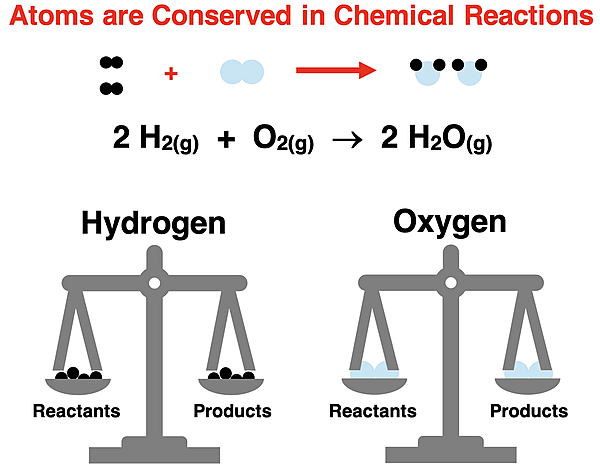
For example:
There are four H atoms and two O atoms on each side. The coefficients also give the mole ratio:
This ratio will become essential when you begin mole calculations in the next lessons.
A useful distinction:
- A subscript is part of a formula and fixes the identity of a substance. In , the 2 means each water molecule contains two hydrogen atoms.
- A coefficient multiplies the entire formula. In , there are six H atoms and three O atoms in total.
Never alter subscripts simply to balance an equation. Changing to , for instance, changes water into hydrogen peroxide: it is a different substance.
How To Write Chemical Equations From Word Descriptions
Watch “How To Write Chemical Equations From Word Descriptions” by The Organic Chemistry Tutor for a clear first model of converting words into formulae, adding state symbols, and balancing.
Watch the first example, which models phosphorus reacting with fluorine and introduces diatomic elements. Then watch the ionic example, focusing on why calcium nitride is \mathrm{Ca_3N_2} and how atom counts lead to the final coefficients. Pause before the balancing stages and attempt the next coefficient yourself.
Step 1: Translate names into correct formulae
Before balancing anything, write a skeleton equation: correct chemical formulae, correct state symbols, but not necessarily balanced coefficients.
This is where many lost marks originate. Balancing cannot rescue an incorrect formula.
Elemental substances: remember the diatomic elements
When these elements appear on their own, they exist as molecules containing two atoms:
So chlorine gas is , not , and hydrogen gas is , not .
A small but important qualification: not every element is diatomic. Metals such as magnesium and zinc are written as and . Carbon is . Use the diatomic list specifically for the seven elements above.
Ionic compounds: balance charges, not atoms
For a compound made from a metal and a non-metal, work out the ions first. The overall compound must be electrically neutral.
For magnesium chloride:
Two chloride ions are needed to balance one magnesium ion:
For aluminium oxide:
The lowest common total charge is six, so use two aluminium ions and three oxide ions:
For rapid recall, make sure these familiar ions are secure:
| Ion or group | Formula / charge |
|---|---|
| Group 1 metal ion | |
| Group 2 metal ion | |
| aluminium ion | |
| zinc ion | |
| silver ion | |
| hydroxide | |
| nitrate | |
| carbonate | |
| sulfate | |
| ammonium |
Roman numerals in a name specify the metal ion charge:
- iron(II) means
- iron(III) means
- copper(II) means
For example, iron(III) chloride is:
Brackets around polyatomic ions
Use brackets only when you need more than one polyatomic ion.
The 2 applies to the whole nitrate ion. Without brackets, would incorrectly suggest one N atom and six O atoms in one unit.
In contrast, potassium sulfate is:
There is only one sulfate ion, so brackets are unnecessary and should not be used.
How to write formulae for simple ionic compounds
Read Chemguide’s explanation of ionic formulae to consolidate the charge-balancing method that you will use before balancing equations.
Under “How writing formulae for ionic compounds works,” read the neutrality principle. Then, in “How do you know how many charges an ion has?”, read the part beginning with Roman numerals. Under “Awkward complex negative ions,” learn the listed polyatomic ions. Finally, in “Some worked examples,” study magnesium nitrate and the bracket rule.
Covalent substances: formulae come from known names
When a compound contains only non-metals, its formula usually comes from its name rather than charge balancing. Common examples to know include:
Prefixes can help:
- monoxide means one oxygen
- dioxide means two oxygens
- trioxide means three oxygens
- pentafluoride means five fluorines
So sulfur trioxide is , while sulfur dioxide is . They are different substances and must not be interchanged.
Step 2: Add state symbols accurately
State symbols are part of a complete equation:
| Symbol | Meaning | Typical use |
|---|---|---|
| solid | metals, insoluble precipitates | |
| liquid | water, liquid elements or reactants | |
| gas | oxygen, hydrogen, carbon dioxide | |
| aqueous | dissolved in water |
The distinction between and matters:
- is liquid water.
- is sodium hydroxide dissolved in water.
- is hydrochloric acid.
- is hydrogen chloride gas.
In an exam, use the description given. If it says “aqueous copper(II) sulfate,” write . If it says a “solid precipitate of copper(II) hydroxide forms,” write .
Do not assume every ionic compound is aqueous. A compound may be a solid, dissolved ion, or precipitate depending on the reaction conditions. Where the state has not been stated, use the knowledge or data provided in the question.
Step 3: Balance using coefficients only
Use this reliable sequence:
- Write all formulae and state symbols.
- Count each type of atom on both sides.
- Balance elements that occur in just one reactant and one product.
- Leave elements such as oxygen until later when they appear in several substances.
- Recount every atom at the end.
- Ensure coefficients are in the smallest whole-number ratio.
For combustion equations, a particularly dependable order is:
Worked example 1: a metal reacting with a halogen
Written description: Solid aluminium reacts with chlorine gas to form solid aluminium chloride.
First translate each substance:
- aluminium:
- chlorine gas:
- aluminium chloride:
The skeleton equation is:
Balance chlorine first. The least common multiple of 2 and 3 is 6, so use and . This gives two aluminium atoms on the right, so put 2 before aluminium:
Final check:
| Element | Reactants | Products |
|---|---|---|
| Al | 2 | 2 |
| Cl | 6 | 6 |
Notice what did not change: remained chlorine gas, and remained aluminium chloride. Only coefficients changed.
Worked example 2: an aqueous precipitation reaction
Written description: Aqueous copper(II) sulfate reacts with aqueous sodium hydroxide to form solid copper(II) hydroxide and aqueous sodium sulfate.
Write the formulae first:
Copper and sulfate are already balanced. There are two sodium ions in , so place 2 before sodium hydroxide:
Now check every atom:
| Element or unchanged group | Reactants | Products |
|---|---|---|
| Cu | 1 | 1 |
| 1 | 1 | |
| Na | 2 | 2 |
| O | 6 | 6 |
| H | 2 | 2 |
Because sulfate remains unchanged on both sides, it is efficient to treat as one group while balancing. This will save time in equations involving nitrate, sulfate, carbonate, or hydroxide ions.
Read The Physics Classroom’s method for turning a skeleton equation into a balanced equation, especially its emphasis on coefficients and final atom counts.
In “The Use of Coefficients to Balance Chemical Equations,” read the coefficient rule. Then read all four steps under “Step-by-Step Method for Writing Balanced Chemical Equations,” from the full method. In Example 5, follow the precipitation example, noting how hydroxide can be handled as a unit.
A compact exam method: words to final equation
When faced with a question, use this layout on paper:
1. Identify substances and states.
Underline the reactants, products, and words such as solid, aqueous, and gas.
2. Write formulae.
Check elemental forms, ionic charges, brackets, and named molecular compounds.
3. Write the skeleton equation.
Do this before attempting coefficients.
4. Balance atom by atom.
Write a quick count beneath the equation if it is not immediately obvious.
5. Check lowest whole numbers and state symbols.
Consider this combustion example.
Written description: Methane gas burns in oxygen gas to produce carbon dioxide gas and liquid water.
Formulae and states first:
Balance C: one carbon is already present on both sides.
Balance H: methane has four H atoms, so place 2 before water.
Now balance O. The products contain four O atoms altogether: two in carbon dioxide and two in the two water molecules. Therefore, use two oxygen molecules:
The oxygen coefficient was left until the end because O appears in more than one product.
Errors to eliminate deliberately
| Common error | Why it loses marks | Better habit |
|---|---|---|
| Writing instead of | Chlorine is diatomic when elemental | Learn the seven diatomic elements as one recall set |
| Writing | The 2 must multiply the whole nitrate ion | Write |
| Changing into | You have changed the substance | Add a coefficient: |
| Missing or using for a solution | Aqueous means dissolved in water, not liquid | Copy state information as you translate the words |
| Leaving coefficients as | They are not in the lowest ratio | Divide all coefficients by 2 to obtain |
| Checking only one element | An equation may still be unbalanced elsewhere | Make a final count of every element |
For the rest of this course, make an equation-error log. Each time you lose a mark, record the exact error under one of three headings: formula, state symbol, or balancing. Reattempt that equation one day later without looking at the correction. This is more useful than merely rereading the answer.
Timed approach for exam questions
For a standard “write a balanced equation” question, aim to spend about 90 seconds to 2 minutes, depending on how unfamiliar the formulae are.
A sensible timing split is:
- 20–30 seconds: identify species, formulae, and states;
- 30–60 seconds: add coefficients;
- 15 seconds: count atoms and scan for omitted state symbols.
If you are stuck, do not begin guessing coefficients. Return to the formulae first. For instance, if you wrote iron(III) oxide as , no amount of balancing can produce the right equation because contains iron(II), not iron(III).
The key principle is therefore:
Correct formulae first; coefficients second; full atom check last.
Key takeaways
A complete balanced symbol equation requires:
- correct reactant and product formulae;
- correct state symbols;
- coefficients that conserve every type of atom;
- the smallest whole-number ratio;
- no alteration of formula subscripts during balancing.
Remember the most exam-relevant habits:
Next, you will build on those coefficients by converting between mass, moles, relative formula mass, and numbers of particles. The balanced equation will then become a numerical map of the reaction rather than just a symbolic description.
Can't find a good explanation? Sign up and we'll make it for you
Sign up