
Hello! Welcome back to our module on Go-to-Market Content Strategy.
In the last lesson, you mastered a crucial skill: using tools like Ahrefs and SEMrush to find high-intent, low-competition keywords. You now know how to identify the exact search terms your most valuable potential customers are using when they are ready to make a decision.
Today, we'll bridge the gap between that keyword list and a tangible content plan. The goal isn't just to rank for keywords, but to create content that persuades and converts. Your learning outcome is to outline a series of content pieces, including 'competitor alternative' comparisons and use-case-focused articles. These are the two most powerful content types for an early-stage SaaS to drive initial sign-ups and revenue.
Part 1: The Strategic "Why": Content for High-Intent Prospects
Before we dive into what to write, let's solidify why this approach works. For a new SaaS, you don't have the time or resources to educate people who don't even know they have a problem. You need to target those who are actively searching for a solution.
This is where the concept of "levels of awareness" comes in. Prospects range from "unaware" they have a problem to "most aware" and ready to buy your specific product. Your fastest path to traction is by focusing on the people in the middle and bottom of this funnel.
This Is the SMARTEST SaaS Marketing Strategy I’ve Ever Seen… 🤯
Startup founder and author Rob Walling gives a brilliant overview of these awareness levels and explains why early-stage SaaS companies should focus their content efforts on 'solution aware' and 'product aware' prospects. This is the strategic foundation for our lesson today.
Watch the video from 01:06 to 06:57. Pay close attention to: The definitions of each awareness level (01:06 - 02:02). The types of content for 'solution aware' people, like 'alternative to' articles (03:04 - 03:43). The content for 'product aware' people, like 'versus' articles (03:43 - 04:46). His final recommendation on where an early-stage SaaS should start (04:46 - 06:57).
As Rob Walling explains, focusing on solution-aware and product-aware content means you're creating assets for people who are already looking to buy. This is the most efficient use of your resources to get your first customers. Let's break down how to outline these two critical content types.
Part 2: Bottom-of-Funnel (BOFU) Content: Competitor Comparison Pages
These pages target "product-aware" prospects who are in the final stages of making a decision. They are actively typing keywords like "[Your SaaS] vs [Competitor]" or "[Competitor] alternative" into Google. Your goal is to own this conversation.
These content pieces are some of the highest-converting assets you can create.
My best SaaS content marketing strategy guide for 2025
The article 'My best SaaS content marketing strategy guide' from MarketerMilk provides a tactical overview of creating these pages, which it calls 'VS pages' and 'alternative' pages.
Read the subsection titled 'VS pages'. Notice the emphasis on their high conversion rate and the practical advice on URL structure (e.g., /vs/competitor).
While the concept is simple, execution is key. A great comparison page is not just a sales pitch; it's an honest, persuasive guide that helps the buyer make an informed decision—while framing your product as the superior choice for them.
The Anatomy of a High-Converting Comparison Page
Let's break down the essential components. Creating these pages is a repeatable formula.
B2B SaaS comparison pages: The complete guide for 2026
For a complete, tactical blueprint, we'll turn to 'B2B SaaS comparison pages: The complete guide' by Backstage SEO. This resource provides an incredibly detailed breakdown of what to include on the page.
Read the section 'The anatomy of a great SaaS comparison page'. This will be your checklist. Focus on understanding each component: SEO Details: The importance of a simple Brand vs Brand title and /vs/you-vs-them URL. Above the Fold: A clear headline that frames the comparison. Feature Comparison Table: A visual way to show where you win. Qualitative Differentiators: The 'why' behind the features. What makes you different beyond a checklist? Social Proof: Testimonials, case studies, and logos. High Contrast CTA: A clear, final call-to-action.
A well-structured comparison table is often the centerpiece of these pages. It allows for a quick, visual understanding of the key differences.
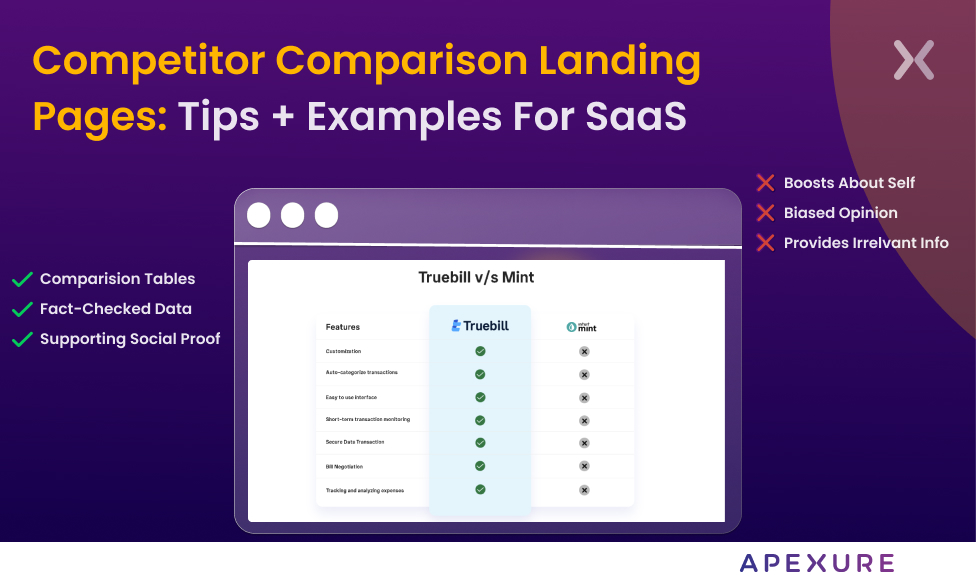
Many founders hesitate to create these pages, fearing they might promote competitors. The Backstage SEO article also addresses these common hesitations. The key takeaway is: the search is already happening. You can either control the narrative or let a third-party blog or your competitor do it for you.
Test your understanding!
Imagine your SaaS is a new, AI-powered project management tool called "TaskFlow." Your main competitor is Asana. Based on the "Anatomy of a great SaaS comparison page," list 5 essential sections you would include in your "TaskFlow vs. Asana" landing page.
Show answer
A strong outline for a "TaskFlow vs. Asana" page would include:
- Above the Fold/Hero Section: A headline like "TaskFlow vs. Asana: A Clear Choice for AI-Driven Project Management."
- Feature Comparison Table: A table comparing key features, highlighting TaskFlow's unique AI capabilities (e.g., AI task generation, AI timeline prediction) where Asana has standard features.
- Qualitative Differentiators: A section titled "Why Teams Choose TaskFlow over Asana," with sub-sections on "Smarter Automation with AI," "Simpler User Interface," and "More Affordable Pricing for Startups."
- Social Proof: Testimonials from early users, especially any who switched from Asana. For example, "TaskFlow's AI saved us 10 hours a week compared to Asana."
- High Contrast CTA: A final section with a dark background and a clear call-to-action like "See the AI Difference. Start Your Free TaskFlow Trial."
Part 3: Middle-of-Funnel (MOFU) Content: Use-Case-Focused Articles
These articles target "solution-aware" prospects. They know they have a problem and are looking for a type of solution, but they might not know your product exists. Your goal is to connect their problem to your solution.
The key is to focus on the problem, not the product.
Copy This $33M SaaS Content Strategy
The 'Copy This $33M SaaS Content Strategy' video from Exposure Ninja perfectly explains this mindset. It's about marketing the solution to problems that keep your audience 'awake at night.'
Watch from 01:43 to 03:39, and then from 07:35 to 11:11. Focus on: The core idea of marketing the solution to the problem, not the product itself (01:43 - 03:39). The concept of 'target audience domination' by creating content for all the things your ICP would search for related to their job (07:35 - 11:11).
There are two primary ways to outline use-case content:
1. Dedicated "Use Case" Pages
These are pages on your website that explicitly state who your product is for and what it helps them achieve. They are a hybrid between a marketing landing page and a blog post.
My best SaaS content marketing strategy guide for 2025
Let's return to the MarketerMilk article, which has an excellent, tactical section on this.
Read the subsection titled 'Use case pages'. Pay close attention to the URL structure examples, such as your-saas.com/for/recruitment-outreach or your-saas.com/client-outreach-tool. This shows how to target specific audiences and their jobs-to-be-done.
For your SaaS idea, you might create pages like:
/for/marketing-teams/for/startup-founders/use-cases/social-media-management
2. Problem-Solving Blog Posts
These articles target the informational keywords you discovered in the last lesson. They answer a question or solve a problem for your ICP, and subtly introduce your SaaS as the ultimate tool for the job.
For example, if your SaaS is an email outreach tool, you could write articles based on these keywords:
- Keyword: "how to write a follow up email" -> Title: "How to Write a Follow-Up Email That Gets a Reply (Templates Included)"
- Keyword: "best time to send cold email" -> Title: "We Analyzed 1 Million Emails: The Best Time to Send a Cold Email is..."
These articles attract your ideal customer by providing value first.
Part 4: Bringing It All Together: Your Content Outline
Now, it's time to translate these concepts into a concrete plan. The output should be a simple document or spreadsheet that outlines the content pieces you will create. This doesn't have to be complex; it's a blueprint to guide your work.
Here is what a structured content plan can look like:

Here's a simple template you can use to start outlining your first few pieces:
Content Piece #1: Competitor Comparison
- Title:
[Your SaaS] vs. [Top Competitor]: Which is Better for [Your ICP]? - Target Keyword:
[your saas] vs [competitor] - Content Type: Competitor Comparison Page (BOFU)
- Core Sections: Hero Section, Feature Table, 3 Key Differentiators, Social Proof, Final CTA.
Content Piece #2: Use-Case Page
- Title:
The Ultimate [Your Product Category] Tool for [Specific Role] - Target Keyword:
[product category] for [specific role] - Content Type: Use-Case Landing Page (MOFU)
- Core Sections: Headline addressing the role's pain point, How it works for them, Features relevant to the role, Testimonial from that role.
Content Piece #3: Problem-Solving Blog Post
- Title:
How to Solve [Specific Problem] in 5 Easy Steps - Target Keyword:
how to solve [specific problem] - Content Type: Blog Post / How-to Guide (MOFU/TOFU)
- Core Sections: Introduction to the problem, Step-by-step solution, How [Your SaaS] automates this process, Conclusion.
Conclusion
You have now moved from abstract keywords to a concrete plan of attack. By outlining these high-impact content pieces, you are building a powerful engine for customer acquisition.
Key Takeaways:
- For rapid growth, focus content on solution-aware and product-aware prospects first.
- Competitor comparison pages (
vsandalternative) target high-intent BOFU searchers and convert very well. Structure them with a clear narrative, feature tables, and social proof. - Use-case-focused articles target MOFU searchers by solving their problems and demonstrating how your product is the best solution.
- A simple outline for each content piece, including the target keyword, title, type, and core sections, is all you need to get started.
Preview of the Next Lesson:
Creating great content is the first step. The second is capturing value from the traffic it generates. In our next lesson, you will learn how to identify a high-value lead magnet idea (e.g., checklist, template) that solves a specific pain point for your ICP. This will be the key to turning your website visitors into email subscribers and future customers.