
Introduction
In our last lesson, we saw how George Berkeley, pushing John Locke's empiricism to its limit, argued for idealism. He concluded that reality consists only of minds and their ideas (esse est percipi), with God as the great cosmic perceiver ensuring the world's stability. While Berkeley dismantled the material world, he kept mind, self, and God as foundational pillars.
We now turn to the third and arguably most formidable of the great British empiricists, David Hume. Hume takes up the empiricist's skeptical tools with unparalleled consistency and rigor. His project was to create a "science of man," applying the experimental method of reasoning to the study of human nature itself. To do this, he first needed a sharp tool to clear away centuries of what he considered metaphysical confusion.
This lesson addresses the learning outcome: Reconstruct Hume's fork: the distinction between relations of ideas and matters of fact. This distinction is the cornerstone of his entire philosophy. Understanding it is the key to unlocking his later, more radical arguments about causality, personal identity, and religion.
1. Hume's Project: A Science of Human Nature
Before we examine Hume's famous "fork," it's helpful to understand why he created it. Hume was frustrated with the state of philosophy, which he saw as full of "endless disputes" and speculative theories not grounded in experience. Inspired by the success of Isaac Newton in the physical sciences, Hume aimed to become the Newton of the moral sciences (the study of human nature). His goal was to discard any system "not founded on fact and observation."
David Hume - Stanford Encyclopedia of Philosophy
To understand Hume's motivation, let's look at a brief overview of his philosophical project from the Stanford Encyclopedia of Philosophy. This will frame the tool we are about to study.
Please read section 3, 'Philosophical Project'. Focus on Hume's desire to apply the 'experimental method' to 'moral subjects' (i.e., human nature) and his critique of traditional metaphysics for being too speculative and not based on observation.
Hume's first step in this project was to map the "province of human reason"—to determine what kinds of things we can genuinely know and what lies beyond our cognitive grasp. This leads directly to his fundamental distinction.
2. The Two Branches of Human Reason
Hume argues that all objects of human thought or inquiry can be divided into two distinct categories. He lays this out with remarkable clarity at the beginning of Section IV of his An Enquiry Concerning Human Understanding.
Section IV - Hume Texts Online
Let's turn to the primary source. Here, Hume himself introduces the two kinds of propositions that form the prongs of his famous 'fork'.
Please read Part I of Section IV. Pay close attention to the names Hume gives the two categories, the examples he provides for each, and the different ways we determine their truth.
As you've just read, Hume divides all knowable propositions into Relations of Ideas and Matters of Fact. Let's break down each of these in more detail.
3. Prong 1: Relations of Ideas
This category includes propositions whose truth can be determined by pure reason, without any need for experience or observation of the world. Think of it as the domain of logic and mathematics.
Key characteristics:
- They are known a priori (prior to, or independent of, experience).
- They are demonstrably certain. Their truth can be proven through logical demonstration.
- Their denial implies a contradiction. It's logically impossible to conceive of them being false.
Examples:
- "The square of the hypotenuse is equal to the square of the two sides." (Geometry)
- "3 x 5 = 15." (Arithmetic)
- "All bachelors are unmarried men." (Definition)
You don't need to survey all the triangles in the world to know the Pythagorean theorem is true. Its truth is contained within the definitions of the concepts themselves. To say "a bachelor is married" is to contradict the very definition of the word.
David Hume, Enquiry Concerning Understanding | Relations of Ideas & Matters of Fact | Core Concepts
Dr. Gregory B. Sadler offers a clear, step-by-step analysis of Hume's distinction. Let's start with his explanation of 'Relations of Ideas'.
Please watch from 03:20 to 07:56. Focus on how he explains that these truths are certain, demonstrable, and 'a priori'—meaning no experience is needed to confirm them.
4. Prong 2: Matters of Fact
This category includes all propositions about the world, about what exists and what happens. These are the things we learn through experience.
Key characteristics:
- They are known a posteriori (after, or dependent on, experience).
- Their truth is never demonstrably certain; it's always contingent.
- Their denial does not imply a contradiction. The contrary of any matter of fact is always conceivable.
Examples:
- "The sun will rise tomorrow."
- "My computer is on my desk."
- "Water boils at 100°C at sea level."
Hume's crucial insight here is that we can always imagine the opposite of any matter of fact without logical contradiction. It is "no less intelligible a proposition" to say "the sun will not rise tomorrow" than to say that it will. While we might have overwhelming evidence to believe it will rise, its falsehood is not a logical impossibility in the way that "2+2=5" is. Its truth or falsity must be confirmed by observation.
David Hume, Enquiry Concerning Understanding | Relations of Ideas & Matters of Fact | Core Concepts
Now, let's continue with Dr. Sadler's video to understand the other side of the distinction: 'Matters of Fact'.
Watch from 07:56 to 12:44. Pay close attention to the key test: the 'contrary of a matter of fact is conceivable'. Understand why this makes our knowledge of them less certain than our knowledge of relations of ideas.
5. Visualizing Hume's Fork
This distinction is so fundamental that it's often called "Hume's Fork." A proposition must fit on one prong or the other. If it fits on neither, Hume would argue it is meaningless nonsense.
The following diagram provides a clear visual summary, connecting Hume's terms to the related concepts of a priori/a posteriori and necessary/contingent.
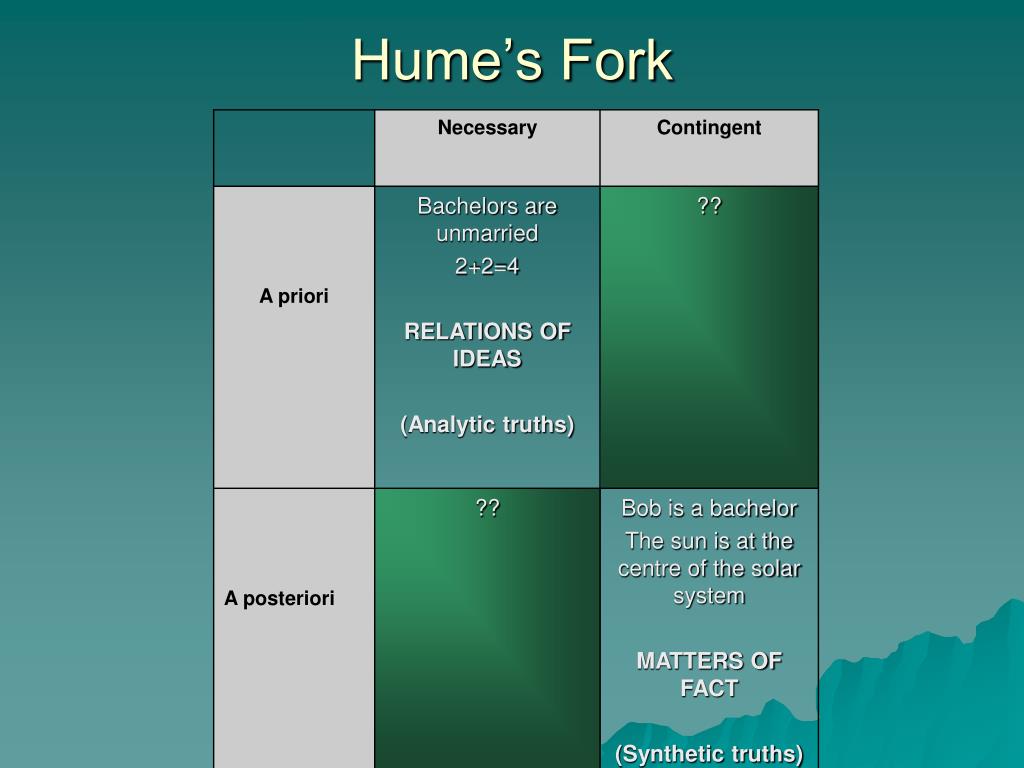
This sharp division of knowledge had profound consequences. When Hume looked at the grand metaphysical claims of his predecessors—about God, the soul, or the ultimate nature of reality—he would apply this test. Are these claims Relations of Ideas? No, their denial isn't a contradiction. Are they Matters of Fact? No, they can't be verified by any sensory experience. Hume's conclusion, therefore, was that such metaphysical claims are not genuine knowledge.
PHILOSOPHY - Epistemology: Hume's Skepticism and Induction, Part 1 [HD]
The team at Wireless Philosophy provides another excellent, concise explanation that reinforces these concepts and explicitly connects them to the a priori/a posteriori distinction, which was later made famous by Immanuel Kant.
Please watch from 01:24 to 04:31. This will serve as a quick and effective summary of everything we've covered so far, using slightly different examples.
6. The Context and Power of the Fork
Hume's distinction was a radical re-imagining of a traditional philosophical division between absolute knowledge (scientia) and mere belief (opinio). Previous philosophers, even empiricists like Locke, believed that reason could, in principle, demonstrate necessary connections in the world, particularly regarding cause and effect.
Hume's Fork challenges this directly. By showing that all our reasoning about the world falls under "Matters of Fact," he confines our knowledge to what we can experience. No amount of pure reasoning can establish a necessary truth about the world.
David Hume - Stanford Encyclopedia of Philosophy
Let's return to the Stanford Encyclopedia of Philosophy article one last time. This section places Hume's Fork directly in its historical context and shows how he used it to set up his attack on traditional ideas about causation.
Please read the first three paragraphs of section 5, 'Causation'. Focus on how Hume translates the old distinction between 'knowledge and belief' into his new categories and uses it to frame his investigation into causal inference.
Conclusion
In this lesson, we have reconstructed Hume's foundational epistemological tool: his distinction between Relations of Ideas and Matters of Fact. This "fork" is the engine that drives his entire philosophical project.
Key Takeaways:
- Hume's Fork: All meaningful propositions can be divided into two mutually exclusive types.
- Relations of Ideas: These are a priori, necessary truths known by reason alone. Their denial is a logical contradiction. They are the domain of logic and math (e.g., "All triangles have three sides").
- Matters of Fact: These are a posteriori, contingent truths known through experience. Their denial is not a contradiction, merely a falsehood. They describe the world (e.g., "It is sunny outside").
- The Function of the Fork: Hume uses this distinction as a philosophical razor. Any statement that is neither a Relation of Ideas nor a Matter of Fact is, for Hume, cognitively meaningless.
Preview of the Next Lesson:
Now that we have Hume's primary tool, we will see him put it to devastating use. In our next lesson, we will focus on his analysis of cause and effect. We believe that fire causes heat or that one billiard ball striking another causes it to move. Hume will ask: is the connection between a cause and its effect a Relation of Ideas or a Matter of Fact? As we will see, his answer to this question leads to one of the most famous and enduring problems in all of philosophy: the problem of induction.
Can't find a good explanation? Sign up and we'll make it for you
Sign up