
Introduction
In our last lesson, we examined John Locke's attempt to bridge the gap between the world as described by science—composed of colorless, odorless particles in motion—and the world of our vibrant sensory experience. His solution was the distinction between primary qualities (like shape and size), which he argued truly exist in objects, and secondary qualities (like color and taste), which are merely powers in objects to produce sensations in us.
Today, we meet the next great empiricist, George Berkeley, who looks at the bridge Locke built and decides to set it ablaze. Berkeley argues that Locke's position is unstable and ultimately leads to skepticism. If all we ever directly experience are our own ideas, on what basis can we confidently say that any of them resemble an external, material world?
This lesson will fulfill our learning outcome: Analyze Berkeley's idealism and his arguments against material substance in 'Three Dialogues'. You will see how Berkeley takes Locke’s own empiricist principles and pushes them to a radical conclusion: there is no such thing as matter. Instead, reality consists only of minds and the ideas they perceive. This doctrine is known as idealism.
1. What is Idealism?
Before diving into Berkeley's arguments, let's clarify his core position. He is responding to materialism, the view that mind-independent material things exist. A material object is something that exists whether or not any mind is perceiving it.
Berkeley's alternative, idealism, is captured in his famous Latin phrase: esse est percipi (aut percipere)—to be is to be perceived (or to perceive). For anything that is not a mind (like a table, a tree, or a color), its existence consists entirely in its being perceived by a mind.
George Berkeley - Stanford Encyclopedia of Philosophy
The Stanford Encyclopedia of Philosophy provides a concise and authoritative definition of Berkeley's project. This brief section will establish the core concepts we'll be working with.
Please read section 2, 'Berkeley’s critique of materialism in the Principles and Dialogues'. Focus on the definition of materialism as the belief in 'mind-independent things' and Berkeley's counter-slogan, 'esse est percipi'.
This idea can seem counter-intuitive at first. To understand how Berkeley defends it, we'll follow the logical progression of his arguments in his masterpiece, Three Dialogues between Hylas and Philonous. The characters' names are symbolic: Hylas (from hyle, the Greek word for matter) defends materialism, while Philonous ("lover of mind") represents Berkeley's own view.
2. The Negative Project: Dismantling the Material World
Berkeley's first task is to demolish the case for matter. He does this not by introducing new evidence, but by showing that the materialist's own position, when closely examined, collapses into contradiction and incoherence. He systematically attacks the perceived qualities of objects, starting with the ones Locke had already conceded were problematic.
Step 1: Secondary Qualities are Mind-Dependent
Philonous begins by getting Hylas to agree that intense heat is indistinguishable from pain, and since pain can only exist in a mind, intense heat must also be in the mind. He then uses a classic relativity argument: imagine plunging a hot hand and a cold hand into a bucket of lukewarm water. The water will feel cold to the hot hand and warm to the cold hand. But the water itself cannot be both hot and cold at the same time. Therefore, heat and cold are not properties of the water itself, but sensations in the mind of the perceiver.
This reasoning is extended to all other secondary qualities.
Three Dialogues between Hylas and Philonous
Here we turn to the primary text. You will read the portion of the First Dialogue where Philonous convinces Hylas that what Locke called 'secondary qualities' cannot exist in an unthinking, external object.
Please read the First Dialogue, starting from the discussion of heat and pain (around page 3, 'Phil: So heat is a sensible thing.') up to Hylas's concession about secondary qualities (page 11, '...have no existence outside the mind.'). As you read, identify the specific arguments Philonous uses against the mind-independent existence of: Heat and cold (the pain argument and the lukewarm water example) Tastes (pleasure/pain and variability among perceivers) Smells Sounds (the distinction between 'scientific' sound as motion and sound as a sensation) Colors (the relativity of perception based on distance, light, microscopes, and animal eyes)
At this point, Hylas has retreated to the Lockean position: secondary qualities like color and taste are mind-dependent, but primary qualities like shape, size, and motion truly exist in material objects.
Step 2: Primary Qualities are Also Mind-Dependent
This is Berkeley's crucial and most original move. He argues that the very same arguments that work against secondary qualities also work against primary ones.
- Relativity: The apparent size of an object changes with distance. To a tiny insect, a dust mite might look like a huge mountain. An object that looks smooth and round to the naked eye might appear rough and angular under a microscope. Since the object cannot have all these different shapes and sizes at once, shape and size must be ideas in the mind, not properties of the object itself.
- Inseparability: This is a powerful argument. Try to conceive of an object's shape without conceiving of its color or some other visual or tactile quality. It's impossible. You can't imagine a shapeless color, and you can't imagine a colorless shape. Berkeley argues that since primary qualities like shape cannot be separated even in thought from secondary qualities like color, and since we've already agreed secondary qualities exist only in the mind, primary qualities must exist only in the mind as well.
Three Dialogues between Hylas and Philonous
Now for the core of Berkeley's attack on Locke. In this section of the dialogue, Philonous demolishes the distinction between primary and secondary qualities.
Continue reading the First Dialogue, from Hylas's retreat to primary qualities (page 11, 'Colours, sounds, tastes...have no existence outside the mind.') to his eventual concession (page 16, 'I freely admit...that all sensible qualities should alike be denied existence outside the mind.'). Focus on: How Philonous applies the relativity argument to extension (size) and motion. The 'inseparability' argument: his claim that you cannot abstract or conceive of primary qualities separate from secondary ones.
Step 3: The Myth of Material "Substratum"
Defeated on the front of qualities, Hylas makes a final stand. He claims there must be an underlying material substratum—a featureless, unknown substance that "supports" or "stands under" the qualities we perceive.
Philonous mercilessly exposes this notion as empty and incoherent. What does it mean for something to "support" qualities? If it means it's spread out underneath them, then the substratum itself must have extension, which means it needs another substratum to support it, leading to an infinite regress. If "support" is just a metaphor, what does it actually mean? Hylas cannot say. The idea of material substance is, quite literally, a word without a meaning.
To cap off his argument, Berkeley introduces his famous "Master Argument." He challenges Hylas (and the reader) to conceive of any sensible object existing unperceived.
This video from Philosophy Vibe provides a clear and concise explanation of two of Berkeley's key arguments against matter: the likeness principle and the master argument.
Please watch from 03:10 to 04:41. Pay attention to the two arguments presented: The Likeness Principle: 'An idea can be like nothing but an idea.' Why does this make it impossible for our ideas to 'resemble' a material world? The Master Argument: Why is it a 'manifest repugnancy' (a clear contradiction) to try to conceive of an unperceived tree?
The master argument is powerful but has also been criticized. Philosophers point out that Berkeley seems to confuse the act of conceiving with the content of what is conceived. While your act of imagining a tree is in your mind, the content of your thought can be "a tree that no one is thinking about." Nonetheless, within the flow of the dialogue, it serves as the final nail in the coffin for matter.
3. The Positive Project: Building an Immaterial World
If matter doesn't exist, what does? And how does the world work? This is Berkeley's positive project. The world consists of two things:
- Minds (or Spirits): Active, perceiving beings. This includes you, me, and God.
- Ideas: Passive, perceived things. These are the sensations, thoughts, and feelings that exist within minds.
Ordinary objects, like an apple, are simply stable collections or "bundles" of ideas (the idea of red, the idea of round, the idea of sweet, etc.).
This immediately raises some urgent questions, which Berkeley is keen to answer.
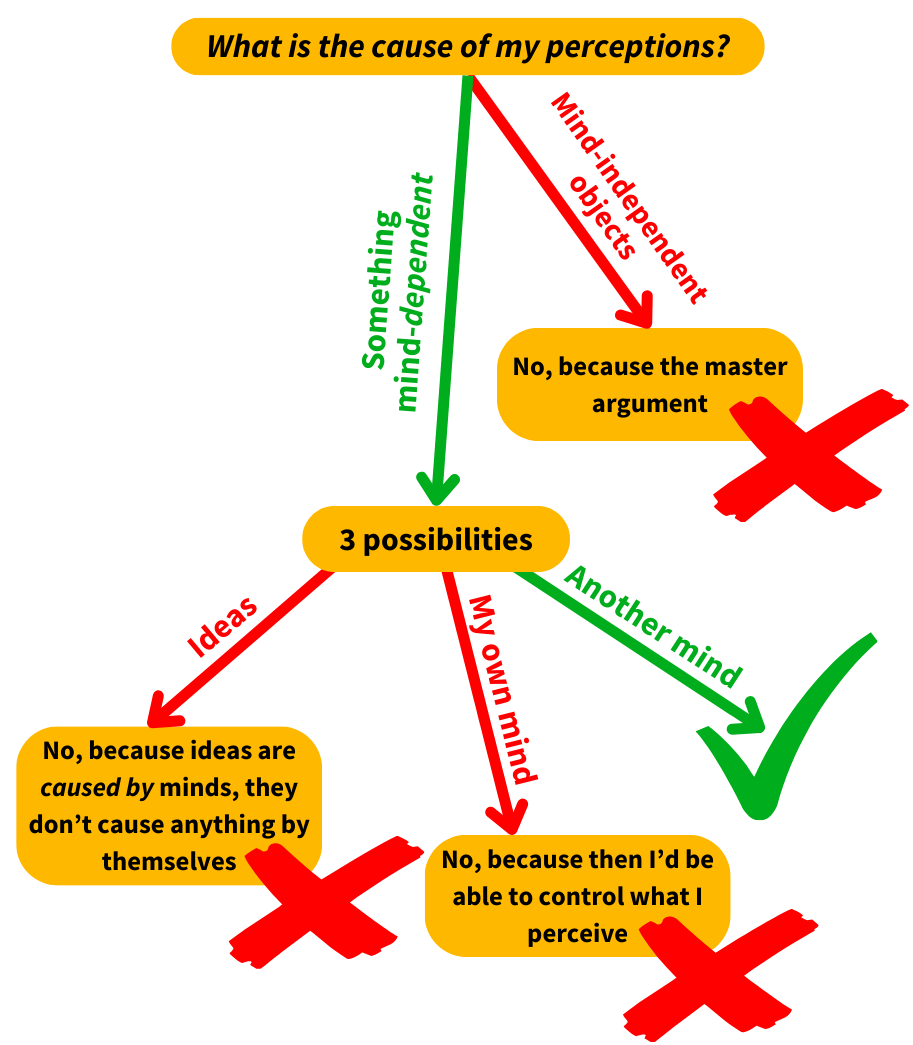
Question 1: What causes my ideas? If there's no material world, why do I see a computer screen in front of me?
Berkeley argues by elimination:
- Ideas can't cause anything. They are passive and inert. The idea of fire can't cause the idea of heat.
- I don't cause my own sensory ideas. I can will myself to imagine a pink elephant, but I cannot will myself to not see the screen in front of me. My sensory experience is involuntary.
- Therefore, my sensory ideas must be caused by another, more powerful Mind. This mind, which produces the vast, complex, and orderly system of ideas we call nature, must be God.
This flowchart visually maps out this line of reasoning.
Question 2: If things only exist when they are perceived, does the tree in the forest disappear when no one is around?
This is the most famous objection. In the Principles, Berkeley suggests that "to exist" might just mean "would be perceived if someone were there." But in the Dialogues, he provides a more robust answer: things continue to exist because they are constantly being perceived by the omnipresent mind of God.
Question 3: How do we distinguish reality from a dream?
Both real things and dream-things are ideas. Berkeley's answer is that the ideas which constitute the real world are more forceful, vivid, and, most importantly, orderly and coherent. They follow predictable patterns, which he calls the "laws of nature." These are the set rules by which God produces ideas in us. Dreams, by contrast, are chaotic and inconsistent.
Let's return to the Philosophy Vibe video, which does an excellent job of explaining how Berkeley uses God to solve the major objections to his system.
Watch from 04:41 to 06:47. Focus on how the introduction of God is used to explain: The regularity of our experience (why your room is the same every time you enter it). The continuity of objects (why a candle continues to melt even when you're not in the room to perceive it).
Conclusion
Today we have traced Berkeley's daring argument for idealism. By taking empiricism—the idea that all knowledge comes from experience—to its logical extreme, he dismantled the material world of his predecessors.
Key Takeaways:
- Idealism: Berkeley's central doctrine is esse est percipi—to be is to be perceived. Reality is composed solely of minds and their ideas.
- The Case Against Matter: Berkeley argues that both primary and secondary qualities are mind-dependent, using arguments from relativity and the inseparability of qualities in our minds. The notion of an unknowable material "substratum" is shown to be meaningless.
- The Role of God: In Berkeley's system, God is not just a creator but the constant perceiver who guarantees the continuity of the world and the direct cause of all our sensory ideas, producing them in an orderly fashion according to the laws of nature.
- Reality vs. Imagination: Real objects are stable, coherent bundles of ideas caused by God, whereas imaginary ones are fleeting, incoherent, and caused by our own will.
Preview of the Next Lesson:
Berkeley demolished Locke's material world but held onto the existence of our own minds and the mind of God to make sense of reality. The final great empiricist, David Hume, will apply the same skeptical toolkit with even more devastating consistency. Hume will ask: What right do we have to believe in causality? What evidence do we have for a continuous "self" or "mind"? And what becomes of Berkeley's God under this intense scrutiny? Be prepared, as Hume pushes empiricism to its absolute breaking point.
Can't find a good explanation? Sign up and we'll make it for you
Sign up