
Good reasoning is not just spotting bad claims. It ends with a disciplined answer: what does the available evidence justify us saying, and what does it not justify?
In the previous lesson, you learned to inspect numbers for their denominator, time frame, comparison, baseline risk, and uncertainty. Now you will turn that inspection into a defensible conclusion. By the end, you should be able to make a clear claim, select relevant evidence, explain the link between them, and name the limits that keep the claim from becoming overconfident.
From information to a justified conclusion
A conclusion is not merely the last sentence of a report. It is an answer to a specific question that has been earned through evidence and reasoning.
Consider this fictional public-service briefing:
In the three months from April to June, 48 bicycle thefts were recorded around Central Station, compared with 29 in the same months last year. Eighteen of the 48 reports occurred between 18:00 and 22:00. Two evenings of patrol observations found poor lighting near the south bicycle racks. No data on the number of bicycles parked at the station were collected.
Several conclusions are possible, but they are not equally justified.
| Statement | Assessment | Why |
|---|---|---|
| “The poor lighting caused the rise in bicycle theft.” | Not justified | Two observations of poor lighting do not establish cause. Footfall, reporting, bicycle use, offending patterns, or other changes may also matter. |
| “Bicycle theft is definitely rising at Central Station.” | Too strong | Recorded theft rose in this comparison, but recorded reports are not identical to all theft, and one period may not show a durable trend. |
| “Recorded bicycle theft was higher in April to June than in the same period last year.” | Justified | This is a direct description of the records supplied. |
| “The evidence supports examining evening prevention measures and collecting better data on bicycle parking and lighting.” | Justified and useful | The rise in recorded thefts, timing pattern, and observation justify further action and inquiry without pretending that the cause is settled. |
The key distinction is between a descriptive conclusion (“the recorded number was higher”) and a causal conclusion (“poor lighting caused it”). Causal claims need stronger evidence because they rule out or reduce plausible alternatives.
A useful rule is:
Make the conclusion no broader, more certain, or more causal than the evidence can carry.
The core structure: Claim, Evidence, Reasoning
A practical framework is CER:
- Claim: your answer to the question.
- Evidence: relevant facts, observations, data, or credible sources.
- Reasoning: the explanation of why that evidence supports this claim.
Watch this short extract from CER (Claim, Evidence, Reasoning) in Biology by Amoeba Sisters. Although it uses a biology example, the structure works for incident analysis, engineering decisions, news claims, and everyday arguments.
CER (Claim, Evidence, Reasoning) in Biology
In “CER (Claim, Evidence, Reasoning) in Biology” from Amoeba Sisters, watch the introduction to the framework and then its worked example. Focus on the difference between merely listing data and explaining why the data support a conclusion.
Watch the CER overview for the three-part structure. Then watch the worked conclusion, paying particular attention to why the reasoning is a necessary separate step from the evidence.
Here is CER applied to the Central Station scenario.
1. Claim
A claim should answer the actual question at the right level of certainty:
“The available evidence indicates that Central Station should be prioritised for further bicycle-theft prevention work, particularly during the evening.”
Notice what this does not claim. It does not say that one cause has been proven, that every theft happens in the evening, or that a particular intervention will definitely work.
2. Evidence
The strongest relevant evidence is specific:
- 48 thefts were recorded in April to June, compared with 29 in the equivalent period last year.
- 18 of the 48 reports occurred between 18:00 and 22:00.
- Two patrol observations noted poor lighting near the south racks.
Evidence should be accurate, relevant, and clearly sourced. It is also important to use the correct label: these are recorded theft reports, not a complete count of every bicycle theft that occurred.
3. Reasoning
Reasoning connects the facts to the claim:
“The higher number of recorded reports suggests an increased demand for attention at this location compared with the same period last year. The concentration of some reports in the evening identifies a time period worth examining. The lighting observations provide a plausible practical concern, but they do not establish that lighting caused theft.”
Without this middle step, someone can throw out a statistic and jump straight to a preferred action. CER makes that jump visible, so it can be tested.
Make the warrant visible
The philosopher Stephen Toulmin developed a more detailed model of argument. It adds tools especially useful when a conclusion must remain careful under uncertainty.
Read Purdue OWL’s “Toulmin Argument” to see how a claim, evidence, and the link between them form an argument—and how qualifiers and rebuttals prevent unjustified certainty.
In the section “What is the Toulmin Method?”, begin with the paragraph starting the Toulmin framework. Read through the dog and research examples, identifying claim, grounds, and warrant. Then continue to the paragraphs beginning “The other three elements” and focus on qualifiers and rebuttals: these are the parts that explicitly state uncertainty and acknowledge a serious alternative view.
In Toulmin’s language:
- Claim is the conclusion you want the evidence to justify.
- Grounds are the evidence.
- Warrant is the principle that makes the evidence relevant to the conclusion.
- Backing supports the warrant.
- Qualifier states the degree of certainty.
- Rebuttal identifies a condition or alternative that could weaken the claim.
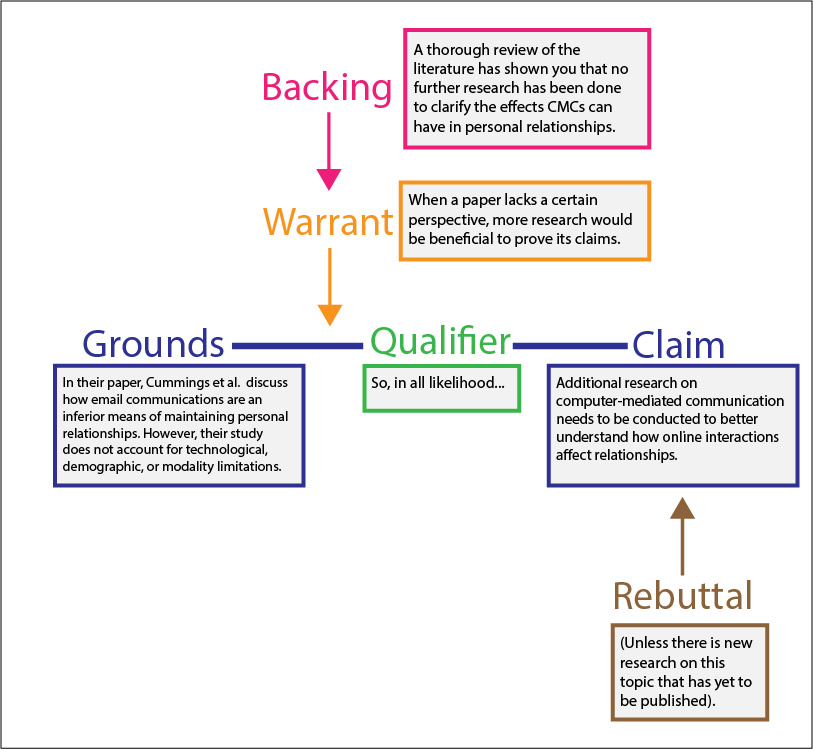
The warrant is often the hidden part of an argument. In the station example, the warrant might be:
“When a location has a higher number of recorded theft reports than the comparable previous period, it is reasonable to examine whether prevention resources should be directed there.”
That is not a law of nature. It is a practical decision principle. Its backing might include professional experience, prior evaluations of prevention work, and the duty to respond proportionately to patterns of reported harm.
The same evidence could support a different claim if the warrant changes. For example, “48 reports compared with 29” may justify allocating an analyst to investigate the location, but it may not by itself justify an expensive redesign of the whole station. The scale of the action should fit both the evidence and the possible consequences.
Qualifiers: calibrating how strongly you speak
A qualifier tells the reader how firmly the evidence supports your conclusion. It does not weaken sound reasoning; it makes the reasoning accurate.
Compare these versions:
| Overstated | Properly qualified |
|---|---|
| “The data prove that lighting causes theft.” | “Poor lighting may be one factor worth investigating.” |
| “This intervention will stop theft.” | “This intervention may reduce opportunity for theft, but its effect should be monitored.” |
| “Residents do not trust the police.” | “Among respondents to this survey, trust was lower than in the previous survey.” |
| “The equipment failed because of user error.” | “The available account is consistent with user error, but the equipment log and physical condition should also be examined.” |
Useful qualifiers include:
- indicates
- suggests
- is consistent with
- is likely to
- may
- appears to
- on the available evidence
- in this sample
- for this period
- provided that
Do not use qualifiers as empty fog. “Maybe, perhaps, sort of” avoids commitment without explaining why. A good qualifier attaches to a real limitation:
“The pattern may be concentrated at Central Station, but this is uncertain because no rate per parked bicycle is available.”
That tells the reader both what is uncertain and why.
Limits are part of the conclusion, not an afterthought
Every body of evidence has a boundary. The aim is not to say “there are limitations” in a vague, ritual way. Name the limitation, explain its likely effect, and state what would reduce the uncertainty.
A helpful format is:
Limit: What is missing or potentially biased?
Consequence: What does that stop us from concluding?
Next evidence: What would help resolve it?
For the station scenario:
| Limit | Consequence for the conclusion | Next evidence that would help |
|---|---|---|
| Data count reports, not all thefts | Cannot infer the exact underlying theft rate | Victimisation data, reporting information, insurance claims where appropriate |
| No number of parked bicycles or station users | Cannot tell whether risk per bicycle has risen | Bicycle-parking counts and footfall data |
| Only one three-month comparison | Cannot establish a long-term trend | Several years of comparable monthly data |
| Poor lighting was observed on only two evenings | Cannot show lighting caused offending | Systematic lighting assessment and comparison with similar locations |
| Other changes may have occurred | Cannot isolate one cause | Information on construction, security changes, local events, and patrol patterns |
These are not “excuses” to do nothing. They help separate two questions:
- Is there enough evidence to justify a proportionate response now?
- Is there enough evidence to claim we know the cause or likely effectiveness of a solution?
The answer can be yes to the first and no to the second. That is often how responsible decisions work under real-world uncertainty.
Rebuttals: take alternatives seriously
A rebuttal is not a random objection. It is a valid alternative explanation, exception, or condition that bears directly on your conclusion.
For the station example, a strong rebuttal might be:
“The higher recorded number may partly reflect easier online reporting introduced this year, rather than a comparable increase in underlying theft.”
This matters because it attacks the inference from “more reports” to “more theft.”
A weak rebuttal would be:
“Maybe people just need to lock their bikes better.”
That may be worth investigating later, but it does not directly explain the rise in recorded reports unless evidence connects it to this place, time, and comparison.
When assessing a rebuttal, ask:
- Does it offer a plausible alternative explanation?
- Does it fit the evidence already available?
- What evidence would distinguish it from the original explanation?
- Does it overturn the conclusion, narrow it, or simply add a condition?
Often, a rebuttal does not destroy a conclusion. It refines it.
For example, after considering the reporting-change rebuttal, you might revise the claim:
“Recorded bicycle-theft reports at Central Station were higher in April to June than in the previous year. This supports reviewing local prevention and reporting data, but it is not yet clear how much of the increase reflects underlying theft rather than changes in reporting.”
That revised conclusion is stronger intellectually because it says exactly what is known and what remains open.
A field-ready conclusion template
When you need to write or speak a conclusion from incomplete information, use this six-part pattern.
-
Answer the question directly.
“The available evidence suggests…” -
State the most relevant evidence.
“This is based on…” -
Explain the link.
“This supports the conclusion because…” -
Set the scope.
“This applies to this location, group, period, or sample…” -
Name the key limitation or alternative.
“However, the evidence cannot establish…” -
State the proportionate next step.
“Further information should be gathered by…”
Here is the full result:
“The available evidence suggests that Central Station should be prioritised for further bicycle-theft prevention work, especially in the evening. This is based on 48 recorded theft reports in April to June, compared with 29 in the same period last year, with 18 reports occurring between 18:00 and 22:00. This supports targeted inquiry because the location and time pattern identify a potentially concentrated problem. However, the figures are recorded reports rather than a theft rate per bicycle parked, and poor lighting was observed only twice, so the evidence does not establish a cause. Parking counts, footfall data, reporting-process information, and a systematic lighting assessment should be gathered before attributing the increase to any single factor or committing to a major intervention.”
This is not hesitant writing. It is a conclusion with a clearly stated evidential boundary.
Avoiding two common failures
Failure 1: Listing evidence without reasoning
“There were 48 thefts. Eighteen were in the evening. Lighting was poor. Therefore, install new lights.”
The conclusion may turn out to be sensible, but the argument skips essential questions: Why do those facts justify that intervention? Is lighting the main problem? What alternatives exist? What evidence shows that new lights are likely to help?
Failure 2: Giving limitations without a conclusion
“We do not know footfall. We do not know how many thefts were unreported. There may have been reporting changes.”
All true, perhaps—but this is only a list of uncertainties. Reasoning still needs to decide what the current evidence supports.
A careful thinker does both: reaches a proportionate conclusion and identifies its limits.
The Writing Center at UNC gives the same advice in the context of scientific reports: strong conclusions use evidence to support a claim, acknowledge anomalous data, and avoid treating a limited study as final proof.
Scientific Reports – The Writing Center
Read the “Discussion” guidance from The Writing Center at UNC to reinforce the professional habit of matching the strength of a conclusion to the strength of the evidence.
In the “Discussion” section, read the subsections “Explain whether the data support your hypothesis,” “Acknowledge any anomalous data, or deviations from what you expected,” and “Derive conclusions, based on your findings, about the process you’re studying.” Focus first on how the page distinguishes support from proof. In the anomalies subsection, read the warning about speculative limitations: a limitation should be specific and connected to a plausible effect on the result. Finish the next subsection with the cautious-language guidance, noting that precise uncertainty is better than a sweeping claim.
Key takeaways
A justified conclusion has four essential features:
- a clear claim that answers a defined question;
- relevant evidence accurately described;
- reasoning that explains why the evidence supports the claim;
- stated limits, including uncertainty, scope, and plausible alternatives.
The Toulmin model extends this structure. Its qualifier calibrates certainty, while its rebuttal makes you confront a serious alternative explanation rather than ignoring it.
Do not confuse careful language with weak thinking. “The evidence suggests” can be much stronger than “this proves,” when the former precisely reflects what the available evidence can actually establish.
This completes the first module’s reasoning toolkit. The next module moves from factual and evidential judgement into ethics: how consequentialist, duty-based, and virtue-based approaches can lead to different answers to the same difficult decision.
Can't find a good explanation? Sign up and we'll make it for you
Sign up