
Welcome to Day 4. In our last session, we delved into the engineering calculations required to translate a 3D sheet metal part into an accurate 2D flat pattern. That was a deep dive into a critical, component-level task. Today, we will zoom out to understand the high-level project management framework that governs how all such design, engineering, and manufacturing activities are planned, executed, and controlled in the automotive industry.
This lesson introduces Advanced Product Quality Planning (APQP). As an engineer, you won't just be designing parts; you'll be executing your work as part of a much larger product launch program. APQP is the playbook for that program. You will learn to describe the five distinct phases of APQP and understand how "phase gates"—formal management reviews—are used to control project progression and connect design activities to physical validation builds.
What is Advanced Product Quality Planning (APQP)?
APQP is a structured methodology created by Ford, GM, and Chrysler in the late 1980s to standardize the product development process for their suppliers. Its fundamental goal is to ensure that a new product satisfies the customer by focusing on proactive planning and risk prevention, rather than reactive problem-solving after launch.
It is considered one of the five "core tools" of automotive quality management, alongside:
- Production Part Approval Process (PPAP)
- Failure Mode and Effects Analysis (FMEA)
- Statistical Process Control (SPC)
- Measurement Systems Analysis (MSA)
APQP orchestrates when and how these other tools are used throughout a project. It ensures that every required step, from defining customer needs to validating production, is completed on time and with the right level of quality.
To get a concise overview of APQP and its purpose, watch the following introductory clip.
Advanced Product Quality Planning (APQP) – Learn 05 phases of APQP (English Version)
This video from Quality HUB India provides a clear definition of what APQP is and its role in systematic product development.
Watch the section from the definition of quality planning. Focus on how APQP is described as a multi-disciplinary, systematic approach that involves suppliers and emphasizes early identification of potential failures.
The Five Phases of APQP
The APQP process is broken down into five sequential phases. The output from one phase serves as the critical input for the next. This ensures a logical and controlled flow of product development.
This next video segment outlines these five phases. As you watch, pay attention to the name and primary goal of each phase, and note how the activities transition from pure planning to design, and finally to physical production and validation.
Advanced Product Quality Planning (APQP) – Learn 05 phases of APQP (English Version)
This segment from the same video details the sequence of the five APQP phases.
Watch the core explanation from the five phases. This section provides a high-level overview of each stage: Plan and Define Program Product Design and Development Verification Process Design and Development Verification Product and Process Validation Feedback, Assessment, and Corrective Action
Let's break down these phases with more detail on their key activities and outputs.
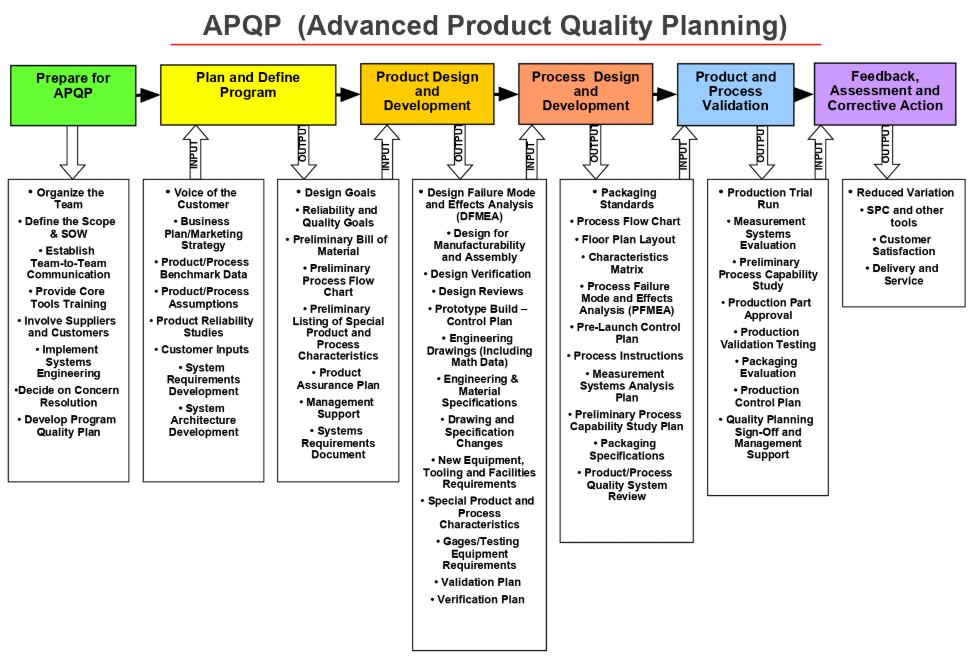
Phase 1: Plan and Define Program
- Goal: To clearly understand customer requirements and translate them into concrete design and quality goals.
- Key Activities: Gathering "Voice of the Customer" (VOC) data, conducting market research, defining product reliability and quality targets, performing initial feasibility assessments.
- Key Outputs: A list of design goals, preliminary Bill of Materials (BOM), a preliminary process flow chart, and a formal Product Assurance Plan.
Phase 2: Product Design and Development
- Goal: To translate the design goals into a final, verifiable product design. This is where the bulk of your core design engineering work happens.
- Key Activities: Creating 3D models and 2D drawings, performing Design FMEA (DFMEA), conducting Design for Manufacturability/Assembly (DFM/DFA) reviews, building and testing prototypes.
- Key Outputs: Finalized engineering drawings and specifications, a completed DFMEA, a Prototype Control Plan, and a commitment from the engineering team that the design is feasible.
(Note: This phase is primarily for "design responsible" organizations. If you are only manufacturing to a customer's print, your involvement might be limited to providing feedback.)
Phase 3: Process Design and Development
- Goal: To design and develop the manufacturing process that will produce the product to specification.
- Key Activities: Creating the final Process Flow Chart, designing the factory floor layout, developing the Process FMEA (PFMEA), creating work instructions, and designing packaging.
- Key Outputs: A detailed floor plan, a completed PFMEA, and a Pre-Launch Control Plan.
Phase 4: Product and Process Validation
- Goal: To validate that the manufacturing process, under normal production conditions, can consistently produce a product that meets all customer requirements.
- Key Activities: Conducting a "significant production run" (e.g., producing 300+ parts), performing Measurement System Analysis (MSA) on gauges, conducting initial process capability studies (Cpk/Ppk), and completing the Production Part Approval Process (PPAP) submission.
- Key Outputs: An approved PPAP, a signed Part Submission Warrant (PSW), and a finalized Production Control Plan.
Phase 5: Feedback, Assessment, and Corrective Action
- Goal: To monitor production, continuously improve, and capture lessons learned after the product has launched.
- Key Activities: Using Statistical Process Control (SPC) to monitor variation, reducing process variation, improving customer satisfaction, and responding to any quality issues with formal problem-solving (e.g., 8D).
- Key Outputs: Reduced variation, improved delivery performance, and documented lessons learned to feed back into Phase 1 of future projects.
Phase Gates: The Management Checkpoints
The transition from one phase to the next is not automatic. It is controlled by a formal process called a Phase Gate Review or Gate Review.
A phase gate is a formal meeting at the end of a phase where the cross-functional team presents the outputs and deliverables of that phase to senior management and, sometimes, the customer. The purpose of the gate is for leadership to make a "go/no-go" decision: has the team successfully completed the objectives of this phase, and is the project ready to move to the next, more expensive phase?
This article and accompanying chart provide an excellent explanation of this "Gated Management" concept.
APQP – Advanced Product Quality Planning: What You Need to Know
This article from AutomotiveQual.com clearly explains the concept of gates as program milestones that require leadership approval.
Read the section titled "Gated Management". Pay close attention to the definition of a gate, the requirement for leadership approval, and the list of the gates (0 through 5).

As you can see from the chart, these gates are formal decision points that directly connect to your design work and the validation builds:
- Design Reviews and Feasibility: Your DFM/DFA and DFMEA reviews in Phase 2 are critical inputs for the Gate 2: Design Feasibility Approval. You must present evidence that the design is manufacturable and that the risks have been analyzed and mitigated.
- Validation Builds and Launch Readiness: The prototype build (Phase 2) provides the first physical parts for testing. More importantly, the significant production run in Phase 4 is the core validation build. The results from this run—dimensional data, material tests, and process capability studies—form the PPAP package. This entire package is reviewed at Gate 4: Launch Readiness Approval. Passing this gate gives you the authority to start mass production and ship parts to the customer.
By enforcing these gates, the organization prevents a project from moving forward with an unfeasible design, an incapable process, or unresolved risks, thereby preventing costly failures down the line.
Conclusion
You now have a foundational map of the automotive product development process. APQP provides the structure, the five phases define the timeline of activities, and the phase gates ensure that quality is built in and verified at every critical step. This framework is what transforms individual engineering tasks into a successful product launch.
Key Takeaways:
- APQP is a 5-phase structured methodology focused on proactive quality planning.
- The five phases are: 1. Plan & Define, 2. Product Design, 3. Process Design, 4. Validation, and 5. Feedback & Corrective Action.
- Phase Gates are formal management reviews at the end of each phase that serve as "go/no-go" decision points for the project.
- Deliverables from your design work (drawings, DFMEA) and from validation builds (PPAP data) are the evidence presented at these gates to get approval to proceed.
In our next lesson, we will build directly on this framework. We will take the engineering tools you are already familiar with—DFM, DFMEA, and GD&T—and map them onto the APQP timeline to see exactly where and when they are required as official project deliverables.
Can't find a good explanation? Sign up and we'll make it for you
Sign up