
In our previous lesson, we established the high-level framework of Advanced Product Quality Planning (APQP), outlining its five phases and the role of gate reviews in managing product development. You now have the "map" of an automotive project.
Today, we will place your specific engineering tasks onto that map. This lesson connects the engineering activities you're familiar with—DFM, DFMEA, and GD&T—to the APQP timeline. You will learn precisely when these deliverables are created, what purpose they serve in each phase, and how they function as formal requirements in the product launch process, not just as isolated engineering exercises.
The APQP Master Timeline
Let's start with a visual overview that integrates the five APQP phases with the key quality tools.
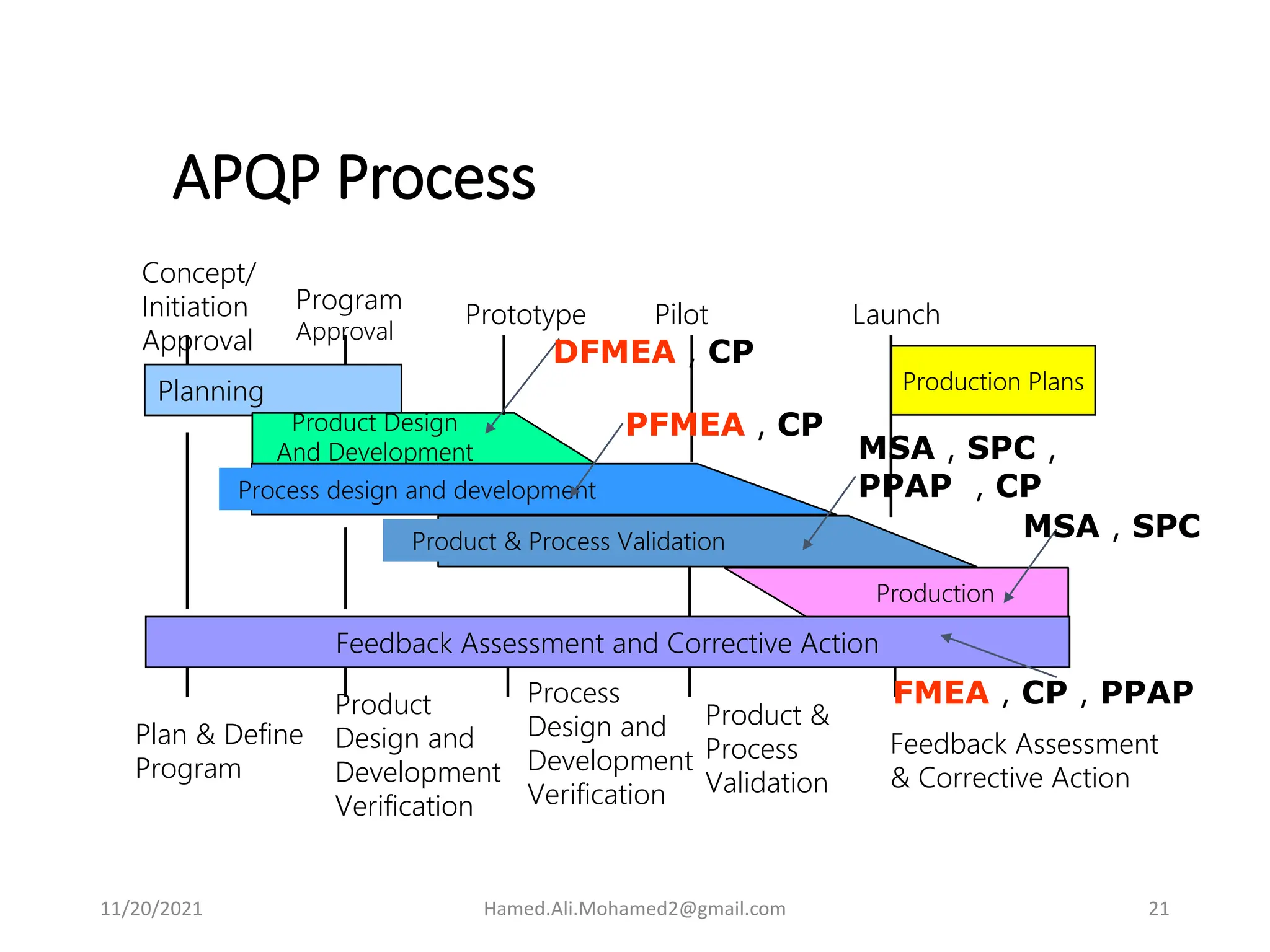
As you can see, the APQP framework orchestrates a logical flow where design activities precede process development, and both are validated before launch. Now, let's pinpoint where DFM, DFMEA, and GD&T fit into this flow.
Phase 2: The Core of Engineering Design
The second phase of APQP, Product Design and Development, is where the theoretical concept is translated into a tangible, detailed design. This phase is the primary home for your core design engineering deliverables.
Your university experience with DFM/DFA and DFMEA gives you a head start here. You know what they are; APQP dictates when and why they are formally completed.
The following video segment explicitly lists these as outputs of Phase 2.
Why Advanced Product Quality Planning (APQP)?
This segment from "Why Advanced Product Quality Planning (APQP)?" by PMC Videos details the expected outputs from the Product Design and Development phase.
Watch the portion covering the expected outputs for phase two. Note the explicit mention of Design FMEA (DFMEA) and Design for Manufacturability and Assembly (DFM/DFA).
Design for Manufacturability (DFM) and DFMEA
DFM/DFA reviews and the DFMEA are not just good practices; they are formal deliverables in Phase 2. Their purpose is to front-load problem-solving—identifying and mitigating risks while the design is still digital and changes are cheap.

The logic is simple: it is far less expensive to change a CAD model than it is to re-cut a multi-ton steel stamping die.
The GM Global APQP standard provides a very clear and task-oriented view of this. It defines the DFMEA as a core activity that drives design improvements.
This document from General Motors outlines the specific tasks within their APQP process. It provides a real-world example of how an OEM manages these deliverables.
Read Task 8: DFMEA. Focus on the description: "The DFMEA is a living document that is initiated before or at design concept... It supports the design process in reducing the risk of failure by: 1) aiding in the evaluation of design requirements, DFM, and DFA..."
This confirms that DFMEA is the formal tool used to document the risk analysis that occurs during DFM/DFA activities. They happen together in Phase 2 to ensure the design is robust and manufacturable before it is finalized and released for tooling.
Geometric Dimensioning & Tolerancing (GD&T): A Multi-Phase Deliverable
Unlike DFMEA, which is largely completed in Phase 2, GD&T's role extends across multiple phases of APQP. It is created in one phase, but it is used and validated in subsequent ones.
Phase 2: GD&T Creation and Definition
The initial GD&T scheme is created during Phase 2: Product Design and Development. This is when the 2D engineering drawing is detailed. Key activities include:
- Establishing the Datum Reference Frame (DRF) based on the part's function and assembly position.
- Applying geometric tolerances (Position, Profile, etc.) to control critical features.
- Defining Key Product Characteristics (KPCs)—features critical to safety or function.
The GM APQP document again provides a clear mandate for this.
This task describes the formal design reviews that happen within the APQP process.
Read Task 9: Conduct Design Reviews. Pay close attention to the methodology, which describes a "GD&T review" led by the design engineer. Note the SQE responsibilities, such as inquiring "whether or not the design has a 3-point datum scheme that matches the part in car position." This directly links back to the fundamentals of setting up a DRF that we discussed on Day 1.
Phase 3: GD&T as an Input to Process Design
In Phase 3: Process Design and Development, the finalized drawing with its GD&T scheme becomes a critical input for designing the manufacturing and measurement processes. Specifically, the GD&T dictates the design of the checking fixtures (gages). The fixture must locate the part using the same datums defined on the drawing to ensure measurement correlation.
Read the follow-on task from the GM document.
This task covers the review and approval of the tools and gages needed for production.
Read Task 10: Conduct Gage, Tooling and Equipment Reviews. Focus on the SQE responsibility to "Confirm that gage... complies with GD&T." This shows the direct link between the drawing and the physical inspection equipment.
Phase 4: GD&T Verification
Finally, in Phase 4: Product and Process Validation, you prove that the production process can consistently make parts that meet the GD&T specifications. This validation is formalized through the Production Part Approval Process (PPAP).
One of the 18 mandatory elements of a PPAP submission is the Dimensional Results report. This is a full inspection report of several parts from the production run, measured against every dimension and tolerance on your drawing. A successful dimensional report is the ultimate proof that your design intent, as defined by the GD&T, has been achieved.
The video below lists "Dimensional Results" as a key requirement of the PPAP package, which is the capstone output of the APQP validation phase.
Why Advanced Product Quality Planning (APQP)?
This final clip from "Why Advanced Product Quality Planning (APQP)?" explains that PPAP is an output of APQP and lists its core requirements.
Watch the overview of the PPAP requirements. Notice that "Design Records" (the drawing) and "Dimensional Results" are both required, closing the loop on GD&T.
Summary: Your Deliverables on the APQP Timeline
Let's consolidate this into a clear timeline.
| APQP Phase | Key DFM, DFMEA, and GD&T Deliverables |
|---|---|
| Phase 1: Plan & Define | - (Inputs received) Customer requirements, quality targets, preliminary list of special characteristics. |
| Phase 2: Product Design & Development | - DFM/DFA reviews are conducted. - DFMEA is created and updated to mitigate design risks. - GD&T scheme (including datums and tolerances) is created on the 2D drawing. |
| Phase 3: Process Design & Development | - PFMEA is created, using the DFMEA as an input. - Gage and fixture designs are created and approved, based on the GD&T. - A Pre-Launch Control Plan is developed to monitor KPCs defined on the drawing. |
| Phase 4: Product & Process Validation | - A PPAP package is submitted for approval. Key contents include: - The approved Design Record (the drawing with GD&T). - The final DFMEA and PFMEA. - The Dimensional Results report, verifying conformance to GD&T. |
| Phase 5: Feedback & Corrective Action | - Lessons Learned from production are documented and fed back into the DFMEA and PFMEA for future projects. |
Conclusion
You now see how your core engineering tasks are not performed in a vacuum. They are integral, timed deliverables within the APQP framework.
- DFM and DFMEA are concentrated in Phase 2 to proactively manage risk and cost before tooling is kicked off.
- GD&T originates in Phase 2 as part of the design record, serves as a critical blueprint for tooling and gaging in Phase 3, and is the final standard for acceptance during validation in Phase 4.
Understanding this timeline is essential for a design engineer. It clarifies what you need to deliver, when you need to deliver it, and how your work enables the subsequent steps in bringing a quality automotive product to market.
This concludes Day 4, where we've covered the fundamentals of sheet metal design and the APQP process that governs it. Tomorrow, we will begin Day 5 by putting this theory into practice. Your first task will be to start the design of a sheet metal bracket, beginning with the justification of material and thickness—an activity that sits squarely in Phase 2 of the APQP process.
Can't find a good explanation? Sign up and we'll make it for you
Sign up