
Introduction
Hello! In our last lesson, we delved into the philosophical underpinnings of balance and duality, comparing the "logics" of the Muisca, Wayuu, and Kogi worldviews. We saw how these weren't just abstract ideas but core operating principles for their societies.
Today, we take that understanding and ground it firmly in the physical world. This lesson addresses the learning outcome: Explain how distinct environments (mountains, deserts, and rainforests) shaped unique mythological themes. We will explore how the very land these cultures inhabited—its climate, resources, and challenges—provided the raw materials for their cosmologies.
From your perspective as a designer and storyteller, think of the environment as the ultimate set of constraints and affordances. Just as a project's context shapes the final design, the Andes mountains, the Guajira desert, and the Chocó rainforest shaped the "design" of these mythological systems. Understanding this connection is the key to creating illustrations that feel authentic, not just in their details, but in their very atmosphere and logic.
1. The Mountain Worldview: Order and Origin in the Muisca Highlands
The Muisca inhabited the Altiplano Cundiboyacense, a series of fertile highland plateaus in the Andes. This environment is not one of extremes, but of structured layers and unique, concentrated resources. To get a better sense of this landscape, let's start with a video.
The Muisca: Legends of Gold (subtitulos en español)
This video from Ancient Americas, which we've referenced before, provides an excellent overview of the Muisca's environment and their relationship to it.
Please watch the following three clips: The Land (1:51 - 2:30): This sets the scene, describing the temperate climate and diverse ecological zones of the altiplano. Resources (10:52 - 13:08): Pay attention to the specific resources the Muisca had access to due to their unique geology, such as salt, emeralds, and gold (via trade). Mythology (21:53 - 23:17): This clip directly links their origin myth to a specific feature of their environment—a lake. Focus on how the combination of fertile land, valuable minerals, and distinct water bodies might foster a particular kind of worldview.
As the video illustrates, the Muisca environment was a high-altitude haven, offering fertility and incredible wealth, but also requiring ingenuity to manage (like the raised fields for flood control). This physical reality is directly mirrored in their mythology.
-
Water as Womb: The most powerful environmental feature in Muisca myth is the lagoon. As you'll recall, humanity, in the form of Bachué and her child, emerged from the waters of Lake Iguaque. The ceremony of El Dorado also took place on a sacred lake. For the Muisca, these calm, reflective, highland bodies of water were not just sources of sustenance; they were portals to the sacred, the origin point of life itself. This gives water a serene, generative quality in their stories.
-
Geology as Divinity: The Muisca lands contained valuable salt deposits and emeralds. Gold was acquired through trade but became central to their rituals. These materials weren't just commodities; they were sacred substances. Gold's incorruptibility and color linked it to the Sun god, Sué. The myths and rituals, especially El Dorado, became a way to honor the divine powers that provided this unique wealth, reinforcing the sacredness of their specific territory.
-
A World of Structure: Living in a productive, settled, and organized agricultural society, the Muisca worldview reflects a desire for order and structure. The landscape itself, with its distinct mountains, plains, and lakes, lends itself to a structured cosmology of complementary pairs (mountain/lake, sun/moon). Their environment, challenging but ultimately manageable and generous, fostered a mythology centered on cosmic order, sacred origins, and structural harmony.
2. The Desert Worldview: Tension and Survival in the Wayuu Peninsula
Now, let's travel north to the arid La Guajira peninsula, home of the Wayuu people. This environment is the complete opposite of the Muisca highlands—a landscape defined by scarcity, relentless winds, and the constant, desperate need for water.
To understand why this desert exists and the forces at play, the following video provides a fantastic scientific explanation that reads like the backstory for a mythological drama.
Why This Strange Desert Exists In Tropical Colombia?
This video by Urban Atlas explains the specific climatic and geographic phenomena that create the La Guajira desert. As you watch, think about how you would personify these immense, invisible forces.
Please watch these three sections: Ocean Currents (2:07 - 3:47): This explains the concept of coastal upwelling, where cold water starves the land of moisture. The Wind (3:47 - 6:18): Focus on the description of the powerful Caribbean low-level jet. This is the dominant force in the region. The Complete Picture (6:18 - 7:27): This summarizes how the wind and ocean currents reinforce each other to create the desert climate. Pay attention to the vocabulary used: 'starves the land of moisture,' 'relentless winds,' 'master architect.'
The forces described in the video—the cold currents and the powerful wind jet—are precisely the forces the Wayuu personified in their core myths.
-
Climate as Antagonists: The central Wayuu myth features the eternal struggle between Juya (the male figure of rain) and Pulowi (the female spirit of drought and the underworld). This isn't just a story; it's a direct allegorical representation of their environmental reality. Juya's arrival is sporadic and life-giving, while Pulowi's influence is constant and deadly. Their existence is dictated by the precarious balance and dynamic tension between these two climatic deities.
-
Resilience as a Creative Act: Surviving in the desert requires immense knowledge and creativity. This is embodied in the myth of Wale'kerü, the spider, who taught the Wayuu women how to weave their intricate
mochilabags and hammocks. This myth transforms a creature of the desert into a symbol of cultural identity and resilience, turning the act of creation into a tool for survival. The art itself becomes a story of their relationship with the land.
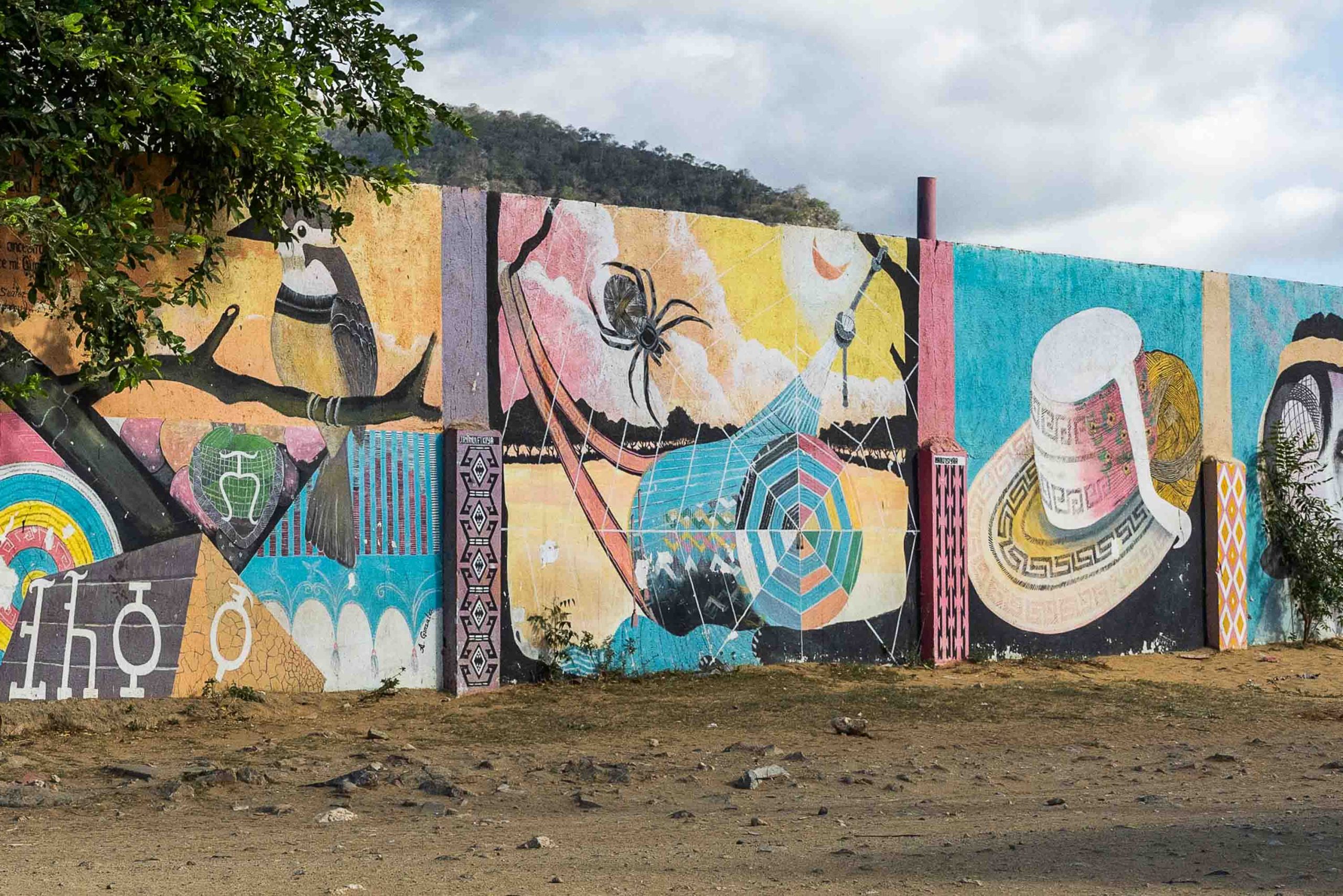
The Wayuu environment, defined by scarcity and climatic struggle, shaped a mythology of dynamic tension, precarious survival, and the personification of powerful natural forces.
Test your understanding!
Imagine you are designing a visual concept for a short animated film about the origin of water. How would a Muisca version of this story visually and tonally differ from a Wayuu version, based on their respective environments and mythologies?
Show answer
-
Muisca Version (Order & Origin): The visual tone would be serene, mystical, and symmetrical. The story might begin in a dark, formless void, with the first light revealing the calm, pristine surface of Lake Iguaque. The camera would likely be still or move slowly. The emergence of Bachué would be a gentle, deliberate event, like a flower blooming. The color palette would emphasize cool blues, greens, and the shimmering gold of divine presence. The overall feeling would be one of sacred birth and the establishment of a harmonious order.
-
Wayuu Version (Tension & Survival): The tone would be dramatic, tense, and dynamic. The story wouldn't be about a placid origin, but about a desperate need. It might start on a cracked, parched earth under a blazing sun (Pulowi's domain). The arrival of Juya would be a violent, powerful event—a storm gathering, winds howling, and finally, a torrential downpour. The camera would be handheld or moving rapidly to capture the conflict. The color palette would be stark, contrasting the hot oranges and browns of the desert with the deep blues and grays of the storm. The feeling would be one of temporary, hard-won relief in an ongoing struggle.
3. The Rainforest Worldview: Immersion and Animism in the Embera Jungles
Finally, we venture into the tropical rainforests of the Chocó region, home to the Embera people. This environment is one of overwhelming abundance: of rain, of vegetation, of life, and of danger. It is an immersive world where everything is interconnected, and the boundaries between things are often blurred.
“All Within the Same Thought”: Embera People Relations ...
This academic paper, 'All Within the Same Thought,' provides a deep dive into the Embera's relationship with their rainforest environment. We will focus on the sections that explicitly connect the physical forest to their spiritual worldview.
Please read the following two sections to understand how the rainforest shapes Embera mythology: The Environment (page 6): Start at the paragraph beginning 'The Embera’s Polines and Yaberaradó reservations...' and read to the end of that page. This section describes the biogeographical Chocó—its steep slopes, high rainfall, and powerful rivers—and explicitly states that sacred sites are found in these humid tropical forests. The Sacred Sites (pages 9-11): Read the section titled 'Sacred sites: drua wãndra' up to the paragraph before 'The ontological condition...'. This part is crucial. It explains that the pristine rainforest is not empty but is a refuge for wildlife and home to a host of spirits (jai). It introduces the creator god Karagabí and establishes the forest as a landscape filled with spiritual agency. Focus on how the sheer density and vitality of the rainforest lead to a worldview where the entire environment is spiritually alive.
The Embera's world is not one of balanced pairs or dueling forces, but of total immersion in a landscape that is itself alive.
-
An Animated World: In the dense, layered rainforest, everything is hidden and revealed. The rustle of leaves could be the wind, an animal, or a spirit. This uncertainty and density are reflected in the Embera's animistic worldview. The forest is populated by a multitude of spirits known as
jai. These are not distant gods but immediate presences that inhabit specific places, plants, and animals. The creator god, Karagabí, organized this landscape, but it is thejaithat one must negotiate with daily. -
Transformation and Danger: The rainforest is a place of constant transformation—growth, decay, and mimicry. The jaguar, a master of stealth and a powerful predator, is a central figure in this worldview, often associated with the shaman (
Jaibaná) who can travel between worlds and transform. Myths are filled with stories of shapeshifting, reflecting a world where the boundaries between human, animal, and spirit are fluid. The forest is both a provider and a source of immense danger, a duality embodied in ambivalent forest spirits who can be allies or enemies. -
Nature as the Divine Itself: Unlike myths where gods control nature from afar, in the rainforest, powerful spiritual entities are often fused with the environment. The concept of
Madre Monte(Mother Mountain/Forest), a figure in broader Colombian folklore with deep indigenous roots, is a perfect visualization of this idea. She is not a goddess of the forest; she is the forest—a protector of nature who punishes those who harm it.

The immersive, dense, and dangerously alive rainforest shaped a mythology of animistic immersion, spiritual negotiation, and constant transformation.
Synthesis: The Environment as a Mythological Blueprint
The environment is not merely a backdrop for myths; it is the blueprint from which they are constructed. The distinct challenges and gifts of each landscape directly shaped the central themes and figures of these Colombian cosmologies.
| Environment | Key Features | Central Mythological Theme | Human's Role in Myth |
|---|---|---|---|
| Mountains (Muisca) | High-altitude plains, fertile soil, sacred lagoons, unique mineral wealth. | Order & Sacred Origin | To maintain cosmic structure and perform rituals that honor the sacredness of their specific territory and its gifts. |
| Desert (Wayuu) | Extreme aridity, relentless winds, scarce fresh water, but rich marine life. | Dynamic Tension & Survival | To survive the precarious balance between opposing climatic forces (rain/drought) through resilience, knowledge, and creativity. |
| Rainforest (Embera) | Overwhelming biodiversity, constant rain, dense vegetation, hidden dangers. | Animistic Immersion & Transformation | To navigate a world teeming with spirits, negotiating with the spiritual "owners" of the forest for resources, health, and protection. |
Conclusion
Today, we've seen how the land speaks through mythology. The serene, orderly cosmology of the Muisca is a reflection of their structured life in the fertile Andes. The tense, dramatic myths of the Wayuu are a direct personification of the harsh climatic forces governing their desert home. And the immersive, spirit-filled world of the Embera is born from the dense, overwhelmingly alive rainforest.
Key Takeaways:
- Muisca (Mountains): An environment of structured abundance fostered a mythology of order and sacred origin.
- Wayuu (Desert): An environment of scarcity and climatic struggle fostered a mythology of dynamic tension and precarious balance.
- Embera (Rainforest): An environment of immersive biodiversity and hidden danger fostered a mythology of animism and transformation.
- Mythology can be seen as a culture's collective, generational effort to make sense of, and encode knowledge about, its specific ecological niche.
As you develop your illustrations, let the environment guide your hand. The quality of light, the dominant colors, the very texture of the air in these places are as much a part of the story as the characters themselves.
Preview of the Next Lesson:
These worldviews, so deeply entwined with the land, were developed over centuries of intimate interaction with the environment. In our next lesson, we will examine what happened when a powerful external force—the Spanish Empire—arrived, bringing with it a different worldview and a colonial agenda that sought to suppress and erase these ancient traditions.
Can't find a good explanation? Sign up and we'll make it for you
Sign up