
Introduction
Hello! In our last lesson, we explored the powerful symbolism of the jaguar, snake, and eagle, culminating in the eagle-snake conflict as a potent example of cosmic duality. Today, we will expand on that theme to explore how the concept of balance is not just a single story element, but the very foundation of entire worldviews.
This lesson directly addresses the learning outcome: to compare concepts of duality and balance in Muisca, Kogi, and Wayuu cosmologies. We will examine how each of these three distinct Colombian cultures developed a sophisticated philosophical system built around the idea of maintaining equilibrium. For you as a visual artist and storyteller, understanding these systems is key. They are the 'physics' of these mythological worlds, and illustrating them well means moving beyond depicting characters to visualizing the fundamental forces that shape their reality.
1. The Muisca: Duality as Structural Harmony
For the Muisca of the Andean highlands, the universe was an ordered place built on a foundation of complementary pairs. Their goal was not to resolve tension, but to hold these pairs in a harmonious, stable balance.
A fantastic visual representation of this worldview is the Muisca "Solar Wheel," which functions as a calendar.
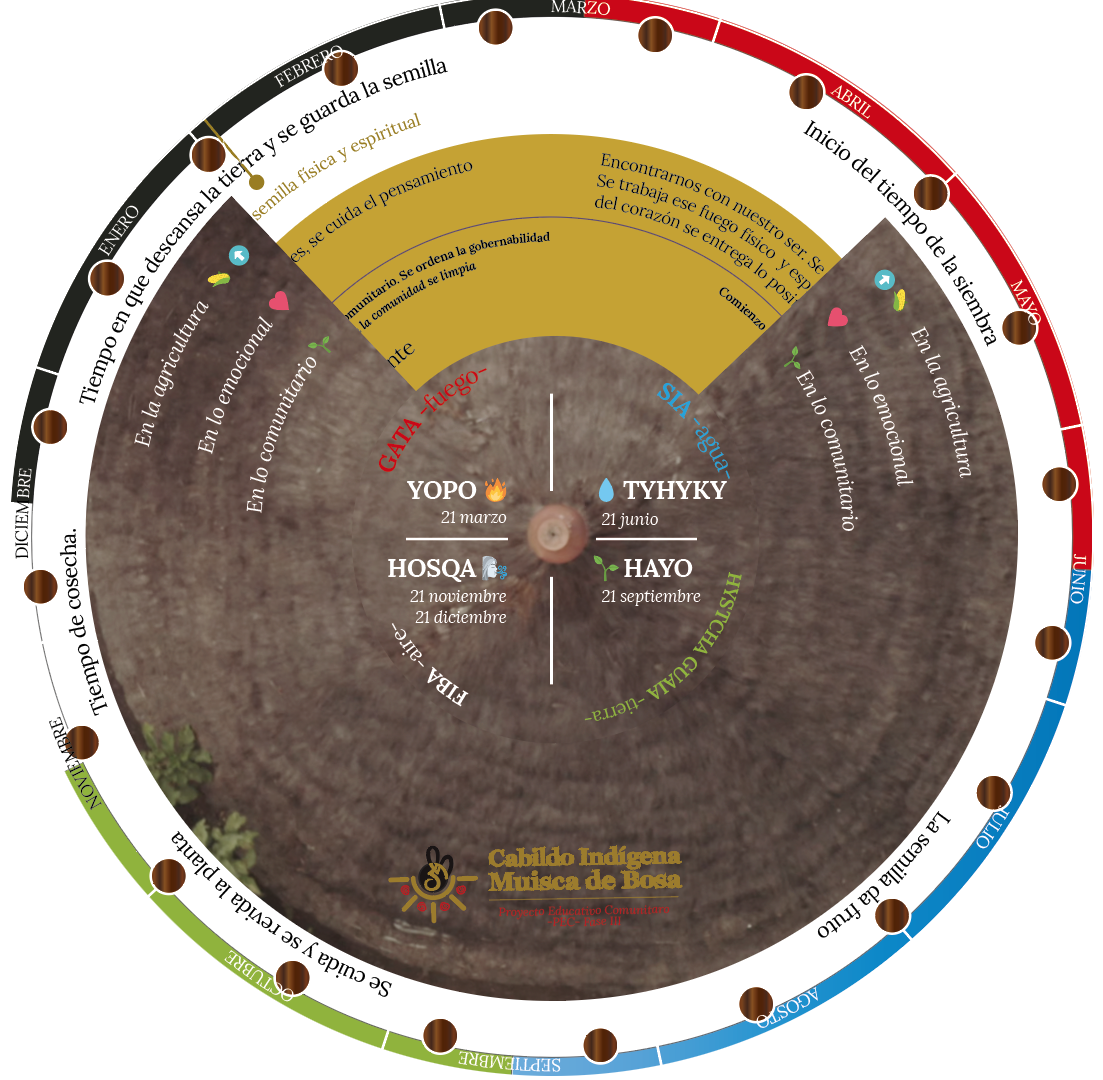
This calendar shows how the Muisca integrated every aspect of their existence—from when to plant crops to when to perform rituals—into a single, balanced system. This principle of balanced pairs is reflected throughout their culture:
- Cosmic Duality: The pairing of Sué (the Sun god) and Chía (the Moon goddess) is a primary example. As mentioned in a resource from our upcoming section, their union represents a fundamental astral complementarity of light and dark, male and female principles that brought order to the universe.
- Political Duality: The Muisca Confederation was ruled by two main leaders: the Zipa in the south (Bacatá) and the Zaque in the north (Hunza). This division created a political balance of power across their territory.
- Geographic Duality: We saw in the myth of Bachué that life emerged from a lagoon. The Muisca worldview often paired mountains (seen as masculine) with lagoons and water bodies (seen as feminine, places of origin and spiritual power).
The Muisca concept of balance, therefore, is one of structural harmony. Their world was like a finely constructed building, with each dualistic pair acting as a pillar supporting the whole structure. Their rituals and social organization were all designed to ensure these pillars remained strong and in equilibrium.
2. The Wayuu: Duality as Dynamic Tension
Now, let's travel from the cool highlands to the arid La Guajira peninsula, home of the Wayuu people. Here, in a harsh desert environment, the concept of balance is less about static harmony and more about a constant, dynamic tension between powerful forces.
The central duality in the Wayuu worldview is between Juya (rain), a male figure who is a hunter and wanderer associated with the sky, and Pulowi, a female figure representing drought, the underworld, and the mistress of wild animals.
This stunning painting captures the relationship between these two powerful beings.
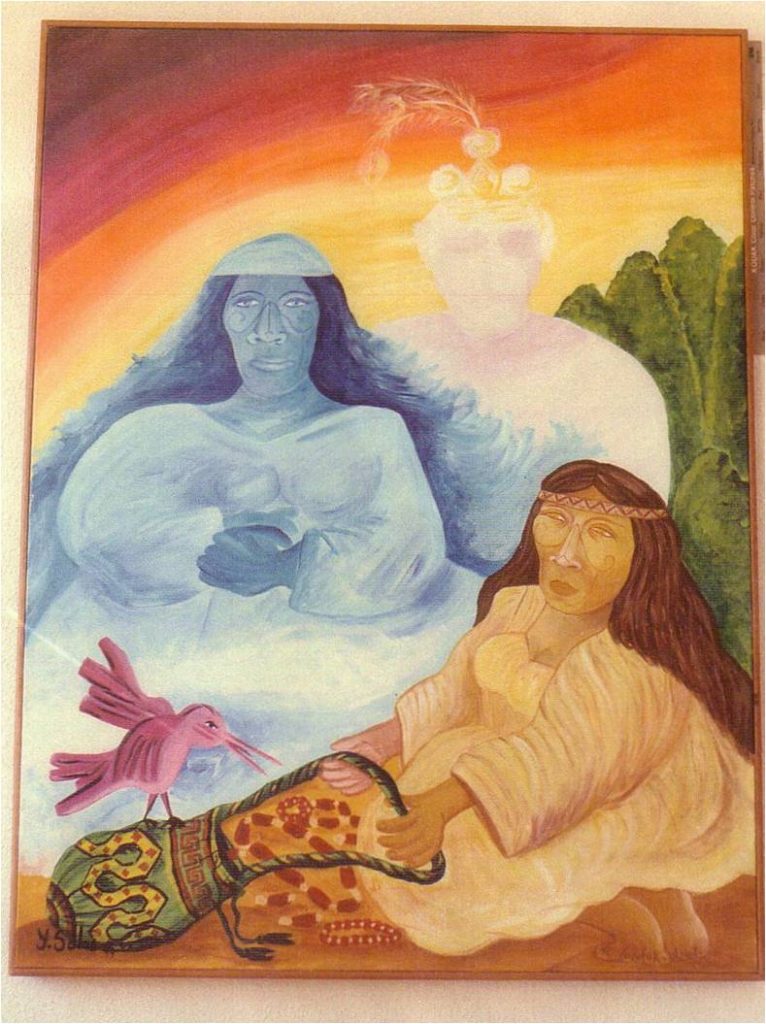
This is not a simple story of good versus evil. For life to exist in the desert, both are necessary, but in measure. Too much of Juya's influence brings destructive floods; too much of Pulowi's brings famine and death from drought. Life, and Wayuu culture itself, exists in the precarious balance achieved through the constant struggle and interaction between these two forces.
This dynamic tension is also reflected in their matrilineal society, where lineage and property pass through the mother's line, creating a unique social balance between male and female roles within the community.
The Wayuu concept of balance is one of dynamic tension. It is the ever-shifting, often precarious equilibrium between opposing forces that defines the cycles of life and death. Your illustrations could capture this as a cosmic tug-of-war or a dance where the fate of the world hangs on every step.
3. The Kogi: Duality as Reciprocal Exchange
In the Sierra Nevada de Santa Marta, the Kogi have a worldview that you may find resonates with your experience in systems thinking. They see the universe as a single, living organism—or, alternately, an immense, woven fabric. Every part is interconnected, and balance is actively maintained through a constant, reciprocal flow of energy.
To begin, let's watch the opening of a film made with the Kogi themselves. It introduces their foundational concept of Aluna.
Aluna - An Ecological Warning by the Kogi People
This clip from the film 'Aluna' beautifully explains the Kogi creation myth. It introduces the core concept of 'Aluna'—the spiritual dimension of reality, or 'thought'—from which the material world originates. This sets the stage for their entire philosophy of balance.
Watch the first 3 minutes and 27 seconds. Pay close attention to how the Great Mother 'conceives the world in thought' and 'spins the thread' of reality. This metaphor of a cosmic weave is central to their understanding of interconnectedness.
The idea of the world being "woven" from thought is a powerful one. But how do the Kogi keep this fabric from unraveling? This requires a deeper look into the mechanics of their worldview.
nourishment and exchange among the Kogi
The 'Aluna' film gives us the poetic foundation. Now, let's dive into the mechanics of how the Kogi maintain balance. This academic paper by Falk Parra Witte explains their system of exchange in detail, connecting their cosmology directly to practical, ecological actions.
Please read two key sections from this paper. Start with the section titled 'Ecological balance as cosmological structure' (page 16). This part is crucial as it lays out the fundamental dualities (sky/earth, male/female, sun/moon) that structure the Kogi cosmos. It includes a very helpful diagram (Figure 3). Then, read the section 'Debt and imbalance' (page 23). This explains the consequences of failing to maintain balance, introducing the concept of 'shalá' (debt). This highlights the active, ongoing responsibility the Kogi feel. Focus on how these dualities are not static but require active maintenance through reciprocal exchange.
From these resources, we can see the Kogi concept of balance is one of reciprocal exchange.
- Foundational Dualities: Like the Muisca, their world is structured by complementary pairs: sky and earth, male and female, mountain peaks and coastal estuaries.
- A Living System: Unlike a static structure, the Kogi see this system as a living body. The material world is nourished by the spiritual world (
Aluna), but this is not a one-way street. - Nourishing the Spirit: For the world to remain healthy, humans must "pay back" or "nourish" the spiritual parents (
Kalguasha) for everything they take. This is done through ritual offerings (zʉbihi) and confessions (aluna ishguashi), where thoughts and vital essence are given back to the spiritual realm. - The Concept of Debt (
shalá): When this reciprocity fails, the world goes into debt. This spiritual debt manifests physically as illness, drought, and crop failure. The spirits are not punishing humans; they are simply reclaiming what they are owed. The Mamos, their spiritual leaders, work constantly to keep this cosmic account in balance.
Comparative Synthesis
Let's consolidate these three distinct philosophies of balance.
| Culture | Core Concept | Metaphor for the Universe | Mechanism for Balance | Visual Idea |
|---|---|---|---|---|
| Muisca | Structural Harmony | A temple or a balanced scale | Maintaining the proper relationship between stable, complementary pairs. | Symmetrical architecture; a balanced composition. |
| Wayuu | Dynamic Tension | A tug-of-war or seasonal cycle | The constant, precarious struggle between opposing forces. | A swirling vortex of opposing colors; figures in conflict. |
| Kogi | Reciprocal Exchange | A living body or a woven fabric | Active, continuous "nourishment" of the spiritual world to ensure a flow of life to the material world. | A loom weaving threads; a circulatory system. |
A useful theoretical lens to understand the "why" behind these practices comes from the work of scholars like Ernst Halbmayer. He describes a core principle in this region as "hierarchical symbiosis." The idea is that humans are seen as being "cultivated" by the gods, much like plants in a garden. In return, it is the fundamental duty of humans to "nourish" or "feed" their cultivators through ritual, prayer, and offerings. This establishes a relationship of mutual dependence—a cosmic symbiosis—that keeps the world running.
Test your understanding!
You are tasked with creating a triptych (a three-panel artwork) to represent the concept of cosmic balance. Assign one culture (Muisca, Wayuu, Kogi) to each panel.
What central visual metaphor would you use for each panel to clearly distinguish their unique approach to balance?
Show answer
Here is one possible approach that leverages the distinct concepts we've discussed:
-
Panel 1: Muisca (Structural Harmony): The central image could be a stylized representation of a Muisca temple or the Solar Wheel. The composition would be highly symmetrical and orderly. On one side, you could have imagery of the sun and mountains (Sué, masculine); on the other, the moon and a lagoon (Chía, feminine). The overall feeling would be one of stability, structure, and perfect equilibrium.
-
Panel 2: Wayuu (Dynamic Tension): This panel would be defined by movement and conflict. You could adapt the "Juya and Pulowi" painting, showing the figures swirling around each other, not in a hug but in a tense dance. One side of the panel could show lush growth and rain, the other a parched desert with animal bones. The dividing line would be irregular and contested, emphasizing the precarious nature of their balance.
-
Panel 3: Kogi (Reciprocal Exchange): The visual metaphor would be a loom or a great circulatory system. You could show threads of light (
Aluna) descending from the top, being woven by human figures (Mamos) in the middle, and then threads of substance (offerings, thoughts) ascending back up from the bottom. Alternatively, you could depict the Sierra Nevada as a giant human body, with rivers as veins and Mamos performing rituals at key "acupuncture points" (sacred sites) to keep the lifeblood flowing.
Conclusion
Today we have seen that "duality and balance" are far from simple concepts. They are sophisticated, culturally specific systems for making sense of the world and humanity's place within it.
Key Takeaways:
- Muisca: Balance is achieved through structural harmony between complementary, stable pairs.
- Wayuu: Balance is a dynamic tension, a constant and precarious struggle between opposing, essential forces.
- Kogi: Balance is maintained through reciprocal exchange within a single, interconnected, living system that must be actively nourished.
- These worldviews are not just myths, but active philosophies of life, grounded in a sense of responsibility to maintain the cosmic order.
By grasping these different "logics" of balance, you can create illustrations that are not only visually compelling but also rich with authentic philosophical and cultural depth.
Preview of the Next Lesson:
Now that we've compared these indigenous worldviews in their own right, our next lesson will confront a major historical turning point: the impact of the Spanish conquest on these traditions. We will explore how colonial policies of religious suppression directly affected the oral transmission and practice of the very myths and philosophies we have been studying.
Can't find a good explanation? Sign up and we'll make it for you
Sign up