
Introduction
Welcome back! Over the past few modules, we've journeyed through the rich mythological landscapes of various Colombian indigenous cultures, from the Muisca highlands to the Amazonian rainforest. We've encountered specific deities, heroes, and stories, much like collecting individual, compelling visual assets.
Now, we shift our perspective from the individual story to the larger narrative system. This lesson marks the beginning of our synthesis module, where we start to connect these disparate threads into a coherent tapestry. Our goal is to compare creation myth patterns across different Colombian indigenous cultures (e.g., from water, from light).
For you as a storyteller and illustrator, understanding these underlying patterns is like grasping the fundamental archetypes of a story. It allows you to move beyond simply illustrating a single myth to creating art that speaks to the deeper, shared cosmological principles of these cultures. We will analyze three dominant patterns using cultures we've already studied:
- Creation from light and duality.
- Creation from water and earth.
- Creation from a primordial, thinking being.
This comparative approach will enrich your visual vocabulary and help you develop a more nuanced and systemic understanding of these worldviews.
Pattern 1: Creation from Light and Duality
One of the most powerful and fundamental creation patterns involves the emergence of the world from a state of primordial darkness through the introduction of light. This act establishes a fundamental duality—light/dark, order/chaos—that often underpins the entire cosmology. The Muisca provide a classic example.
Let's begin with the Muisca creation myth. The encyclopedia entry on 'Muisca Religion' gives a concise account of how the supreme being, Chiminigagua, brought forth the world.
Please read the section that begins 'In Muisca cosmology, the supreme deity, Chiminigagua, was equated with light...' and ends '...animals and plants of the earth.' Focus on the initial state of the world (darkness and silence) and the actions Chiminigagua took to create light and life.
As you read, the key elements to note are:
- The Primordial Void: The world begins in darkness, silence, and sterility.
- The Self-Contained God: Light exists, but it is contained within the deity, Chiminigagua.
- The Act of Creation: The god breaks open this shell, releasing light and initiating creation. The dispatching of birds carrying light from their beaks is a wonderfully vivid image, suggesting how light actively spreads to reveal and form the world.
This "creation from light" theme isn't unique to the Muisca. The Kogi people of the Sierra Nevada de Santa Marta, whose cosmology we've also explored, share a similar concept. Their creation story speaks of a world emerging from spiritual darkness into the "dawn" of light. This often involves a fertilizing union of male (light/sun) and female (dark/moon) powers.
nourishment and exchange among the Kogi
Now, let's look at a scholarly text on Kogi cosmology to see a parallel. This paper, 'Nourishment and exchange among the Kogi,' discusses the complementary forces that structure the universe.
Please read the paragraph under the subheading 'Ecological balance as cosmological structure' that starts with 'Following Kogi cosmogony, the world emerged upward...'. Notice how it explicitly compares the Kogi's union of male and female powers with the Muisca marriage of the sun and moon.
This pattern gives us a powerful visual and conceptual archetype: creation as an act of illumination and the establishment of cosmic balance through duality.
Pattern 2: Creation from Water
Another widespread creation pattern centers on water as the source of life. In these myths, humanity and the natural world often emerge from sacred lakes, rivers, or primordial seas. Water is the womb of the world.
The Muisca, in addition to their light-based myth, have a separate and equally important origin story for humanity that is rooted in water.
Let's return to the 'Muisca Religion' resource to read the legend of Bachué, the mother of the Muisca people.
Read the paragraph starting with 'Complementing this dawn-creation myth is the legend of Bachue...' and ending '...disappeared into the depths of the lake.' Focus on the setting (Lake Iguaque) and Bachué's role as the progenitor of humanity.
This myth is a perfect example of creation ex aqua. Key elements include:
- The Sacred Site: Life begins at a specific, sacred location—Lake Iguaque.
- The Primordial Mother: Bachué is the maternal deity who emerges from the water.
- The Peopling of the Earth: She populates the Muisca territory through her children.
- The Return to the Source: At the end of her life, she and her consort transform into snakes and return to the water, completing the cycle.
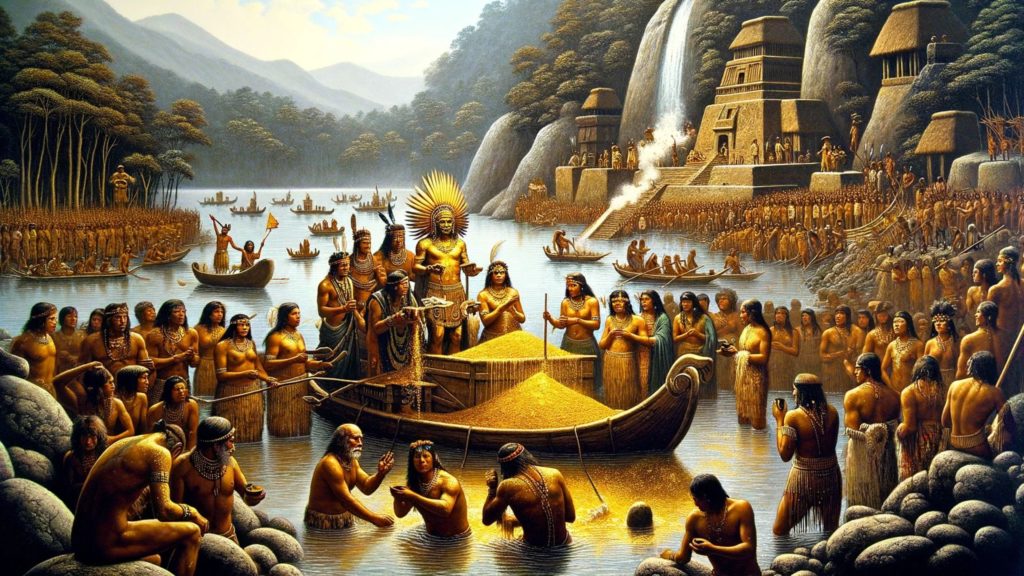
This profound reverence for sacred lakes is a cornerstone of Muisca culture, most famously expressed in the ceremony of El Dorado at Lake Guatavita. While not a creation myth itself, the ceremony echoes the themes of the Bachué legend: a leader enters the sacred water and emerges renewed, ensuring the prosperity of his people.
Pattern 3: Creation from a Primordial Thinker/Weaver
A third pattern presents creation not as a sudden flash of light or an emergence from water, but as a slow, deliberate process of thought, emanation, and organization by a single, all-encompassing being. Here, the cosmos is conceived and 'woven' into existence. The Kogi's cosmology is the quintessential example of this.
nourishment and exchange among the Kogi
Let's go back to the paper on Kogi worldview. This section introduces the concept of the 'Great Mother' and the 'Fabric of Life.'
First, read the paragraph under the subheading 'A web of relations' (starting 'In basically every detail of life...'). Focus on how the Great Mother 'conceived the world in Her thought, called Aluna, and wove life together.' Then, jump to the section 'From Homologism to Organism' and read the paragraph starting with 'Since mind-bodies are unique expressions...'. This will help you understand the idea that everything shares a common origin from this one source.
This pattern differs significantly from the others:
- Creation from Thought: The world begins in Aluna, a spiritual or mental dimension, before it becomes material. It is "thought" before it "is."
- A Single Source for Everything: Unlike the Muisca myths where one god creates light and another creates people, the Kogi Great Mother is the singular origin point for the entire cosmos and everything in it. This idea is called "homologism"—all things share a common substance and identity because they all come from the same source.
- The World as a Body/Textile: The cosmos is her living body, and all of creation is a great "Fabric of Life" woven by her. This is a very organic and interconnected model of the universe.
Your background in systems thinking is particularly relevant here. The Kogi worldview is a perfectly integrated system where every element—a mountain, a river, a lineage, a ritual—is a "thread" in a cosmic weave, originating from a single source and governed by a single "Law of Origin."
Comparing the Patterns
To synthesize these ideas, let's compare them side-by-side. I've also added the Wayuu, whose myth of Maleiwa we studied in Module 5, as another point of comparison.
| Culture | Core Creation Myth | Primary Pattern | Key Visual Elements |
|---|---|---|---|
| Muisca | Chiminigagua breaks the shell of darkness. | Creation from Light / Duality | An explosion of light, dark birds with shining beaks, a chaotic void being ordered. |
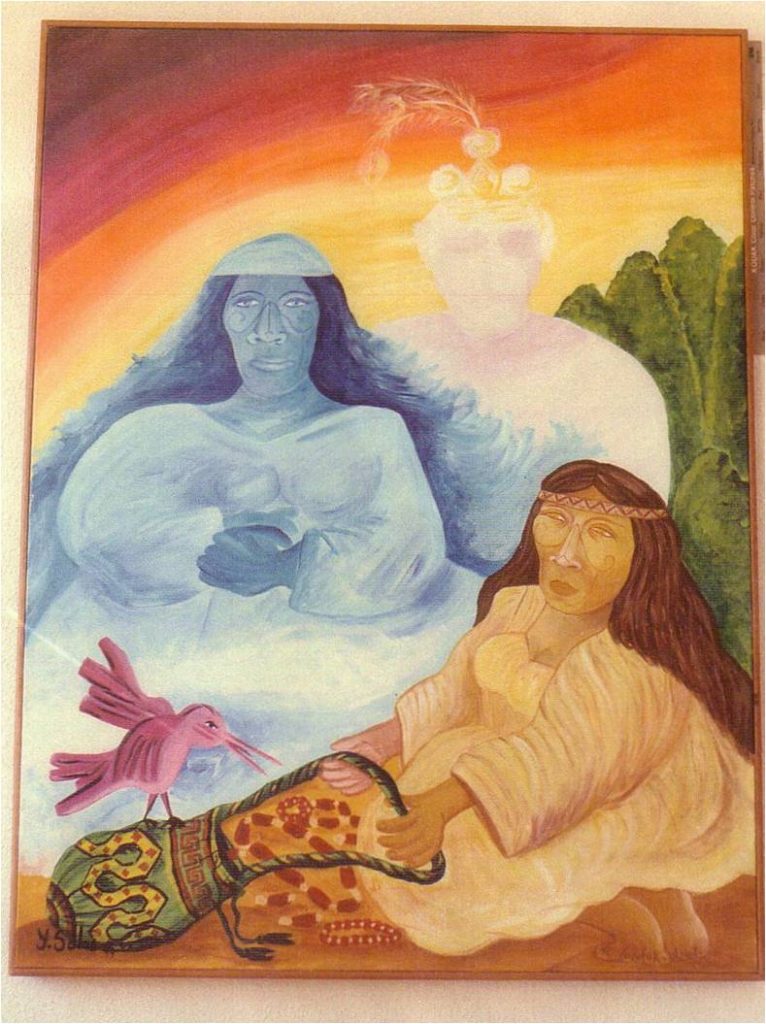
| Muisca | Bachué emerges from Lake Iguaque. | Creation from Water | A still, high-altitude lake; a woman and child emerging from the depths; serpents. |
| Kogi | The Great Mother thinks and weaves the world. | Creation from Thought / Emanation | Cosmic spiderwebs, threads of light, a mountain as a body, layers of the cosmos. |
| Wayuu | Maleiwa creates humanity from clay. | Creation from Earth | A god shaping figures from mud; the stark desert landscape; the sun and rain. |
Test your understanding!
Imagine you are creating a concept board for a three-part animated short, with each part illustrating a different creation pattern.
- Chiminigagua (Light): What would be the dominant color palette and key motion?
- Bachué (Water): How would the pacing and sound design differ from the first part?
- Kogi Great Mother (Weaving): What visual metaphor, other than a literal textile, could you use to represent the idea of Aluna (thought) becoming the material world?
Show answer
This is an excellent way to think through the visual implications of these patterns.
- Chiminigagua (Light): The palette would be stark contrasts: deep blacks and blues shattered by brilliant, piercing whites and golds. The key motion would be explosive and radial, like a supernova or a shattering object, moving from a single point outwards with great speed and energy.
- Bachué (Water): The pacing would be slow, calm, and deliberate. The sound design would be dominated by water sounds—gentle lapping, deep rumbles—and perhaps a single, rising melodic theme. The visuals would be focused on smooth, upward movement, with soft, diffused light filtering through water.
- Kogi Great Mother (Weaving): A powerful metaphor could be a neural network or a mycelial network. You could show a single point of light (Aluna) sending out branching, glowing filaments. As these filaments connect, they form nodes that slowly resolve into stars, mountains, animals, and people. This captures the idea of an intelligent, interconnected system growing organically from a single, conscious source.
Conclusion
In this lesson, we elevated our analysis from individual stories to the archetypal patterns that structure them. By comparing the creation myths of the Muisca, Kogi, and Wayuu, we've identified distinct yet sometimes overlapping narrative frameworks.
Key Takeaways:
- Creation from Light: This pattern, seen with the Muisca's Chiminigagua, emphasizes the victory of order over chaos and establishes a fundamental duality (light/dark) that shapes the cosmos.
- Creation from Water/Earth: This pattern roots life in a specific place and substance, like Bachué emerging from Lake Iguaque or the Wayuu being formed from clay. It highlights a cyclical, nurturing relationship with the physical environment.
- Creation from Thought/Emanation: The Kogi's Great Mother illustrates a model where the universe is first conceived in a spiritual/mental realm (Aluna) and then woven or emanated into material existence, creating a single, interconnected system.
Recognizing these patterns gives you a powerful toolkit. You can now approach your illustrations not just as depictions of a single event, but as visual essays on these profound cosmological ideas.
Preview of the Next Lesson:
Having identified water as a recurring and vital element in creation, our next lesson will focus on it exclusively. We will contrast the role of water in the mythologies of highland (Muisca), coastal (Zenú), and rainforest (Embera) peoples, exploring how different environments shape the symbolic meaning of this universal source of life.
Can't find a good explanation? Sign up and we'll make it for you
Sign up