
Introduction
Welcome back! In our last lesson, we began synthesizing our knowledge by comparing the fundamental creation patterns across different cultures, identifying archetypes like "creation from light," "creation from water," and "creation from thought." We saw how the Muisca myth of Bachué established water as a powerful source of life—a sacred womb from which humanity emerged.
Today, we will dive deeper into this theme. While many cultures revere water, the specific way they do so is profoundly shaped by their environment. Our goal is to contrast the role of water in the mythologies of the highland (Muisca), coastal (Zenú), and rainforest (Embera) peoples.
By examining how a high-altitude lagoon, a floodplain of interconnected rivers, and a dense, wet rainforest each foster a unique symbolic relationship with water, you will gain a more nuanced understanding of these worldviews. For your work as an illustrator, this means moving beyond a generic depiction of "sacred water" to creating specific, evocative scenes that capture the distinct spirit of each culture's relationship with their environment.
1. Highland Water: The Muisca's Sacred Origin
We'll start on familiar ground: the Muisca highlands. As we've discussed, the Muisca inhabited the high plateaus of the Andes. Their environment is characterized by mountains and, crucially, a series of still, cold, high-altitude lagoons.
These lagoons were not just features of the landscape; they were the center of the Muisca spiritual world. They represented two key concepts:
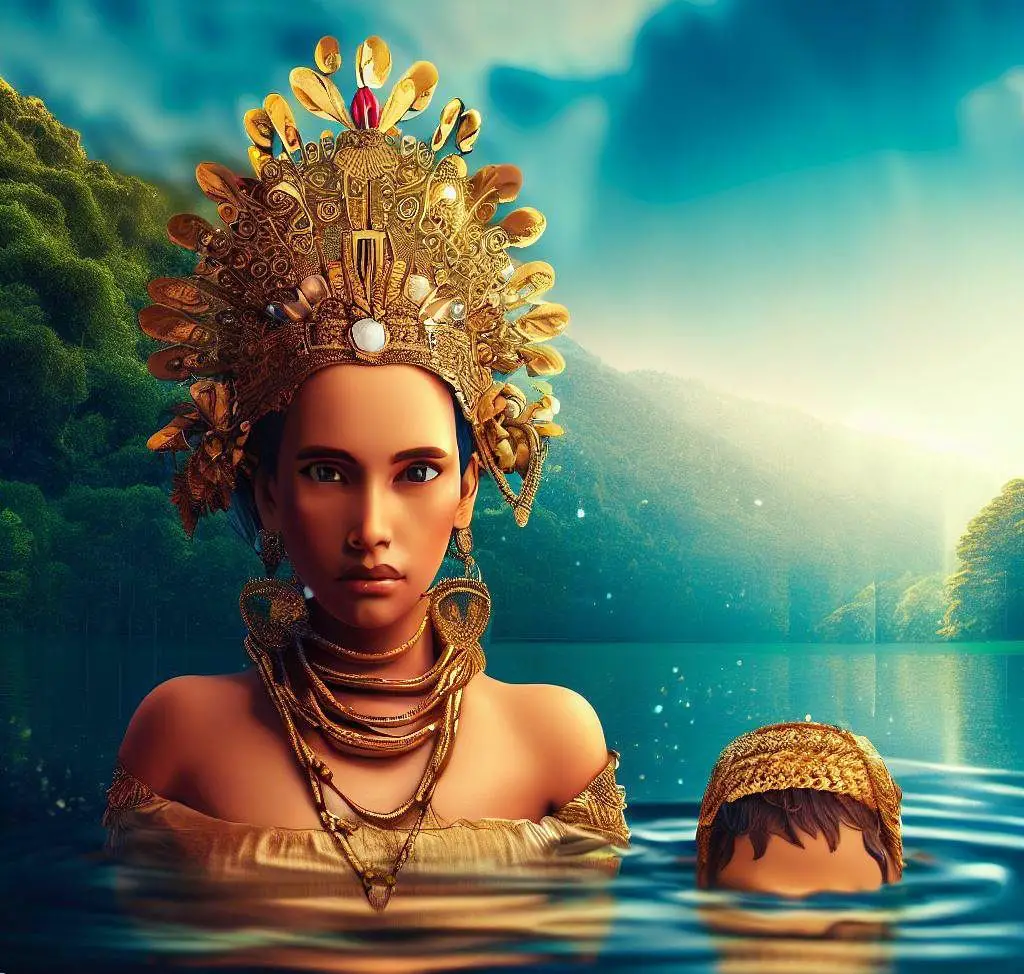
- Water as Womb/Origin: As we saw with the myth of Bachué emerging from Lake Iguaque, these lakes were seen as places of primordial creation. They are the quiet, contained sources from which life begins.
- Water as Portal: They were also understood as gateways to the spirit world. It was through these portals that offerings could be made to the gods to ensure balance and prosperity.
The most famous expression of this belief was the ceremony of El Dorado at Lake Guatavita, where the new Muisca ruler, covered in gold dust, would make offerings into the lake's depths.
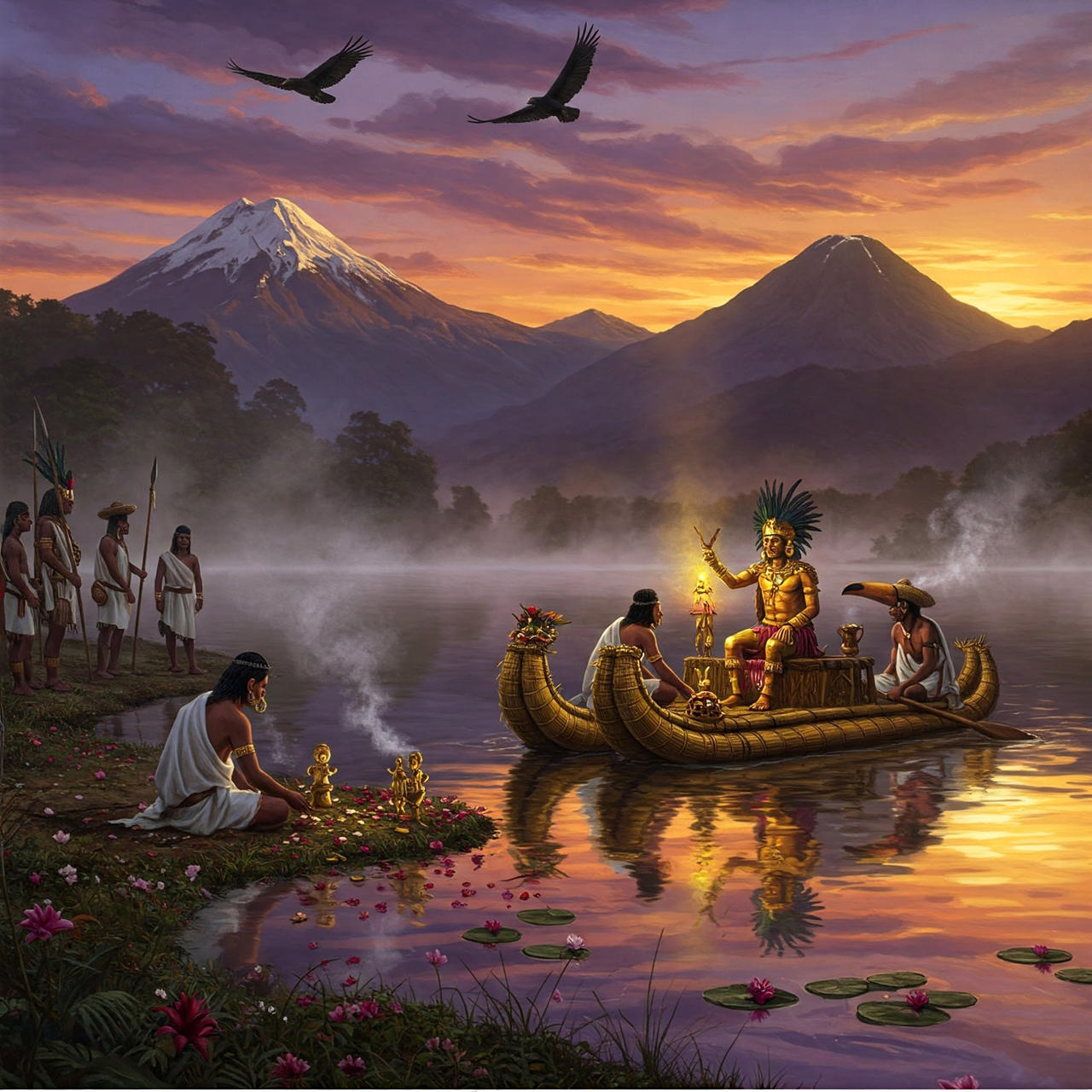
For the Muisca, water is static, concentrated, and generative. It is a point of emergence and a gateway for spiritual exchange, located in the sacred stillness of a mountain lagoon.
2. Coastal Water: The Zenú System of Management
Now, let's travel north to the Caribbean lowlands, the home of the Zenú. Their environment could not be more different from the Muisca's. The Zenú lived on a vast, hot floodplain crisscrossed by the Sinú, San Jorge, and Cauca rivers, an area subject to massive seasonal flooding.
For the Zenú, survival and prosperity depended not just on revering water, but on actively managing it. Their response was one of the most impressive feats of engineering in the ancient Americas.
Pre-Colombian Gold and the Sinu
To understand the Zenú worldview, we first need to appreciate the landscape they engineered. Let's read a short introduction from the article 'Pre-Colombian Gold and the Sinu'.
Please read the 'Overview of the Culture' section. Focus on the description of their environment and the hydraulic system they constructed.
This changes the entire relationship with water. The Zenú lived within a sprawling, interconnected system of water. Their mythology, therefore, isn't focused on a single point of origin but on the powerful forces and spirits that inhabit this complex, flowing network.
Pre-Colombian Gold and the Sinu
Now, let's see how this environment is reflected in their iconography. The same article discusses the symbolic meaning of the animals depicted in Zenú goldwork.
Please read the section titled 'Iconography and Cosmology,' focusing on the paragraph that begins 'Animals that were emblematic of water and fertility were especially prominent...'. Then, jump to the section about their metalwork and read the paragraph starting 'The Sinu's heightened awareness to such nuances meant that even the distinctive scent that copper-based alloys emit...'.
The key takeaways here are:
- Focus on Water Fauna: Zenú art is filled with water birds, frogs, and especially crocodiles. This reflects a world teeming with life shaped by the rivers and swamps.
- The Crocodile Spirit: The most important water spirit was the golden crocodile. This is a powerful, dangerous, and vital inhabitant of the water system itself, not a human-like progenitor emerging from it. It represents the raw power of the riverine environment that the Zenú lived with and managed.
- Pervasive Fertility Symbolism: Even their metalwork connected to themes of fecundity, with scents associated with toads and sexuality.
For the Zenú, water is an abundant, interconnected, and powerful system. It is a force to be channeled and a home to formidable animal spirits, reflecting a life built around the opportunities and challenges of a floodplain.
Test your understanding!
Imagine you are tasked with creating two distinct illustrations: one titled "Muisca Water Spirit" and the other "Zenú Water Spirit." Based on what we've covered, describe the key visual differences in the character and the environment you would design for each.
Show answer
This is a great exercise in translating these concepts visually.
-
Muisca Water Spirit: This would likely be an anthropomorphic figure, like Bachué. The setting would be a still, high-altitude lake, surrounded by mountains. The composition would be centered and vertical, emphasizing the act of emerging from the water. The mood would be serene, mystical, and connected to creation. The color palette might be cool blues, greens, and the gold of the offerings.
-
Zenú Water Spirit: This would be a powerful animal, most likely a stylized crocodile. The setting would be a complex network of canals and rivers, perhaps with raised fields for agriculture visible. The composition would be more horizontal and dynamic, showing the spirit moving within the water system. The mood would be one of potent, untamed natural force. The visual texture would be rich with fauna and flora of the wetlands.
3. Rainforest Water: The Embera's Spiritual Pathway
Finally, we venture into the tropical rainforest of the Chocó region, one of the wettest places on Earth and home to the Embera people. Here, rivers are not just a feature; they are the lifelines—the primary routes for travel, communication, and sustenance.
This constant, intimate interaction with moving water shapes the Embera's cosmology. For them, rivers and waterfalls are not just bodies of water; they are living, conscious entities and pathways to the spirit world.
“All Within the Same Thought”: Embera People Relations ...
To understand this intimate connection, let's explore the Embera's relationship with their sacred sites, or 'drua wãndra.' This academic paper provides a deep look into their worldview, focusing on the stories and rituals associated with water.
This is a detailed text, so let's focus on the narrative elements. First, read the last sentence of the section 'The Embera of Polines and Yaberaradó,' which states that waterfalls are 'symbolically considered the headquarters for spiritual entities.' Next, in the section 'The inhabitants of the sacred drua wãndra sites,' read the story of Pãkðré, starting from 'He then asked the beings and entities in the middle world...' and ending with '...you must teach [...]'. Note how bathing in specific water grants knowledge. Finally, in 'Path and visit to the drua wãndra,' read the paragraph describing the ritual at the waterfall, starting with 'The jaibaná Arnulfo took the plants...' and ending '...this waterfall is the sacred site.' Focus on the act of immersion and gaining permission.
From this reading, we can see a third, distinct role of water:
- Headquarters for Spirits: Waterfalls and river headwaters are not empty spaces but are considered the homes or
katuma(headquarters) of powerful spirits. - A Medium for Knowledge: As the story of Pãkðré shows, ritual bathing in water that has captured the reflection of the sun or a rainbow is a way to gain strength and knowledge. The water acts as a medium that absorbs and transmits spiritual power.
- A Pathway Between Worlds: The shaman's ritual at the waterfall, where his wife immerses herself to gain "permission" to be there, vividly illustrates that these places are seen as liminal spaces or doors to the spirit world. One must ritually engage with the water to pass through.
For the Embera, water is a dynamic, conscious, and connective pathway. It is a living corridor inhabited by a society of spirits, and engaging with it through ritual is essential for shamanic practice, healing, and maintaining balance with the world.
Conclusion
In this lesson, we contrasted the mythological role of water across three distinct Colombian environments. By moving from the highlands to the coast to the rainforest, we saw how this single, universal element can take on vastly different meanings.
Key Takeaways:
- Muisca (Highland): Water is a Source and Portal. Found in still, high-altitude lagoons, it is the womb of humanity (Bachué) and a gateway for offerings to the gods (El Dorado). Visually, this suggests centeredness, stillness, and emergence.
- Zenú (Coastal): Water is a System to be Managed. In the vast floodplains, it is an abundant, interconnected network that is home to powerful animal spirits like the crocodile, reflecting a worldview based on engineering and coexisting with nature's immense power. Visually, this suggests networks, flow, and powerful fauna.
- Embera (Rainforest): Water is a Spiritual Pathway. As the rivers and waterfalls that form the highways of the rainforest, it is a living conduit for travel and a dwelling place for spirits, where immersion grants knowledge and passage. Visually, this suggests dynamic movement, immersion, and liminal spaces.
This deeper understanding of how geography shapes mythology is invaluable for your goal. When you set out to illustrate a myth, you are not just drawing a figure; you are capturing a relationship between a people and their world. Knowing whether water is a quiet portal, a managed system, or a living pathway will infuse your art with a profound sense of place and authenticity.
Preview of the Next Lesson:
We noticed that the Zenú and Embera associate powerful animal spirits with their waters. This is a recurring theme across many cultures. In our next lesson, we will broaden this inquiry and analyze recurring animal symbolism (jaguar, snake, eagle) across different regions, exploring how these key figures embody core cosmological principles.
Can't find a good explanation? Sign up and we'll make it for you
Sign up