
Good to see you again. In the last lesson, you learned to classify the variable being recorded: categorical or quantitative, then nominal through ratio. Now we shift attention to the study design—the plan used to obtain those variables.
This distinction matters because a study design determines what conclusions are reasonable. A well-designed experiment may provide evidence about a treatment’s effect; an observational study can reveal patterns and associations, but it cannot by itself settle cause and effect.
By the end of this lesson, you should be able to read a short study description and classify it as:
- an experiment;
- a cross-sectional observational study;
- a retrospective observational study; or
- a prospective observational study.
Start with the decisive question: did the researcher impose something?
Do not begin by looking for words such as survey, past, or follow-up. First ask:
Did the researcher deliberately assign, administer, or impose a treatment?
An experiment occurs when researchers actively change a condition for participants to investigate its effect. The changed condition is the treatment.
For example, suppose a college wants to know whether an online tutoring program improves test scores:
- Researchers assign some students to use the new tutoring program.
- They assign others to use the usual tutoring resources.
- They later compare test scores.
This is an experiment because the researchers imposed the tutoring condition. It does not matter that the scores are collected later; treatment assignment is the key feature.
An observational study, by contrast, records what is already happening naturally. Researchers may watch, measure, survey, or use existing records—but they do not decide who receives an exposure or treatment.
Suppose the college asks students whether they chose to use tutoring and compares the scores of users and non-users. That is observational. The students’ own choices created the groups, not the researchers.
Retrospective vs Prospective - Observational Study - AP Stat
Watch “Retrospective vs Prospective – Observational Study” by MrCaproni for a compact explanation of the central divide: observing naturally occurring behavior versus applying a treatment, followed by a clear contrast between looking backward and following people forward.
First watch the core contrast, focusing on the phrase “does not actively alter any variables.” Then watch the time designs. Notice that in the prospective music-class example, the researcher follows students but does not make anyone take music; that is why it remains observational.
Treatment assignment is not the same as selecting a sample
Two similar words can cause confusion:
- Random selection means choosing people from a population to participate. It concerns how representative the sample may be.
- Random assignment means placing participants into treatment groups by chance. It is a feature of an experiment.
For this lesson, remember: imposing a treatment makes a study experimental, even if the assignment was not random. Random assignment is an important quality feature, but it is not required simply to call something an experiment.
Observational studies: classify by when and how data are obtained
Once you decide that researchers did not impose a treatment, you have an observational study. Now classify its time structure.
The following reading gives the basic definitions in the same sequence you should use on tests.
Read “Experimental Design” from Statistics with Technology 2e. It gives short, direct definitions of observational studies and experiments, then identifies cross-sectional, retrospective, and prospective time structures.
On the page, start with the definitions and the student-polling/tutor example. Read the example and solution, and identify exactly what the researcher changes in the experiment. Then continue to the later discussion beginning “One last consideration,” reading the three time periods. Focus on the difference between data collected now, data reconstructed from the past, and data gathered as future events unfold.
Cross-sectional: one snapshot in time
A cross-sectional study collects information at one point in time. It describes what is happening now in a group or population.
Example:
In October, researchers survey 1,000 students about their current weekly screen time, current sleep quality, and whether they currently have headaches.
This is cross-sectional. The research team collects all the information during one survey period. It may show that students reporting more screen time also report poorer sleep, but it cannot generally establish which came first.
Cross-sectional studies are especially useful for questions such as:
- What proportion of students currently have a part-time job?
- How common is vaping among first-year students this semester?
- At this moment, is stress associated with sleep quality?
The word current is often a clue, but the real feature is that the study takes a single measurement snapshot rather than tracking change.
Retrospective: look backward at past events
A retrospective study uses information about events that have already happened. Researchers may inspect records, databases, transcripts, charts, archives, or participants’ memories through interviews.
Example:
A researcher uses university records from 2018–2023 to compare graduation rates for students who did and did not attend optional academic workshops.
This is retrospective observational because both the workshop attendance and the graduation outcomes occurred before the study was designed. The researcher is reconstructing the past from existing information.
A common type is a case-control study:
- Researchers begin with people who have an outcome or condition, called cases.
- They choose a comparison group without that outcome, called controls.
- They look backward for possible earlier exposures.
For instance, researchers might compare people with a particular illness to similar people without it, then ask both groups about past smoking history. This is retrospective because it begins with an outcome already known and investigates the past.
Prospective: follow forward as events occur
A prospective study identifies participants in the present and then follows them into the future. It is also often called a longitudinal or cohort study.
Example:
In September, researchers enroll students, record their current sleep habits, and follow them through the academic year to record whether they withdraw from a course.
This is prospective observational if the researchers merely record students’ naturally chosen sleep habits. They establish the group first, then wait for the outcome to occur or not occur.
Prospective studies often have this structure:
- Record a possible exposure or characteristic now, such as smoking status, exercise level, or sleep pattern.
- Follow participants over time.
- Record a later outcome, such as illness, injury, or academic result.
- Compare outcome rates across naturally occurring groups.
Because the exposure is measured before the outcome occurs, prospective studies can clarify time order better than a single cross-sectional snapshot. But without treatment assignment, other differences between the groups can still explain an observed association.
Seeing the time distinction
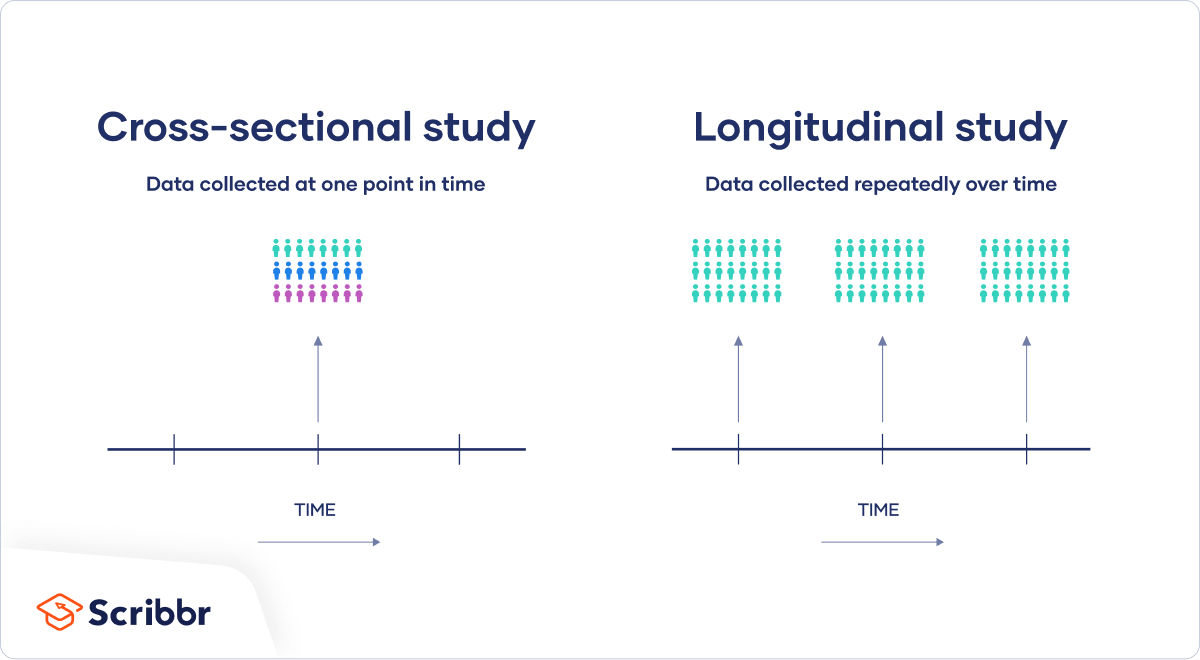
The graphic captures the simplest visual contrast:
| Design | What the researcher does | Typical purpose |
|---|---|---|
| Cross-sectional | Measures a group once | Describe what is true now |
| Retrospective | Looks back using past records or recalled history | Search for earlier exposures or patterns |
| Prospective | Enrolls or identifies a group now and follows it forward | Observe future outcomes |
One caution: a retrospective study may examine several years of old data. That does not make it prospective. The key is that the relevant events had already occurred when the researcher began the study.
Also, the word longitudinal usually signals repeated measurements over time. In this course, prospective and longitudinal are commonly treated together.
A reliable classification routine
Use this two-stage routine whenever you see a study description.
Stage 1: Experiment or observation?
Ask:
Did researchers assign a treatment, alter a condition, or otherwise control participants’ exposure?
- Yes: classify it as an experiment.
- No: classify it as an observational study, then go to Stage 2.
Words that often signal an experiment include:
- assigned
- randomly assigned
- gave
- administered
- required
- imposed
- treatment group
- placebo
Words that often signal observation include:
- surveyed
- asked
- watched
- measured
- reviewed records
- examined files
- tracked naturally occurring behavior
These words are clues, not rules. “Tracked” can describe either type: researchers can track people after assigning a vaccine in an experiment, or track naturally occurring behavior in a prospective observational study. Always check whether a treatment was imposed.
Stage 2: Which observational design?
If no treatment was imposed, ask:
| Question | Classification |
|---|---|
| Were all relevant variables measured at roughly one time? | Cross-sectional |
| Did researchers use records, interviews, or events from the past? | Retrospective |
| Did researchers identify participants now and follow later outcomes? | Prospective |
For this course’s categories, classify an experiment as an experiment first. An experiment may collect outcomes in the future, but you should not replace “experiment” with “prospective observational study,” because it is not observational.
Worked classifications
Study A: A current survey
During one week in March, a random sample of residents is asked about current exercise habits and whether they have been diagnosed with high blood pressure.
Classification: cross-sectional observational study.
The investigators ask questions and impose no treatment, so it is observational. All information is collected during one time period, making it cross-sectional.
Study B: Old records
Researchers examine employee records from the previous decade to determine whether workers exposed to a chemical had a higher injury rate than workers not exposed to it.
Classification: retrospective observational study.
No one is assigned to chemical exposure by the researchers. Both exposure and injuries are already in the past, and existing records are examined.
Study C: Following natural choices
Researchers enroll 500 first-year students this fall, record whether each usually eats breakfast, and follow their academic performance for four semesters.
Classification: prospective observational study.
The researchers start now and follow outcomes forward in time. They do not force anyone to eat or skip breakfast, so it remains observational.
Study D: Imposed study strategy
An instructor randomly assigns students to use either daily retrieval quizzes or conventional review worksheets, then compares final-exam scores.
Classification: experiment.
The instructor assigns the study strategy. Random assignment further strengthens the design because it helps make the groups comparable at the start.
Common traps to avoid
“There are two groups, so it must be an experiment.”
Not necessarily. Groups may arise naturally.
For example, comparing people who smoke with people who do not smoke is observational if researchers merely record existing smoking behavior. It becomes experimental only if researchers actually assign a smoking-related intervention—which would usually be unethical in this case.
“Researchers followed people for years, so it must be prospective.”
Not necessarily. Researchers may begin today and analyze ten years of records. That is retrospective, because the events occurred before the research began.
“A survey is always cross-sectional.”
Often, but not always. A survey conducted today that asks people to reconstruct past exposures may be used for a retrospective study. Look at what period the study is trying to investigate and whether it relies on past information.
“An experiment always proves causation.”
An experiment is designed to investigate causation because researchers control the treatment. But strong causal conclusions depend on sound design, especially appropriate comparison groups, random assignment where possible, adequate sample size, and careful measurement. Observational studies mainly support claims of association, not proof of causation.
Takeaways
Classify a study in this order:
- Check for imposed treatment. If researchers assign or administer a condition, it is an experiment.
- If researchers only observe, identify the time structure.
- One-time snapshot: cross-sectional
- Looking back at completed events: retrospective
- Following a group into future outcomes: prospective
Keep the central distinction clear: in an experiment, researchers determine the treatment or exposure; in an observational study, they record exposures that arise naturally.
Next, you will examine how participants are chosen for a study: identifying sampling methods and spotting likely sources of bias.
Can't find a good explanation? Sign up and we'll make it for you
Sign up