
Hello again. In the previous lesson, you mapped a Global Capability Center (GCC) to the enterprise value streams it supports and chose among extended-office, hybrid, and autonomous-hub operating models. That map establishes where the GCC contributes and how much decision authority it holds.
This lesson focuses on the next practical question: who does what when an enterprise introduces AI? By the end, you will be able to distinguish AI strategy, AI operations, product operations, and technical AI teams by their responsibilities, deliverables, decision rights, and measures of success. This distinction is particularly important in AI Operations and Strategy Manager roles, where blurred accountability is a common reason that promising pilots fail to scale.
Four teams around one AI-enabled outcome
An AI initiative is not owned by “the AI team” in a single, uniform sense. It combines business choices, operational design, product enablement, technical delivery, and ongoing control. The four functions in this lesson address different questions:
| Function | Its central question | Primary contribution |
|---|---|---|
| AI strategy | Where should we invest in AI, and why? | Aligns AI investments to enterprise priorities, value, risk appetite, and capability plans |
| AI operations | How do we run this AI capability reliably and demonstrate value after launch? | Coordinates deployment, adoption, service performance, controls, and continuous improvement |
| Product operations | How can the product organization make sound, repeatable decisions and execute efficiently? | Provides operating processes, product data, feedback systems, launch coordination, and internal enablement |
| Technical AI team | How do we make the solution technically work, safely and reliably? | Designs, configures or builds, evaluates, deploys, and maintains AI systems and their data integrations |
The boundaries are not walls. A mature organization expects these groups to collaborate closely. But collaboration is not the same as shared ambiguity: each function should have a recognizable accountability center.
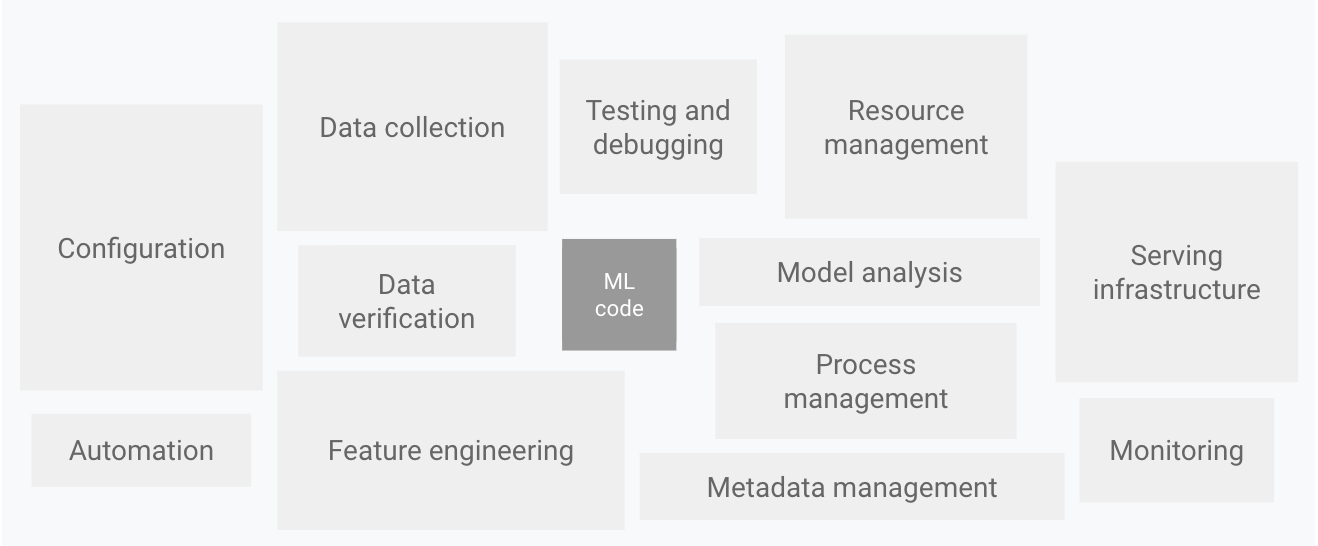
The diagram below is useful as a corrective to the idea that AI is mostly about code. It depicts “ML code” as one component among data collection, data verification, testing, configuration, feature engineering, monitoring, serving infrastructure, and process management. In an AI-enabled operating model, the technical team is essential—but it is only one part of the system required to deliver a reliable business result.
A useful shorthand is:
- AI strategy chooses the right problems and defines the enterprise guardrails.
- Technical AI makes a viable solution.
- Product operations helps the product organization learn, coordinate, and execute.
- AI operations makes the solution work as an ongoing operational service.
The business or process owner remains accountable for the underlying business outcome. For example, an operations leader might own customer-resolution time; none of the four AI functions can claim that outcome in isolation.
AI strategy: direction, portfolio, and enterprise guardrails
AI strategy translates enterprise priorities into a focused, governed set of AI investments. It is not merely a slide deck stating that the company will “become AI-driven.” It is an ongoing discipline of deciding where AI can create value, what not to pursue, what capabilities must be built, and how risks will be governed.
An AI Strategy Manager, AI Center of Excellence (CoE), or equivalent leader typically works on:
- connecting enterprise goals to AI opportunity areas;
- defining the AI ambition, target operating model, and investment themes;
- establishing a demand-intake and prioritization process;
- shaping a portfolio of pilots, products, platforms, and capability investments;
- setting responsible-AI, security, data, and vendor guardrails with specialist owners;
- sponsoring learning, adoption, and organizational capability building;
- measuring portfolio-level value and reporting to executive sponsors.
Suppose a healthcare enterprise has a priority to improve the patient billing experience while safeguarding privacy. AI strategy should not begin with “Which chatbot should we buy?” It should frame the opportunity more rigorously:
“Which patient and agent interactions create avoidable delay or confusion, what information may be used safely, and which AI-supported interventions can improve resolution quality without increasing privacy or billing risk?”
That framing determines whether the organization funds an agent-assist workflow, improves its knowledge base first, runs a limited pilot, or decides that AI is not yet appropriate.
Microsoft’s AI Center of Excellence guidance shows why the strategy role must bridge business and technical concerns: business leaders identify use cases, available data, and model effectiveness, while technical specialists manage the mechanics of data and models.
Establish an AI Center of Excellence - Cloud Adoption Framework
Read Microsoft’s Cloud Adoption Framework guidance to see how an AI CoE combines business leadership, technical expertise, governance, piloting, and service management.
In “Build the AI CoE team,” read the team-composition discussion. Focus on the distinction between business leaders identifying use cases and technical experts handling data and model work. Then, in “Define the responsibilities of the AI CoE,” study the responsibility table. Notice that strategy, intake, standards, pilots, outcome measurement, and AI-service management are distinct responsibilities that may be distributed across several roles rather than assigned to one person.
What AI strategy does not own alone
AI strategy should not unilaterally decide detailed system architecture, approve every operational exception, or become the permanent delivery team for every use case. Its role is to create clarity and coherence across the portfolio.
In a GCC, AI strategy may sit in a central AI CoE, a transformation office, an AI practice, or a business-aligned capability team. The location varies with the GCC operating model from the previous lesson:
- In an extended-office model, strategy may largely come from headquarters, while the GCC supports analysis, pilots, and implementation.
- In a hybrid model, GCC AI strategy leaders may co-own the opportunity portfolio and transformation roadmap with enterprise stakeholders.
- In an autonomous-hub model, the GCC may own a significant AI capability roadmap within enterprise standards and approved investment boundaries.
AI operations: turning an AI solution into a dependable service
AI operations is the discipline of ensuring an AI-enabled workflow delivers value after the initial pilot. This is the most directly relevant area for an operations leader moving into AI.
The scope of AI operations varies by organization. In some firms, it is part of an AI CoE. In others, it sits in platform operations, a transformation office, a product organization, or an operational business unit. Regardless of its reporting line, its concern is practical: Is the solution being used, performing as expected, operating within controls, and improving the intended business process?
Typical AI operations responsibilities include:
- coordinating readiness for launch, including process changes, training, support routes, and stakeholder communications;
- translating operational requirements into delivery priorities and acceptance criteria;
- maintaining the operating rhythm for deployed AI services;
- tracking adoption, output quality, human-review rates, exceptions, costs, and business outcomes;
- managing vendor or platform service relationships;
- coordinating feedback from frontline users into product and technical improvement;
- documenting runbooks, ownership, escalation paths, and evidence for governance reviews;
- identifying performance drift, adoption failures, control failures, or value shortfalls and driving resolution.
The title can be confusing because it overlaps with MLOps. MLOps is primarily a technical engineering practice for reliably deploying and maintaining machine-learning systems, including versioning, testing, deployment automation, monitoring, and infrastructure. AI operations is typically broader and more business-facing: it connects those technical practices to the process, people, controls, adoption, cost, and outcomes of the operational service.
For a no-code AI workflow, an AI Operations Manager may not write model code at all. They might instead ensure that:
- the approved knowledge source is current;
- users know when to trust, edit, or escalate AI output;
- the human-review checkpoint is functioning;
- low-quality outputs are logged and reviewed;
- the vendor is meeting agreed service levels;
- the workflow’s impact on handling time and quality is visible to leadership.
This is not administrative overhead. It is the difference between a demonstration that works once and a capability that can be trusted at scale.
Product operations: enabling the product organization
Product operations, often shortened to product ops, serves the product organization. It improves the systems through which product managers, designers, engineers, customer-facing teams, and analysts discover needs, make decisions, launch changes, and learn from users.
Product ops is often confused with product management. The distinction is important:
- Product management decides what the product should do for customers and why. It owns product direction, customer problems, prioritization, and the roadmap.
- Product operations improves how the product organization operates. It builds the data, processes, tools, feedback loops, and cross-functional coordination that enable better product decisions and execution.
Product Operations: Definition, Role & Manager Guide | Pendo
Read Pendo’s comparison of product operations and product management. It gives a practical way to separate product-team enablement from product direction.
In “Product operations vs. product management: complementary functions,” read the comparison and example. Pay particular attention to the difference between deciding what to build and enabling the team to build, measure, launch, and learn effectively.
In an AI product context, product ops might:
- maintain a consistent taxonomy of user feedback about AI responses;
- coordinate analytics that show where users accept, edit, reject, or escalate AI outputs;
- facilitate launch readiness across support, sales, compliance, operations, and engineering;
- standardize how AI-related experiments and customer insights are reported;
- ensure product teams have reliable dashboards and decision forums;
- support the go-to-market process for a new AI capability.
Product ops is not usually accountable for whether a model is technically accurate, whether an AI workflow complies with privacy policy, or whether a particular business use case belongs in the enterprise portfolio. It makes sure the product organization can see, decide, and execute without wasting product managers’ time on fragmented operational work.
In a smaller GCC or early-stage company, one person may perform AI operations and product operations activities. That can work temporarily, but the two accountabilities should still be named separately. One focuses on the live AI-enabled service; the other focuses on the effectiveness of the product organization that evolves the service.
Technical AI teams: technical feasibility, quality, and reliability
The technical AI team provides the specialized capability that turns an approved use case into a working system. Depending on complexity, this group may include data engineers, data scientists, machine-learning engineers, AI engineers, software engineers, platform engineers, security specialists, and solution architects.
Their work commonly includes:
- assessing data availability, quality, and technical access;
- selecting or configuring an appropriate model or AI service;
- designing data flows, integrations, interfaces, and security controls;
- creating prompts, retrieval mechanisms, evaluations, or model-training approaches as required;
- testing accuracy, robustness, latency, cost, and failure modes;
- implementing deployment, monitoring, version control, and technical incident response;
- maintaining the infrastructure and integrations on which the solution depends.
For a no-code or low-code deployment, technical AI work remains necessary. A visual workflow builder may reduce the need for custom programming, but it does not remove the need to assess data access, identity controls, platform integration, evaluation, logging, reliability, or vendor architecture.
A technical AI team should be deeply involved in deciding whether a proposed solution is feasible. However, it should not independently define the business priority, promise commercial value without baseline evidence, or decide the organization’s risk appetite. Those choices require business, strategy, risk, and operational leadership.
A practical responsibility map
The following table distinguishes the teams through the deliverables they are normally accountable for. “Accountable” does not mean working alone; it means being the clear coordinating owner of that result.
| Decision or deliverable | Primary accountability | Key collaborators |
|---|---|---|
| Enterprise AI ambition and investment themes | AI strategy | Executive sponsors, business leaders, finance, risk, technology |
| AI demand intake and portfolio prioritization | AI strategy | Business owners, AI operations, technical AI, risk and compliance |
| Product roadmap and customer problem definition | Product management | Product operations, AI strategy, business owners, technical AI |
| Product data, feedback loops, and launch coordination | Product operations | Product management, customer support, analytics, AI operations |
| Data architecture, model choice, evaluation design, and integrations | Technical AI team | AI operations, security, data owners, product team |
| User readiness, operating procedures, human-review process, and support model | AI operations | Business process owner, product operations, technical AI |
| Live AI workflow performance, adoption, operational quality, and cost visibility | AI operations | Technical AI, business owner, product operations |
| Technical reliability, model behavior, platform monitoring, and remediation | Technical AI team | AI operations, platform engineering, security |
| Portfolio value reporting and scale-or-stop recommendations | AI strategy | AI operations, finance, business owners, executive sponsors |
The key pattern is that strategy owns choice and coherence, technical AI owns technical integrity, product operations owns product-team enablement, and AI operations owns repeatable operational performance.
One GCC example: AI-assisted billing-query resolution
Consider a GCC that supports patient billing queries for a healthcare enterprise. The enterprise wants to reduce query-resolution time and improve first-contact resolution while protecting personal and healthcare-sensitive information.
The roles could work as follows:
AI strategy
The AI strategy lead frames the opportunity as a portfolio decision rather than a technology purchase. They assess the expected value, data constraints, regulatory risk, and alternatives. They may recommend a limited pilot of an agent-assist capability that retrieves approved billing-policy guidance for customer-service representatives.
Their success measure is not merely “a pilot launched.” It includes a justified decision about whether the initiative merits further investment, based on strategic fit, risk posture, adoption evidence, and validated business value.
Product operations
The product ops lead builds the feedback system around the agent experience. They define how representatives flag unhelpful suggestions, how themes are categorized, what dashboard product managers see, and how frontline insights are gathered during rollout. They coordinate launch readiness with training, support, and communications teams.
Their success measures might include feedback completeness, reporting quality, launch coordination, and the speed with which product teams can identify high-friction user journeys.
Technical AI team
The technical AI team determines how the workflow can access approved information without exposing unauthorized data. It configures the AI solution, implements the required connections, defines evaluation tests, and investigates technical issues such as incorrect retrieval, high response times, or unreliable output.
Its success measures include evaluation performance, system reliability, latency, security-control implementation, and successful remediation of technical defects.
AI operations
The AI operations lead designs the live service model. They specify when an agent may use the AI response, when human review is mandatory, where exceptions go, who reviews recurring issues, and how the enterprise monitors usage and value. After launch, they run the regular performance review, bringing together operational metrics, user feedback, technical monitoring, risk signals, and cost.
Their measures include adoption, handling-time change, first-contact resolution, escalation rate, human-override patterns, compliance exceptions, and ongoing service cost.
No one team can declare success independently. Faster handling time is not success if privacy is compromised; a technically accurate system is not success if representatives will not use it; high adoption is not success if it produces no meaningful operational improvement.
Designing the organization: central standards, distributed delivery
Early in an enterprise AI journey, a central AI CoE often provides useful coordination: common standards, skills, intake, governance, and reusable assets. As adoption grows, a purely central model can create bottlenecks. Delivery responsibilities increasingly need to sit with product, platform, and operational teams, while the central group evolves toward advisory, governance, and portfolio-management work.
Microsoft describes this transition explicitly: as delivery is embedded in platform operations and frontline teams, the CoE can focus on guidance and guardrails rather than acting as a gatekeeper for every initiative.
The following video gives a senior-leadership perspective on this hub-and-spoke structure: a central AI capability provides coordination and shared expertise, while business units retain proximity to real operational problems and opportunities.
AWS re:Invent 2025 - A leader's guide to AI strategy and implementation (SNR305)
In “A leader’s guide to AI strategy and implementation,” AWS Events explains why AI leadership must coordinate an ecosystem rather than try to own every initiative centrally.
Watch AI organization design. Focus on the discussion of the Chief AI Officer’s role, hub-and-spoke structures, the innovation ecosystem, and the “AI translator” role that balances business problem-solving with AI fluency. Relate this to a GCC that may operate as a central hub, a business-aligned spoke, or both.
For interviews and stakeholder conversations, avoid defining these roles by job titles alone. Titles vary widely. Instead, ask four questions:
-
Who decides whether the use case deserves investment?
This is primarily AI strategy, with executive and business sponsorship. -
Who decides what user or customer problem the product should solve?
This is primarily product management, supported by product operations. -
Who decides whether the system is technically feasible, secure, accurate enough, and reliable?
This is primarily the technical AI team, alongside security, data, and architecture owners. -
Who ensures the solution is adopted, monitored, controlled, and improved in the real workflow?
This is primarily AI operations, with the business process owner and technical team.
Common boundary mistakes
Several mistakes repeatedly create delays and poor accountability:
-
Treating AI strategy as a one-time roadmap exercise.
Strategy must continue through portfolio reviews, investment choices, governance, and capability development. -
Assigning AI operations only administrative tasks.
AI operations should own the service-management rhythm and make performance, risk, adoption, and value visible. -
Using product operations as a substitute for product management.
Product ops enables better decisions and execution; it does not replace ownership of customer problems and product direction. -
Expecting technical teams to prove business value alone.
Technical evidence can show feasibility and system quality. The business owner and AI operations function are needed to validate operational value. -
Centralizing every decision in the AI CoE.
Central standards can support scale, but frontline teams need enough authority to deliver and improve solutions in their contexts.
Key takeaways
The four functions differ by the question each is accountable for answering:
- AI strategy aligns investments to enterprise goals, manages the AI portfolio, sets direction, and coordinates guardrails.
- AI operations runs AI-enabled workflows as dependable services, connecting adoption, operational performance, controls, costs, and continuous improvement.
- Product operations equips product teams with reliable processes, product intelligence, feedback loops, and launch coordination.
- Technical AI teams make AI systems technically feasible, secure, evaluated, deployed, and reliable.
For an AI Operations or Strategy Manager role, the most valuable habit is to make accountability explicit. When an initiative stalls, ask whether the problem is one of strategic choice, product-team enablement, technical integrity, or live operational performance—then bring the right owners together.
Next, you will practice translating an enterprise priority into a clear AI mandate for a GCC: a concise statement of the outcome, scope, authority, constraints, and measures that guide AI work without creating confusion about ownership.
Can't find a good explanation? Sign up and we'll make it for you
Sign up