
Hello, and welcome to the first module of this course. We begin with the operating context in which AI Operations and Strategy Manager roles increasingly sit: the Global Capability Center (GCC).
A GCC is not simply an offshore delivery location. At its most basic, it concentrates talent and work for a global enterprise; at its most mature, it owns capabilities, platforms, and business outcomes that are central to the enterprise strategy. Your task as an operations leader is to make the connection explicit: what enterprise value is being created, through which end-to-end value stream, and with what degree of ownership should the GCC contribute?
By the end of this lesson, you will be able to map a GCC operating model to the value streams it supports, rather than describing the center only by headcount, functions, or cost savings.
Start with the enterprise outcome, not the GCC function
A value stream is the end-to-end set of activities, decisions, systems, and teams that turns a need into a valued outcome for a customer, employee, partner, or the enterprise. In a digital product setting, for example, a value stream might begin with an idea and end when a usable feature reaches a customer. In operations, it might begin with a customer order and end when payment is received accurately.
This differs from a functional view of the organization:
- A functional view asks, “What does Finance do? What does IT do?”
- A value-stream view asks, “How does the enterprise deliver a reliable outcome from beginning to end, across Finance, IT, Operations, and other teams?”
That distinction matters because GCCs have historically been organized around discrete service functions, such as HR, Finance, IT, and Procurement. Increasingly, enterprises expect them to support integrated outcomes that cross those boundaries.
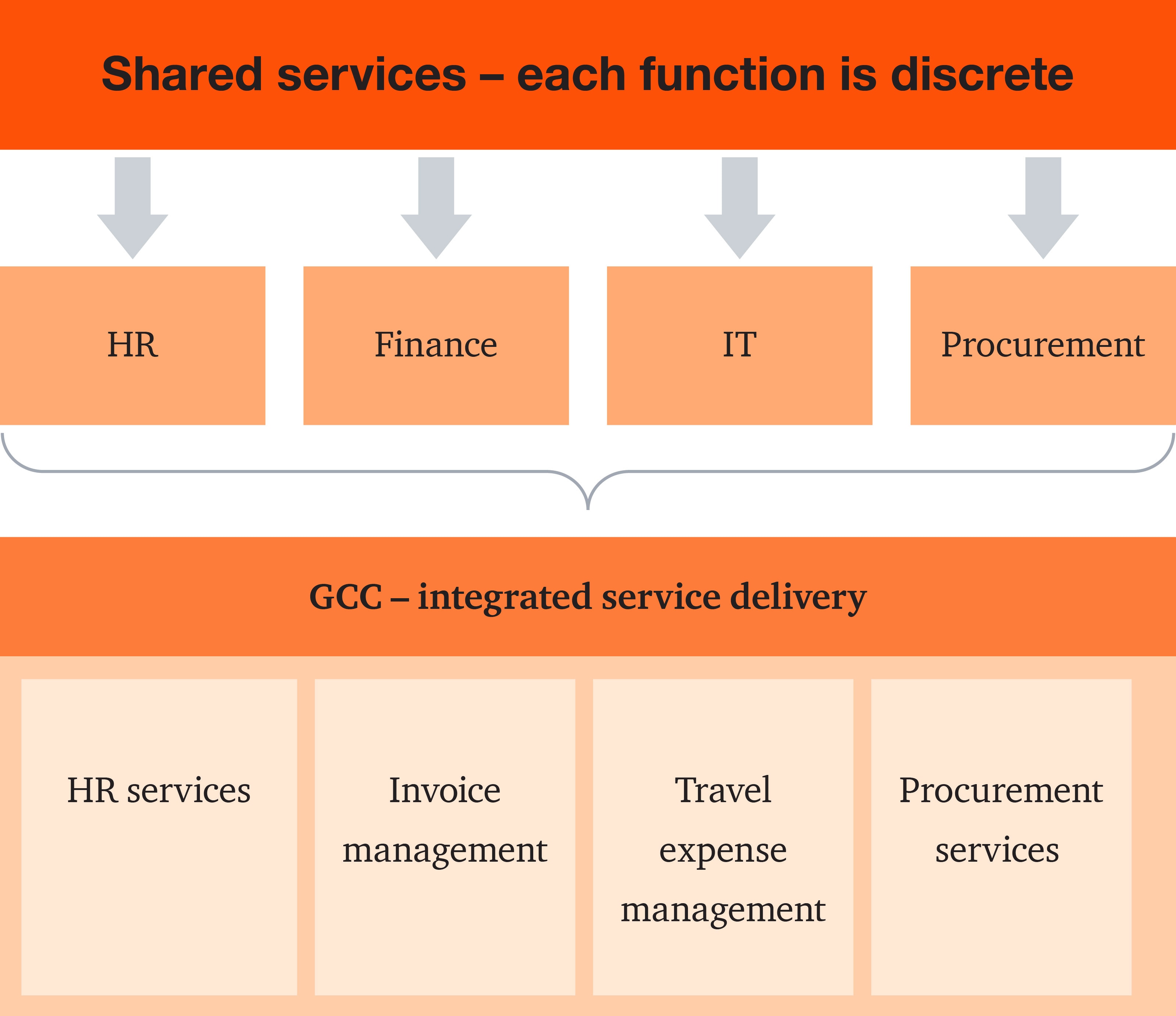
Common enterprise value streams include:
| Enterprise outcome | Illustrative value stream | Possible GCC contribution |
|---|---|---|
| Grow digital revenue | Customer discovery, purchase, fulfillment, retention | Product engineering, analytics, customer operations, experimentation |
| Improve customer experience | Customer request through resolution | Contact-center operations, knowledge management, workflow improvement |
| Reduce operating cost and cycle time | Request through completion | Transaction processing, process redesign, automation operations |
| Improve cash flow | Order through invoice and payment | Billing, collections analytics, invoice operations, dispute resolution |
| Strengthen product delivery | Product idea through customer release | Engineering, quality assurance, platform operations, product operations |
| Improve workforce productivity | Employee hire through effective performance | HR operations, learning platforms, employee-service delivery |
| Manage risk and compliance | Event or transaction through review and closure | Controls operations, audit support, fraud detection, regulatory reporting |
A value stream is not necessarily a single process and it is not identical to a department. “Invoice management,” for instance, can involve procurement data, supplier interaction, workflow tooling, finance controls, and payment operations. A GCC may own one segment of that stream, coordinate several segments, or hold end-to-end accountability.
To ground the concept in a technology-delivery context, watch this short introduction to value-stream management.
What is Value Stream Management?
In “What is Value Stream Management?” by IBM Technology, Eric Minich introduces the core discipline of viewing delivery as one connected system rather than separate team activities. This is a useful lens for deciding where a GCC fits in an enterprise.
Watch the introduction. Focus on the idea that every step from an initial business idea to the end user belongs to one system of value delivery. Apply that same logic beyond software: a GCC can support an entire enterprise outcome even when the work spans several functions.
The point is not that every GCC must own every step. It is that its scope should be described in terms of the outcome and portion of the flow supported, not merely in terms of activity volume.
The three GCC operating models
An operating model specifies how authority, accountability, governance, funding, talent, and delivery responsibility are arranged between headquarters and the GCC. The same enterprise can use different models across different value streams. For example, it might retain close headquarters control over regulatory reporting while allowing an autonomous GCC to own a global developer platform.
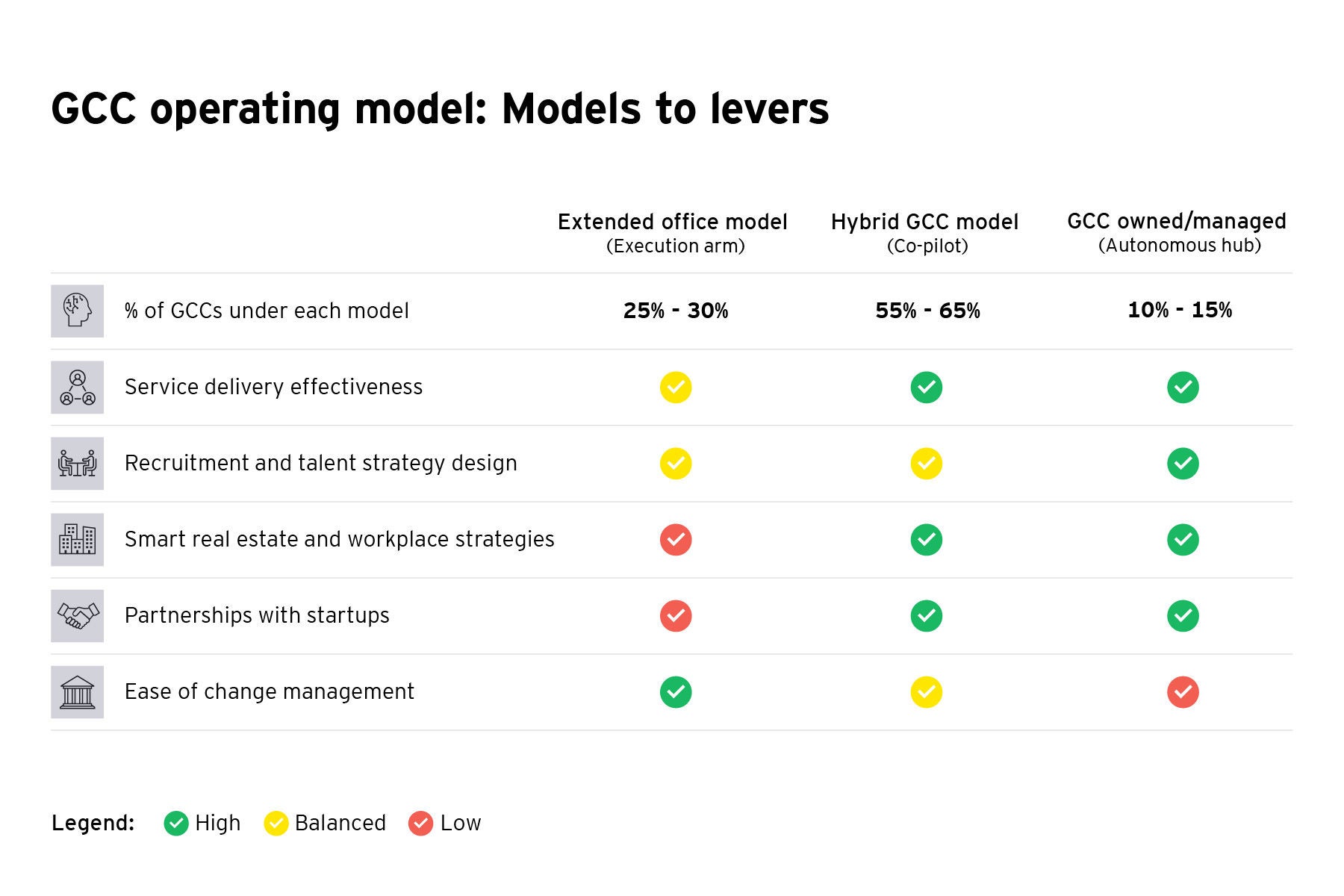
EY describes three broad models: the extended office, the hybrid GCC, and the GCC-owned or managed model, also called an autonomous hub.
Why GCC operating models offer a new competitive advantage | EY - India
Read EY India’s model-wise overview to establish the distinctions among extended office, hybrid, and autonomous-hub models. Pay particular attention to the location of decision rights: that is what determines how a GCC should be mapped to a value stream.
In the “A model-wise view” section, read all three subsections: “Extended office,” “Hybrid office,” and “GCC-owned / managed model (autonomous hub).” Begin with the extended-office description, then read through the hybrid model, and finish with the autonomous-hub accountability statement. As you read, note who retains strategy, budgets, technology choices, and outcome accountability in each model.
1. Extended office: an execution arm
In an extended office model, headquarters or the business unit largely defines the strategy, process design, policies, technology choices, and budget. The GCC supplies standardized execution at scale under close oversight.
This is often the right model when the work is:
- stable and high-volume;
- strongly standardized;
- sensitive to regulation or operational risk;
- newly transitioned to the GCC; or
- best managed through consistent global policies.
The GCC creates value primarily through reliable delivery. Its position in a value stream is usually a defined operational stage or a tightly bounded set of activities.
For example, in a procure-to-pay value stream, an extended-office GCC might process invoices, manage supplier master-data requests, and resolve straightforward exceptions. Headquarters determines controls, process rules, and transformation priorities.
Typical measures include:
- service-level agreement compliance;
- cost per transaction;
- error rate;
- turnaround time;
- backlog volume; and
- control adherence.
These are valid measures, but they primarily evidence execution efficiency, not broad ownership of the enterprise outcome.
2. Hybrid GCC: a co-pilot for outcomes
In a hybrid model, headquarters retains strategic direction, but the GCC has greater authority to improve delivery, redesign processes, shape solutions, and contribute selective innovation. Governance and decision-making are shared.
A hybrid GCC is appropriate when the enterprise needs both control and adaptability. It commonly supports:
- process transformation;
- analytics and digital capabilities;
- product or platform enhancements;
- cross-functional operational improvement; and
- regional or global scaling.
Its contribution to a value stream is broader than execution. It might own operational performance for a segment of the stream and jointly own improvement outcomes with the business.
For example, consider a consumer-technology enterprise with a priority to reduce the time between a merchant application and the merchant becoming active on its marketplace. The value stream is application-to-active merchant.
A hybrid GCC could take responsibility for:
- mapping the onboarding flow and its exceptions;
- redesigning handoffs among operations, risk, and technology;
- managing AI-assisted document review within approved rules;
- monitoring quality, fraud controls, and activation time; and
- proposing improvements through a joint governance forum.
Headquarters still establishes market strategy, risk appetite, and major investment decisions. But the GCC is no longer judged only on how many applications it processed. It shares responsibility for outcomes such as activation time, abandonment rate, compliance quality, and cost to onboard.
3. GCC-owned or managed model: an autonomous value hub
In a GCC-owned or managed model, the GCC has end-to-end ownership of a capability or service. It manages delivery, talent, budgets, improvement, and innovation, while being accountable directly to enterprise leadership for business outcomes.
This does not mean the GCC operates without enterprise governance. It means it has the authority necessary to meet its accountability. Enterprise standards, risk controls, architecture principles, and strategic priorities still apply. The difference is that the GCC is trusted to make many decisions within those boundaries.
This model best fits value streams that are:
- strategically important and digitally enabled;
- global in scale;
- rapidly changing;
- dependent on scarce specialist capabilities;
- closely connected to product, platform, AI, or data ownership; or
- mature enough to benefit from end-to-end accountability.
For the merchant-onboarding example, an autonomous GCC might own the global onboarding platform, operational design, model-performance monitoring, product roadmap, talent plan, and ongoing service performance. Its success measures would move beyond local throughput toward enterprise outcomes such as merchant activation, customer experience, fraud loss, unit economics, and platform reliability.
The operating-model choice affects the ceiling of influence the GCC can have. It does not establish a simple hierarchy in which autonomous is always “better.” An extended office can be the appropriate and high-performing design for a stable, control-heavy activity. The correct model is the one that matches the stream’s strategic importance, risk, need for speed, and required decision rights.
Map the operating model to the value stream
A useful map has five elements:
-
Enterprise priority
What result matters to headquarters? State it in business language, such as improve customer retention, reduce time to market, strengthen regulatory compliance, or increase cash conversion. -
Value stream and outcome
Identify the end-to-end flow that produces that result. Define the outcome at its end, not only the internal activity performed. -
GCC scope within the stream
Be precise. Does the GCC execute a task, operate a process stage, manage a service, own a platform, or own the entire capability? -
Operating model and decision rights
Specify whether the GCC is an extended office, hybrid partner, or autonomous hub for this stream. Record which decisions remain with headquarters and which decisions the GCC can make. -
Outcome measures
Use metrics that reflect the GCC’s real scope. A GCC that owns only transaction processing should not be held solely accountable for enterprise revenue. A GCC that owns an end-to-end platform should not be assessed only by headcount and SLA adherence.
The following map illustrates how the model changes the relationship to the same value stream.
| Mapping element | Extended office | Hybrid GCC | Autonomous hub |
|---|---|---|---|
| Enterprise priority | Improve the cost and reliability of merchant onboarding | Reduce activation time while maintaining risk controls | Build a scalable global merchant-onboarding capability |
| Value-stream scope | Document collection and verification | Application review through activation, with shared ownership of redesign | End-to-end onboarding platform and operating model |
| GCC role | Execute defined, standardized work | Run delivery and improve the process with business and technology teams | Own capability strategy, delivery, talent, roadmap, and continuous improvement |
| Headquarters role | Defines policy, process, systems, budget, and targets | Sets strategy, risk appetite, funding boundaries, and joint priorities | Sets enterprise direction and guardrails; reviews outcomes |
| Decision rights held by GCC | Staffing, work allocation, limited local improvement | Process redesign within boundaries, solution recommendations, delivery choices | Capability roadmap, operating design, talent mix, investment allocation within approved limits |
| Best evidence of value | SLA compliance, accuracy, cost per case | Cycle-time reduction, quality improvement, adoption, reduced rework | Activation and retention impact, control performance, unit economics, platform reliability |
Notice the progression: as GCC authority increases, the unit of measurement shifts from activity, to process performance, to enterprise outcome.
Avoid the “cost center versus innovation center” false choice
GCC maturity is often described as a move from cost center to innovation center. That captures a broad trend, but it can be misleading if treated as a binary choice.
A GCC should make value visible across multiple dimensions:
- Cost and process optimization: lower effort, fewer errors, shorter cycle time.
- Revenue growth: improved conversion, retention, or product adoption.
- Stakeholder experience: better customer, employee, supplier, or internal-user experience.
- Risk, legal, and compliance: more reliable control execution and reduced exposure.
- Skills and innovation: reusable capability, stronger talent, and faster experimentation.
- ESG: outcomes connected to environmental, social, and governance priorities where relevant.
PwC’s framework makes a practical point for operations leaders: performance alone is insufficient if headquarters cannot see how it contributes to enterprise priorities.
Making value visible: A critical imperative for technology GCCs
Read PwC India’s discussion of value visibility and maturity. It provides a practical bridge between a GCC’s delivery metrics and the strategic pillars that matter to headquarters.
First, in “The value management imperative for technology GCCs,” read the value-visibility problem. Continue through the paragraph that introduces the six value dimensions and four strategic pillars. Then move to “How value expectations evolve with GCC maturity,” reading from the maturity and scope discussion. Focus on the difference between horizontal expansion into new capabilities and vertical expansion into deeper ownership of an existing service stack.
Two forms of scope expansion are especially useful when mapping a GCC:
- Horizontal expansion adds a new capability. A GCC that initially provides IT support may add data analytics, cybersecurity, product development, or AI operations.
- Vertical expansion deepens ownership within an existing capability. A GCC may progress from handling a transaction to managing exceptions, improving the workflow, then owning the service end to end.
Neither expansion should be assumed. It should follow from a credible link between the enterprise priority, the GCC’s capability, and the required governance model.
A practical mapping canvas for your role
Use this short canvas when reviewing a GCC initiative, preparing for an interview, or discussing an AI opportunity with a business stakeholder.
| Field | What to write |
|---|---|
| Enterprise priority | The strategic outcome the enterprise is pursuing |
| Value stream | The end-to-end flow that produces that outcome |
| Customer or beneficiary | External customer, employee, business unit, supplier, regulator, or enterprise |
| GCC scope | Specific stages, services, platform, or capability supported |
| Operating model | Extended office, hybrid GCC, or autonomous hub |
| Decision rights | Decisions made by HQ, by the GCC, and jointly |
| Dependencies | Business owner, technology, data, risk, vendors, other regions |
| Success measures | Outcome, process, quality, adoption, risk, and cost measures |
| Evidence of value | Dashboard, baseline comparison, customer metric, audit result, financial analysis, or case study |
Here is a concise healthcare-operations example:
| Field | Example |
|---|---|
| Enterprise priority | Improve the patient financial experience while protecting billing accuracy and privacy |
| Value stream | Patient encounter through accurate bill, query resolution, and payment |
| GCC scope | Claims-status inquiries, billing-query triage, knowledge management, and exception analysis |
| Operating model | Hybrid |
| Why hybrid fits | The GCC needs authority to redesign workflows and improve knowledge access, while clinical, privacy, reimbursement-policy, and risk decisions remain shared with enterprise owners |
| Measures | Query-resolution time, first-contact resolution, billing accuracy, complaints, escalation rate, compliance findings |
| AI relevance | An approved AI workflow may support agent knowledge retrieval or query classification, but only inside defined privacy and quality controls |
The model is chosen because of the nature of accountability, not because “AI” is present. Introducing an AI tool into an extended-office process does not automatically create an autonomous AI hub.
What strong mapping sounds like
Weak description:
“Our GCC supports Finance and uses AI to improve productivity.”
This says little about the enterprise outcome, stream, ownership, or proof of value.
Stronger description:
“The GCC operates the invoice-to-payment exception-management segment for global procurement. It functions as a hybrid partner: headquarters owns payment policy, control standards, and finance strategy, while the GCC owns day-to-day delivery, root-cause analysis, and approved process redesign. Its value is measured through exception cycle time, touchless-resolution rate, supplier experience, duplicate-payment prevention, and cost per resolved case.”
This formulation is useful because it makes clear:
- the relevant value stream;
- the GCC’s bounded scope;
- the operating model;
- the division of decision rights; and
- the evidence expected to demonstrate value.
For an AI Operations or Strategy Manager role, this is the starting point for later decisions about opportunity selection, data readiness, governance, adoption, and value realization.
Key takeaways
A GCC should be mapped to enterprise value streams, not merely to departments or task volumes. The map begins with an enterprise priority and makes explicit the value stream, GCC scope, operating model, decision rights, and success measures.
The three broad models are:
- Extended office: headquarters-led, standardized execution, best suited to stable and controlled work.
- Hybrid GCC: shared governance and shared outcome ownership, well suited to process transformation and capability scaling.
- Autonomous hub: end-to-end capability ownership and direct accountability for enterprise outcomes, suited to strategically important and mature capabilities.
Most importantly, choose the model based on the value stream’s required control, speed, risk profile, strategic importance, and maturity. A mature enterprise may deliberately operate all three models across its portfolio.
Next, we will distinguish the responsibilities of AI operations, AI strategy, product operations, and technical AI teams. That will help you locate your own role within the GCC model you have just learned to map.
Can't find a good explanation? Sign up and we'll make it for you
Sign up