
Hello! Welcome to your fourth lesson on the Venezuelan crisis.
Introduction
In our last lesson, we examined the architecture of the Punto Fijo political system, describing it as an elite pact designed to ensure democratic stability by sharing power and oil wealth. We identified its key features and also its deep-seated vulnerabilities, which made it a form of "feckless pluralism."
Today, we will bring that system to life by mapping the people and groups who operated within it. This lesson directly addresses the learning outcome: Use a Power/Interest Grid to map the key political and economic actors (e.g., political parties, business elites, labor unions, military) in pre-Chávez Venezuela.
You have already studied the Power/Interest Grid in your policy analysis courses. We will leverage that knowledge to move beyond a simple description of the Punto Fijo regime and create a dynamic model of its power structure. This will allow us to visualize who held influence, who had a stake in maintaining the status quo, and, crucially, who was left out. Understanding this landscape is essential to grasping why the system eventually fractured.
Estimated time to complete: 60 minutes.
A Quick Recap: The Punto Fijo System
From our last lesson, remember these key points:
- The system was a duopoly dominated by the AD and COPEI parties.
- It functioned as a patronage network, distributing oil revenues to secure loyalty.
- It was an elite pact, with decision-making concentrated among party leaders, business elites, and union bosses.
- Its stability was contingent on high oil prices.
Now, let's identify the specific actors who made up this elite and map their influence.
1. The Tool: A Refresher on the Power/Interest Grid
As you know from your policy work, a Power/Interest Grid is a simple but powerful tool for stakeholder analysis. It helps us categorize actors based on two key dimensions:
- Power (or Influence): An actor's ability to affect outcomes, block or advance policy, and command resources.
- Interest: The degree to which an actor is affected by the outcomes or has a stake in the system.
Let's watch a quick video to refresh the core concepts and terminology. Pay attention to the four quadrants and the strategy associated with each.
(Watch from 00:55 to 03:11)
The video outlines a classic 2x2 matrix, which we can visualize like this:
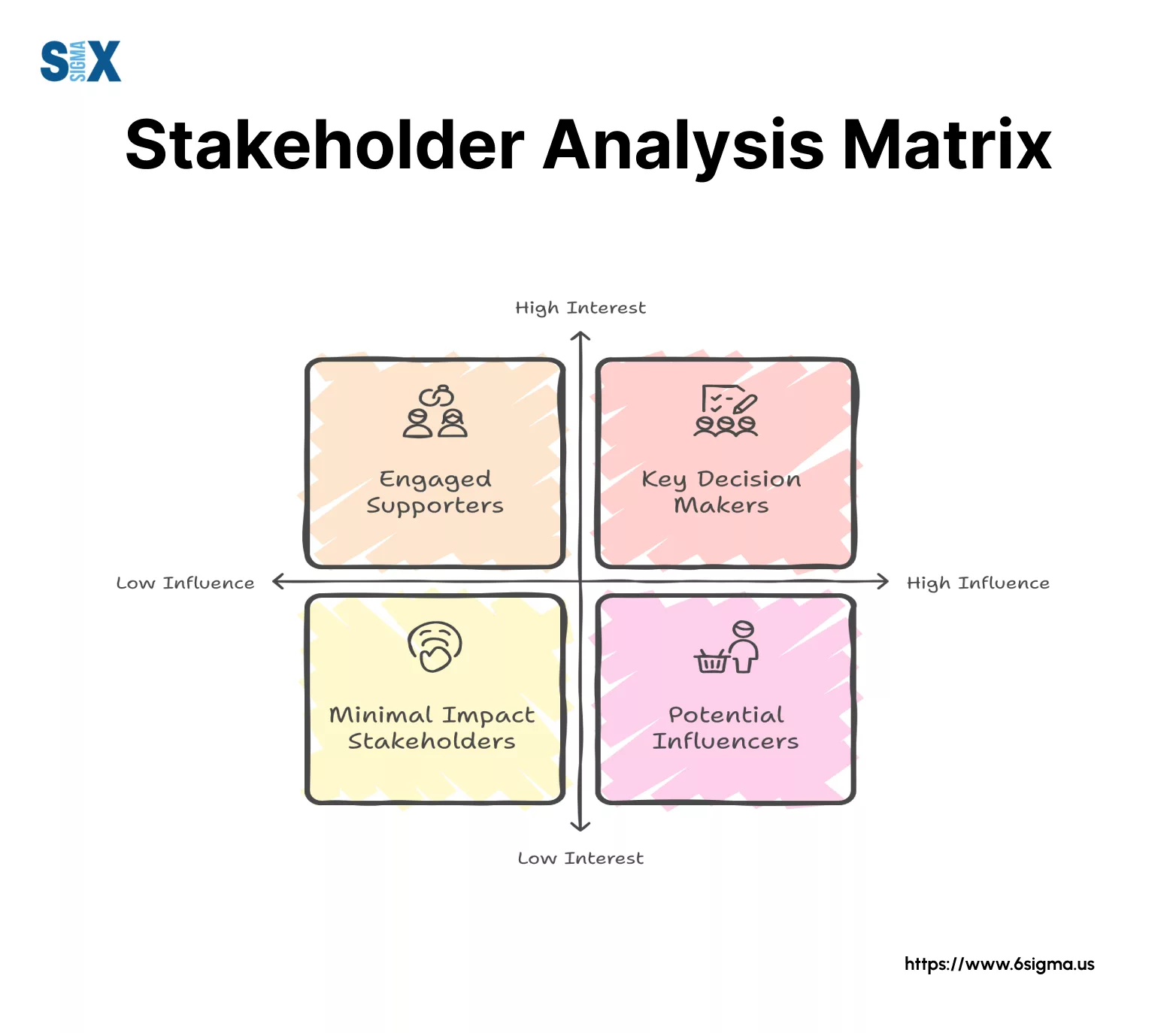
This is a standard Power/Interest Grid. The vertical axis measures an actor's power/influence, and the horizontal axis measures their interest in the project or system. This divides the landscape into four quadrants, helping to prioritize engagement and analysis.
Our "project" in this case is the Punto Fijo political system itself. Our goal is to place the key actors of pre-Chávez Venezuela into this framework.
2. Identifying the Actors and Their Stakes
Before we can map the actors, we need to identify them and understand their roles and motivations. The period of transition from dictatorship to democracy in 1958 is a perfect case study, as it reveals what each group wanted and what they were willing to compromise on.
First, read this short section for a concise overview of the main players who established the post-1958 democratic order.
Reading: The Roots of Venezuela's Failing State
The Roots of Venezuela's Failing State | Origins (The Military, Democratization, and “Partyarchy”)
(Reading time: ~5 minutes)
This text confirms the central role of the military, the main political parties (AD and COPEI), and business interests. It introduces the concept of concertación—a system of consultation between these powerful groups.
Now, let's go deeper. The following academic text by Terry Karl provides a masterful analysis of the negotiations and compromises that created the Punto Fijo system. As you read the suggested excerpts, focus on identifying what each group gained from the 1958 pacts and what power they brought to the table.
Reading: Petroleum and Political Pacts by Terry Karl
WORKING PAPERS (The Politics of Transition: 1957-1958; Negotiating Democracy: The Political and Economic Pacts of Elites)
(Reading time: ~15-20 minutes)
Focus your reading on these two sections:
- "The Politics of Transition: 1957-1958": This section details the motivations of the entrepreneurs, the Church, and the military in turning against the Pérez Jiménez dictatorship. It shows what they were trying to protect.
- "Negotiating Democracy: The Political and Economic Pacts of Elites": This is the most crucial part. It explains the final deal. Note what the military, the Church, the economic elites, and the political parties each received in the final settlement.
Based on these readings, let's summarize the key actors and their positions.
-
The Political Parties (AD & COPEI):
- Interest: Their interest was maximal. The pact gave them the "right to rule." They controlled the state, the ministries, and the distribution of oil money. The system was their creation and the source of their power.
- Power: Extremely high. They could mobilize voters and their affiliated unions, write laws, and control the national budget.
-
Economic Elites (Industrialists, Bankers, Fedecámaras):
- Interest: Very high. The pact was a "classic exchange of 'the right to rule for the right to make money.'" It guaranteed their property rights, provided state subsidies and contracts, protected them from expropriation, and ensured a "stable" labor environment.
- Power: High. Their economic power was immense. They had the support of foreign capital and the U.S. government. Their withdrawal of support was critical to the downfall of the previous dictatorship, and their buy-in was essential for the new democracy.
-
The Military:
- Interest: Medium. Their primary interest was not in day-to-day politics but in their own institutional survival, prestige, and modernization. The pact guaranteed them a generous budget, new equipment, and autonomy from political interference, effectively making them an "apolitical, obedient, and nondeliberative body."
- Power: High. They held the ultimate veto: the monopoly on force. While they agreed to return to the barracks, the threat of a coup always loomed, ensuring their core interests were respected. They were a latent, but decisive, power.
-
Organized Labor (e.g., CTV):
- Interest: High. The system gave them official recognition, the right to organize, and access to the state through their alliance with the AD party. The leadership benefited from political influence and patronage.
- Power: Medium. Their power was significant but derived largely from their connection to the ruling parties. They could mobilize workers for strikes or for political support, making them an important partner in the governing coalition.
-
The Church:
- Interest: Medium. Its interest was to secure its position in society, particularly in education, and to receive state subsidies, which the pact guaranteed.
- Power: Low to Medium. Its power was primarily moral and social, not directly political or economic. It was an influential voice but not a primary decision-maker.
-
The Excluded (Urban Poor, Students, Non-Unionized Workers):
- Interest: High. They were the most affected by economic policy, inflation, and the quality of public services. Their well-being was directly tied to the state's performance.
- Power: Very Low. By design, the Punto Fijo system excluded them. They had no formal channels to voice grievances or influence policy. They were recipients of state largesse during booms but had no seat at the table.
3. Activity: Mapping the Actors
Now it's your turn to apply your analytical skills. Below is a blank Power/Interest Grid. Based on the analysis above, place each of the six actors we've identified into the quadrant that you believe best represents their position within the Punto Fijo system during its stable period (roughly 1960s-1970s).
Actors to Map:
- Political Parties (AD/COPEI)
- Economic Elites
- The Military
- Organized Labor
- The Church
- The Excluded
A blank 2x2 grid with 'Low' to 'High' Power on the y-axis and 'Low' to 'High' Interest on the x-axis. The quadrants are labeled: Keep Satisfied (High Power, Low Interest), Key Players (High Power, High Interest), Monitor (Low Power, Low Interest), and Keep Informed (Low Power, High Interest).
(Take 5-10 minutes to think about where each actor belongs. There isn't one single "correct" answer, but your placement should be justifiable based on our readings.)
4. Discussion: A Model of the Punto Fijo Power Structure
Here is my completed grid. Compare it with yours and consider the reasoning for the placements.
A completed Power/Interest Grid showing the placement of key actors in pre-Chávez Venezuela. 'Political Parties' and 'Economic Elites' are in the 'Key Players' quadrant. 'The Military' is in the 'Keep Satisfied' quadrant. 'Organized Labor' and 'The Excluded' are in the 'Keep Informed' quadrant, with Labor higher on the power axis. 'The Church' is in the 'Monitor' quadrant.
Justification:
- Key Players (High Power, High Interest): The Political Parties and Economic Elites are squarely in this quadrant. They designed the system, benefited most from it, and actively managed it together. This was the core of the concertación.
- Keep Satisfied (High Power, Low Interest): The Military fits perfectly here. They had the power to overthrow the system but had little interest in running it, provided their budget, autonomy, and prestige were guaranteed. The strategy of the political elites was to keep them happy and in the barracks.
- Keep Informed (Low Power, High Interest): This quadrant is revealing. Organized Labor sits here, with more power than the others in this group due to its political connections, but still subordinate to the party leadership. Below them, with almost no power, are The Excluded. They had a huge interest in the system's performance but were systematically ignored. The strategy of the elites was to "keep them informed" (or, more accurately, pacified) with subsidies, but not to give them a real voice.
- Monitor (Low Power, Low Interest): The Church fits here. It was not a primary driver of the political or economic system, but it was an institution that the elites needed to monitor and manage to avoid opposition.
This grid visually represents the "feckless pluralism" we discussed. It's a system run by and for the "Key Players," who buy the acquiescence of the "Keep Satisfied" group, while managing their junior partners and ignoring the powerless.
Conclusion
Today we moved from theory to practice, using a core tool from your policy analysis toolkit to build a model of the Punto Fijo power structure. This exercise visualizes the elite consensus that provided Venezuela with 40 years of stability, but also highlights the profound exclusivity that was its fatal flaw.
Key Takeaways:
- The Punto Fijo system was dominated by a core group of Key Players: the AD/COPEI political parties and the economic elites.
- The Military was a powerful but passive actor, kept "satisfied" with autonomy and resources in exchange for staying out of politics.
- Groups with a high interest but low power, like Organized Labor and especially the vast population of The Excluded, had no real influence on the system's direction.
- The Power/Interest Grid clearly illustrates the system's elite-driven nature and its inherent vulnerability: a crisis that the Key Players couldn't solve with money would leave them exposed and delegitimized in the eyes of the powerless majority.
Preview of the Next Lesson:
Our grid shows a system that appears stable as long as the Key Players can deliver. But what happens when the money runs out? In our next lesson, we will witness the first major crack in this structure. We will analyze the causes and devastating consequences of the 'Caracazo' riots in 1989, an event where the "Low Power, High Interest" quadrant erupted with a force that shook the foundations of the Punto Fijo regime and set the stage for its eventual collapse.
Can't find a good explanation? Sign up and we'll make it for you
Sign up