
Hello! Welcome to the third lesson in our course on the Venezuelan crisis.
Introduction
In our last two lessons, we established the powerful economic force that shaped modern Venezuela: oil. We explored the theory of 'Dutch Disease' and then analyzed hard data showing how Venezuela's GDP and government spending became dangerously dependent on volatile oil prices.
Today, we shift our focus from the economy to the political structure that was built to manage it. We will examine the unique political system that governed Venezuela from 1958 to 1998. This lesson directly addresses the learning outcome: Describe the key features and power-sharing agreements of the 'Punto Fijo' political system (1958-1998).
You'll learn about the elite pact that ended a history of dictatorships and ushered in four decades of democracy. We will analyze how this system, designed for stability, functioned through power-sharing and the distribution of oil wealth. Crucially, we will also uncover the system's inherent flaws, which ultimately made it too brittle to survive the economic shocks of the 1980s and 90s. Understanding this political framework is essential for grasping why the old order collapsed and gave way to Hugo Chávez.
Estimated time to complete: 60 minutes.
A Quick Recap: The Economic Context
Remember from our last lesson that Venezuela's fiscal policy from 1970-1998 was highly pro-cyclical. The government spent lavishly during oil booms and was forced into painful austerity during busts. This created immense economic volatility and social hardship, particularly after the oil price crash of the 1980s. The political system we are about to study was the arena where the decisions about how to spend that oil money were made.
1. The Need for a Pact: Ending a Cycle of Instability
To understand why the Punto Fijo system was created, we must first appreciate the political chaos that preceded it. For most of its history, Venezuela had been ruled by a succession of military strongmen (caudillos) and dictators. Democratic experiments were brief and often ended in coups.
By 1958, after the overthrow of the latest dictator, Marcos Pérez Jiménez, the country's main political leaders faced a critical choice. How could they build a lasting democracy and avoid repeating the mistakes of the past?
This short video explains the context and the solution they devised.
(Watch from 00:05:04 to 00:05:37)
As the video notes, the key political factions did not trust each other, and no single party was strong enough to govern alone. The solution was not to fight for total control, but to agree to share it.
2. The Deal: Key Features of the Puntofijo Pact
On October 31, 1958, the leaders of Venezuela's three main political parties met at the residence of Rafael Caldera, a house named 'Puntofijo' (Fixed Point), to sign a formal power-sharing agreement.
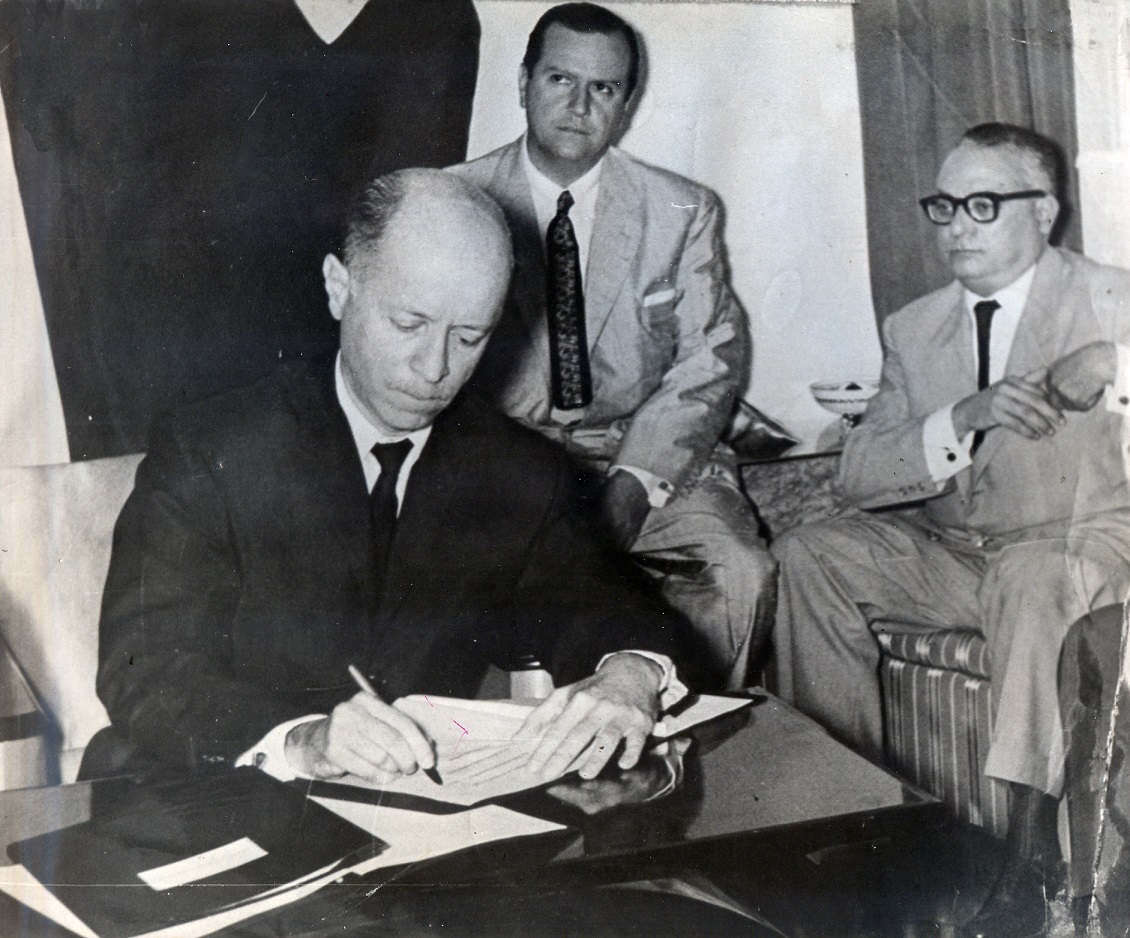
This photograph captures the key signatories of the pact. In the center is Rómulo Betancourt of Acción Democrática (AD), who would become the first president under the new system. To his left is Rafael Caldera of the COPEI party, in whose home the pact was signed. These two men and their parties would dominate Venezuelan politics for the next 40 years.
The pact was a foundational document for the new democratic era. To understand its core components, please read the overview from the Wikipedia entry and then watch the video segment that explains the terms of the deal.
Reading: Puntofijo Pact (Puntofijo Pact Overview) (Study time: ~3 minutes)
Video: (Watch from 00:05:37 to 00:06:47)
Based on these resources, we can identify the key features of the agreement:
- The Players: The pact was signed by Acción Democrática (AD), a center-left party; COPEI, a social Christian party; and the Unión Republicana Democrática (URD), a center-left liberal party.
- The Agreement:
- Pledge to Respect Elections: All parties agreed to recognize the results of the upcoming 1958 election and all future elections, preventing the loser from attempting a coup.
- Formation of "National Unity" Governments: The winning party would not govern alone. It would share power by appointing members of the other signatory parties to cabinet posts and other influential government positions.
- Sharing the Oil Wealth: This was the unwritten, but most important, rule. The parties agreed to use the state's vast oil revenues to fund the government and distribute benefits through a system of patronage to key constituencies like labor unions and business groups.
- Exclusion of the Communist Party: The pact was explicitly anti-communist, a key feature in the context of the Cold War. This helped secure the support of the military and business elites who feared leftist radicalism.
In essence, the Punto Fijo pact was an elite-driven insurance policy against instability. It guaranteed that even if a party lost an election, it would still have access to state power and resources.
3. The System in Practice: "Feckless Pluralism"
The pact succeeded in its primary goal: it created the most stable period in Venezuelan history. However, the system that evolved from it, known as the Punto Fijo regime, developed significant problems.
Scholars like Terry Karl and Thomas Carothers have described this system as a form of "feckless pluralism." This term refers to a state that has the formal institutions of democracy (elections, political freedoms) but where the political elites are perceived as corrupt and ineffective, participation is shallow, and the state itself is weak.
The paper "From feckless pluralism to dominant power system" provides an excellent breakdown of how this applied to Venezuela. Please read the following short section, which lists the characteristics of the Punto Fijo regime as a "feckless pluralism."
From feckless pluralism to dominant power system (Characteristics of Feckless Pluralism in Punto Fijo)
(Study time: ~5 minutes)
Let's summarize the key points from that text:
- A Duopoly of Power: The system quickly evolved into a two-party duopoly dominated by AD and COPEI, who alternated in power.
- Patronage over Policy: The parties operated as vast patronage networks, using oil money to maintain the loyalty of various social classes rather than developing sound, long-term economic policies.
- An Insulated Political Class: As the video mentioned, the elite agreement "by definition, excluded the general public." Decision-making happened behind closed doors among the leaders in Caracas, who became increasingly disconnected from the concerns of ordinary citizens.
- A Persistently Weak State: Despite massive oil revenues, the state's ability to deliver basic services like public safety, health, and education deteriorated. The focus was on distributing money, not on building effective institutions.
4. The Seeds of Decay: In-built Vulnerabilities
Your background in policy analysis has taught you that the design of a system determines its long-term resilience. The Punto Fijo system, while appearing stable on the surface, had deep structural vulnerabilities that made it brittle.
The same academic paper we just looked at identifies four of these "embedded weaknesses." This analysis is crucial because it connects the political system's design directly to the economic problems we studied earlier.
Please read the section detailing these vulnerabilities.
From feckless pluralism to dominant power system (Vulnerabilities and Decay of Punto Fijo)
(Study time: ~10 minutes)
The four vulnerabilities were:
- Dependence on Oil: The system was designed to distribute oil wealth, not to create a diversified economy. This institutionalized the very economic dependency that made Venezuela so vulnerable to price shocks.
- Weak State Capability: The founders neglected to build the state's regulative capacity. When oil income fell, the government lacked the institutional strength to manage the economy or deliver services effectively.
- Entrenched Elites: The "temporary" power-sharing pact became permanent. The founding generation of party leaders became oligarchs who blocked internal party reform and the rise of new leadership.
- Exclusionary Institutions: The pact was an agreement between specific parties, their affiliated unions, and business elites. As Venezuelan society modernized, new groups emerged—the urban poor, intellectuals, middle-class civic associations—but the political system had no room for them. They were marginalized and their grievances ignored.
When the oil price collapsed in the 1980s, these vulnerabilities were exposed. The system had no answers for the ensuing economic crisis because it was built for distributing wealth, not for managing scarcity.
Reflection Activity
Drawing on your understanding of policy, strategy, and history, consider the following:
The Punto Fijo pact can be seen as a classic "elite pact" designed to manage a transition to democracy and ensure stability. However, its success was contingent on a steady flow of oil revenue to satisfy all key players.
Question: What are the inherent risks of founding a political system on such an exclusive, resource-dependent agreement? How might this design choice compromise the state's ability to respond to a major crisis, like the oil price collapse of the 1980s?
(Take about 5-10 minutes to formulate your thoughts. Think about the trade-offs between short-term stability and long-term adaptability and legitimacy.)
Conclusion
Today we have dissected the political engine of pre-Chávez Venezuela. We saw how the Punto Fijo pact was a rational, strategic response to a history of instability, successfully creating a 40-year democratic period.
Key Takeaways:
- The Punto Fijo Pact (1958) was a power-sharing agreement between Venezuela's main political parties (AD, COPEI, URD) to respect election results and govern collaboratively.
- Its key features were the formation of national unity governments, the sharing of oil wealth through patronage, and the exclusion of communists.
- The resulting system evolved into a "feckless pluralism": a two-party duopoly (AD and COPEI) that was formally democratic but dominated by an insulated elite, reliant on patronage, and characterized by a weak state.
- The system's design contained critical vulnerabilities—oil dependency, weak institutions, entrenched elites, and social exclusion—that made it unable to cope with the economic crisis of the 1980s and 90s, leading to a profound loss of public legitimacy.
Preview of the Next Lesson:
We have now identified the key players who held power under the Punto Fijo system: the political parties, business elites, and labor unions. In our next lesson, we will use a Power/Interest Grid—a tool you're familiar with from your policy analysis studies—to visually map these actors and their stakes in the system. This will give us a clear model of the political landscape on the eve of the crisis that brought this entire system down.
Can't find a good explanation? Sign up and we'll make it for you
Sign up