
Welcome. This course is designed to help you build a practical, rules-based swing-trading process across liquid forex, futures, BTC, and ETH markets. We begin with market structure because identical-looking charts can represent very different instruments, contracts, costs, and risks.
By the end of this lesson, you should be able to distinguish spot forex, crypto spot, crypto perpetual futures, and listed futures by what is traded, where it trades, how positions settle, and what keeps a position open or closes it.
One price chart, four different market structures
A chart of EUR/USD, BTC/USD, Bitcoin perpetual futures, or S&P 500 futures may all show candles, support and resistance, and familiar trend patterns. But the contract behind each chart is different.
A useful starting distinction is:
- Spot market: you exchange one asset for another at the current market price.
- Derivative market: you trade a contract whose value is linked to an underlying asset, without necessarily owning that asset.
- Exchange-traded market: a central venue standardizes the contract and matches buyers and sellers.
- Over-the-counter market: parties trade through a network of dealers, banks, brokers, and electronic venues rather than one central exchange.
For a swing trader, structure affects four practical questions:
- What exactly do I own or owe?
- Can the instrument expire or require a roll?
- What recurring costs might I pay or receive while holding it?
- What risks exist beyond being wrong about direction?
The comparison below is the framework for the lesson.
| Feature | Spot forex | Crypto spot | Crypto perpetual future | Listed future |
|---|---|---|---|---|
| What you trade | Exchange of one currency for another | Actual cryptoasset against cash, stablecoin, or another cryptoasset | Derivative contract linked to crypto price | Standardized derivative contract linked to an asset |
| Main venue structure | Global OTC dealer network | Individual crypto exchanges, fragmented across venues | Individual crypto derivatives exchanges | Regulated futures exchange with central clearing |
| Expiry date | No contract expiry in ordinary spot, though retail positions may be rolled | None | None | Yes, a defined delivery or settlement month |
| Asset ownership | Currency exposure; retail arrangement depends on broker | Crypto credited to your exchange account or wallet | No ownership of the underlying crypto | No ownership of the underlying asset merely from holding the contract |
| Long and short access | Usually straightforward through broker | Long is simple; shorting normally requires borrowing or a margin product | Long and short are symmetrical within the contract | Long and short are symmetrical within the contract |
| Important holding effect | Broker financing or rollover may apply | No built-in funding, though borrowing can cost money | Funding payments; margin and liquidation rules | Expiry, potential roll, margin, and daily marking to market |
| Key non-price risks | Broker execution, rollover conventions, OTC pricing | Custody, exchange, transfer, and venue risk | Funding, liquidation, index/mark-price rules, venue risk | Contract specifications, expiry/roll, margin, clearing and execution |
The labels “spot” and “futures” tell you something important, but they do not tell you everything. For example, a retail forex “spot” position held overnight can incur a financing adjustment, while a crypto spot position on an exchange can expose you to exchange custody risk even though you own the asset economically.
Listed futures: standardized contracts with an expiry
A listed futures contract is a standardized agreement to buy or sell a defined quantity of an underlying asset in a stated contract month. The underlying might be an equity index, Treasury note, crude oil, gold, currency, or agricultural commodity.
Watch “What are Futures Contracts?” from CME Group for the institutional structure behind listed futures: standardization, exchange trading, and clearing.
Watch contract basics to see how a futures contract differs from a private forward agreement and why its quantity, quality, and delivery month are specified in advance. Then watch clearing and pricing, focusing on how a central clearinghouse becomes the counterparty to both sides of the trade.
Consider a trader buying one crude-oil futures contract. They have not bought barrels of oil in the ordinary sense. They have bought a standardized futures position. The exact contract size, pricing increment, expiry month, delivery terms, and settlement rules are fixed in the exchange’s contract specification.
Three structural features matter immediately:
1. Standardization
Every participant in the same contract month trades the same contract. If one trader sells a June gold future and another buys it, they do not negotiate the amount of gold or its quality. The exchange has already defined those terms. Price is the principal variable negotiated in the market.
This standardization makes futures highly transferable. A swing trader generally exits by selling a long contract or buying back a short contract, rather than waiting to take delivery.
2. Central clearing
In listed futures, the clearinghouse stands between buyer and seller. It becomes the buyer to every seller and seller to every buyer. This greatly reduces the risk that your original trading counterparty fails to perform.
That does not eliminate risk. You can still lose money from an adverse price move, gaps, leverage, poor execution, or a failure to manage expiry. But the market is not dependent on you personally evaluating the creditworthiness of the trader on the other side.
3. Expiry and settlement
A listed future has an expiry month. At expiry, the contract settles according to its rules:
- Some contracts settle through physical delivery.
- Many financial contracts settle in cash.
- Most swing traders close or roll their position before the delivery or final-settlement process becomes relevant.
Expiry is a fundamental difference from a perpetual future. If you hold a futures position for several weeks, you must know which contract month you own and whether your intended holding period overlaps its expiry. You will address the mechanics and costs of rolling in the futures module; for now, treat expiry as a non-optional item on every futures trade plan.
Spot forex: a decentralized currency market
Spot forex is not one centralized exchange with one official EUR/USD order book. It is a global network of banks, dealers, electronic trading venues, brokers, corporations, and institutional clients.
Sizing up global foreign exchange markets
Read the opening of this Bank for International Settlements article to understand why the foreign-exchange market is structurally different from a centralized exchange.
In the opening section before “Key takeaways,” read the discussion of OTC structure. Focus on the implications of “over-the-counter,” credit relationships, fragmented liquidity, and limited market-wide visibility rather than on the survey statistics.
When you buy EUR/USD in spot forex, you are economically buying euros and selling US dollars. The pair quotation tells you how many US dollars one euro costs. A long EUR/USD position benefits if the euro rises relative to the dollar; a short position benefits if it falls.
However, the way this reaches a retail trader differs from the interbank wholesale market:
- At the institutional level, major participants trade through dealer relationships and electronic venues.
- At the retail level, your broker provides the trading platform, prices, execution method, margin terms, and overnight financing conventions.
- There is no single exchange-wide volume figure or universally identical bid–ask spread for all retail traders.
This does not mean spot forex is inherently illiquid. Major pairs such as EUR/USD, USD/JPY, and GBP/USD are among the world’s most actively traded markets. It means that liquidity is distributed, and the price or execution you receive depends partly on your broker, the session, and current market conditions.
Spot does not always mean “no overnight mechanics”
In wholesale FX, “spot” conventionally refers to near-term currency settlement. Retail traders often hold spot-like positions over multiple days. Brokers commonly roll those positions forward and apply a financing adjustment, often called a swap or rollover.
Therefore, do not confuse a retail spot-forex position with a perpetual future:
- A forex rollover reflects the mechanics and financing conventions of maintaining currency exposure.
- A perpetual-futures funding payment is a transfer mechanism designed to keep a derivative price near its underlying spot price.
Both can affect a swing trade’s outcome, but they arise from different structures.
Crypto spot: acquiring the underlying asset
Crypto spot trading is conceptually closer to buying a share or exchanging currency: you exchange funds for the actual digital asset at the current market price.
What is spot trading in crypto and how does it work?
Read Coinbase’s overview to establish the ownership and order-book mechanics of crypto spot before contrasting it with derivatives.
In “Understanding Spot Trading in Crypto” and “How Spot Trading Works in Crypto,” read the explanation of a spot trade. Then, in “Spot Trading vs. Other Trading Strategies,” read the ownership comparison. Focus on the difference between receiving the asset and merely holding a price-linked contract.
If you buy BTC/USD or BTC/USDT in the spot market, your account is credited with BTC after execution. You may then sell it, transfer it to another wallet, or hold it. If the asset remains on an exchange, you have an account claim on that exchange’s custody system; withdrawing it to a wallet you control changes the custody arrangement.
For trading purposes, crypto spot has several implications:
- No expiry: BTC bought in spot does not mature or require a contract roll.
- No intrinsic funding rate: simply holding spot BTC does not create a perpetual-futures funding payment.
- Long exposure is straightforward: buy BTC, then sell later if your thesis is correct.
- Short exposure is less direct: to short actual spot crypto, you normally need to borrow the asset through a margin facility, creating borrow costs and additional rules.
- Venue fragmentation matters: BTC can trade at slightly different prices across exchanges, against different quote currencies, with different liquidity and custody arrangements.
Spot ownership avoids the liquidation mechanism built into a leveraged perpetual position, but it does not make risk disappear. Crypto spot can still gap sharply, trade continuously through weekends, and expose you to exchange, custody, and transfer risks.
Crypto perpetual futures: derivatives designed not to expire
A crypto perpetual future, often called a perpetual or perp, is a derivative contract that tracks an underlying cryptoasset but has no expiry date. This makes it convenient for traders who want long or short exposure without selecting and rolling contract months.
What Are Binance Perpetual Futures Contracts |Explained for beginners
Watch “What Are Binance Perpetual Futures Contracts” from Binance Academy for a concise visual distinction between ordinary futures and perpetual contracts, followed by the core margin and liquidation concepts.
Watch futures versus spot for the idea of a derivative contract, cash settlement, and fixed expiry in conventional futures. Continue with perpetual mechanics, concentrating on the absence of an expiry date, the role of collateral, maintenance margin, and why liquidation rules matter.
A perp is not ownership of BTC or ETH. If you buy a BTC perpetual, you hold a long derivative position whose profit and loss changes with the contract price. The exchange defines the contract, its collateral assets, its margin rules, its liquidation process, and the index used to help value the position.
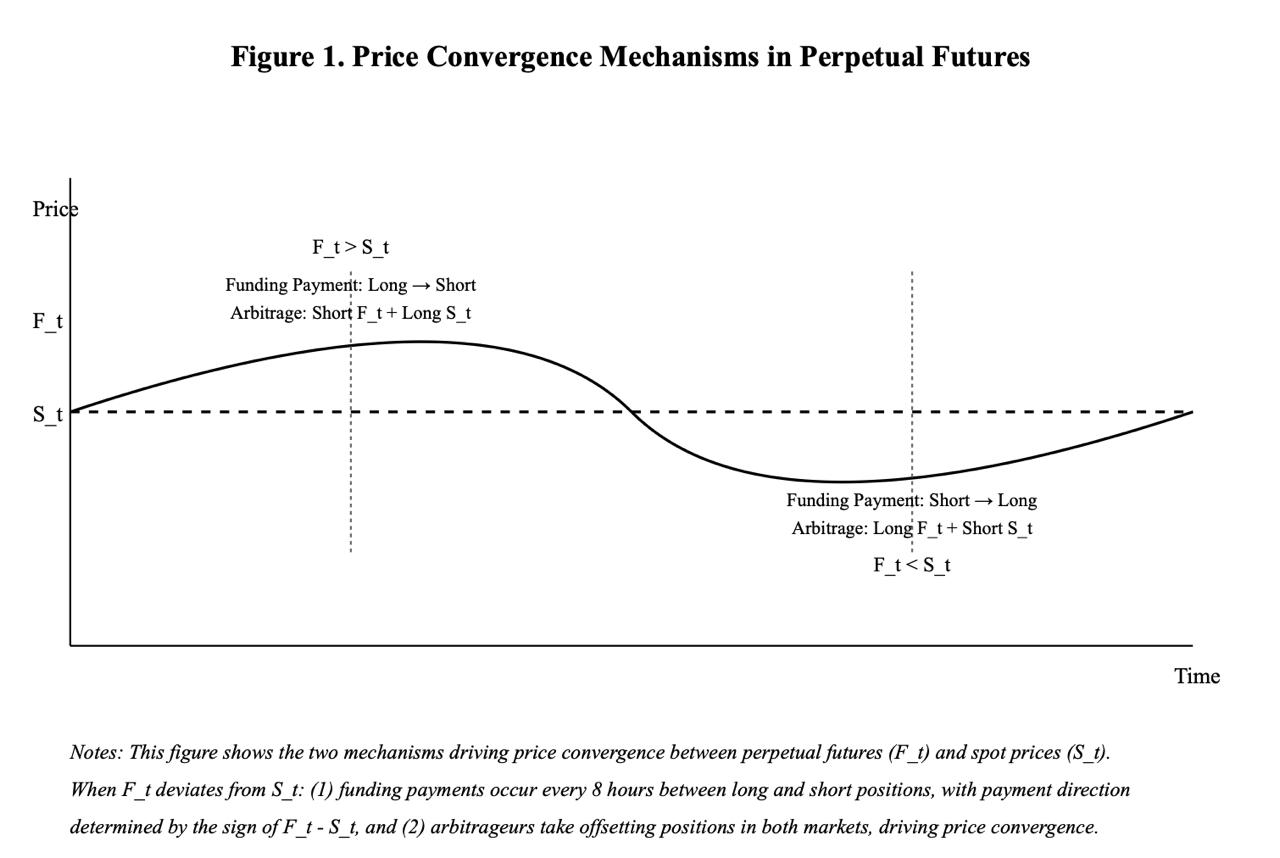
The lack of expiry creates a problem: ordinary futures tend to converge toward the spot price as settlement approaches, but a perpetual has no final settlement date to force that convergence. Perpetual markets therefore use funding and arbitrage incentives.
When a perpetual trades above the underlying spot price, expressed as
the funding rate is often positive. Longs pay shorts. That makes a long position more expensive to maintain and gives traders an incentive to short the perpetual and buy spot, if execution, borrow, and balance-sheet costs permit.
When the perpetual trades below spot,
funding is often negative. Shorts pay longs, encouraging the opposite positioning.
Two cautions are essential:
- Funding is not a prediction tool by itself. Positive funding may signal aggressive long positioning, but price can keep rising while funding remains positive.
- Funding is exchange-specific. Calculation windows, rate caps, mark-price methods, collateral treatment, and liquidation procedures vary across venues. Always check the rules for the exact perpetual contract you trade.
Perpetuals make short exposure and leverage operationally easy, which is why they are widely used. The trade-off is that leverage creates liquidation risk: if your account equity falls below the venue’s required maintenance level, the exchange can forcibly reduce or close the position. The next module will quantify this risk; at this stage, the key point is structural: a spot BTC holding and a BTC perpetual long may express a similar directional view, but they can fail very differently.
A practical way to classify any tradeable chart
Before placing a paper trade, identify the instrument with a short “market-structure label.” For example:
- EUR/USD through a retail broker: OTC spot-currency exposure, broker execution, potential overnight rollover.
- BTC/USD on a spot exchange: ownership of BTC credited to an exchange account, no expiry, exchange-custody exposure.
- BTC perpetual: no-expiry derivative, funding and liquidation rules, exchange-specific mark price and collateral system.
- E-mini S&P 500 future: standardized exchange-traded derivative, centrally cleared, defined expiry month, roll consideration.
Then ask the following questions before using the chart for a swing thesis:
- Am I buying the asset, or a contract linked to its price?
- Does the position have an expiry date?
- What happens if I hold it overnight or for several weeks?
- Can I be liquidated, or is my maximum loss simply the capital committed to the spot position?
- Which institution or venue is responsible for execution, custody, clearing, and settlement?
- Is short exposure native to the instrument, or does it require borrowing?
These questions should come before technical entry analysis. A clean chart setup is not enough if the product’s expiry, funding, financing, or liquidation mechanics conflict with your intended holding period.
Key takeaways
Spot forex, crypto spot, crypto perpetuals, and listed futures can all be used to express a directional swing view, but they are fundamentally different market structures.
- Spot forex is a decentralized OTC market for exchanging currencies; retail trading depends substantially on broker execution and rollover conventions.
- Crypto spot gives economic ownership of the asset, has no expiry, and carries venue and custody considerations.
- Crypto perpetuals are no-expiry derivatives. Funding and arbitrage help keep their price near spot, while margin and liquidation create distinct risks.
- Listed futures are standardized, centrally cleared derivatives with defined expiry and settlement terms. A swing trader must track the contract month and eventually roll or exit.
Next, you will examine the details printed in a futures contract specification: contract size, tick size, tick value, and expiry information. Those details convert the structural understanding from this lesson into numbers you can use to plan real exposure.
Can't find a good explanation? Sign up and we'll make it for you
Sign up