
Welcome back. You have already calculated notional exposure for forex and for BTC or ETH: position quantity multiplied by the relevant price. Listed futures use the same economic idea, but the quantity is usually hidden inside a standardized contract specification.
This matters for swing trading because “one contract” can represent a very different amount of market exposure depending on the market. One E-mini S&P 500 contract, one crude-oil contract, and one gold contract are all single contracts, yet each can represent well over USD of notional exposure. By the end of this lesson, you will be able to read the essential size field in a futures specification and calculate the notional exposure of a futures position.
The contract unit converts “one contract” into a real economic quantity
A listed futures contract is standardized. Instead of choosing any quantity of oil, gold, or an index, you buy or sell a fixed contract unit.
For example:
- One standard WTI crude-oil futures contract represents 1,000 barrels.
- One standard COMEX gold futures contract represents 100 troy ounces.
- One E-mini S&P 500 futures contract uses a USD 50 multiplier per index point.
The contract unit may therefore be a physical quantity, such as barrels or ounces, or a financial multiplier, as with equity-index futures.
CME Group’s short video gives the core idea and three useful examples.
Contract Unit and Notional Value
Watch CME Group’s “Contract Unit and Notional Value” for a compact explanation of how standardized contract units differ across gold, oil, and index futures, and how they determine contract value.
In the opening contract-unit examples, note the three forms a contract unit can take: weight, volume, and a financial multiplier. Then watch the notional calculations, focusing on why each calculation uses the current futures quote rather than a margin figure.
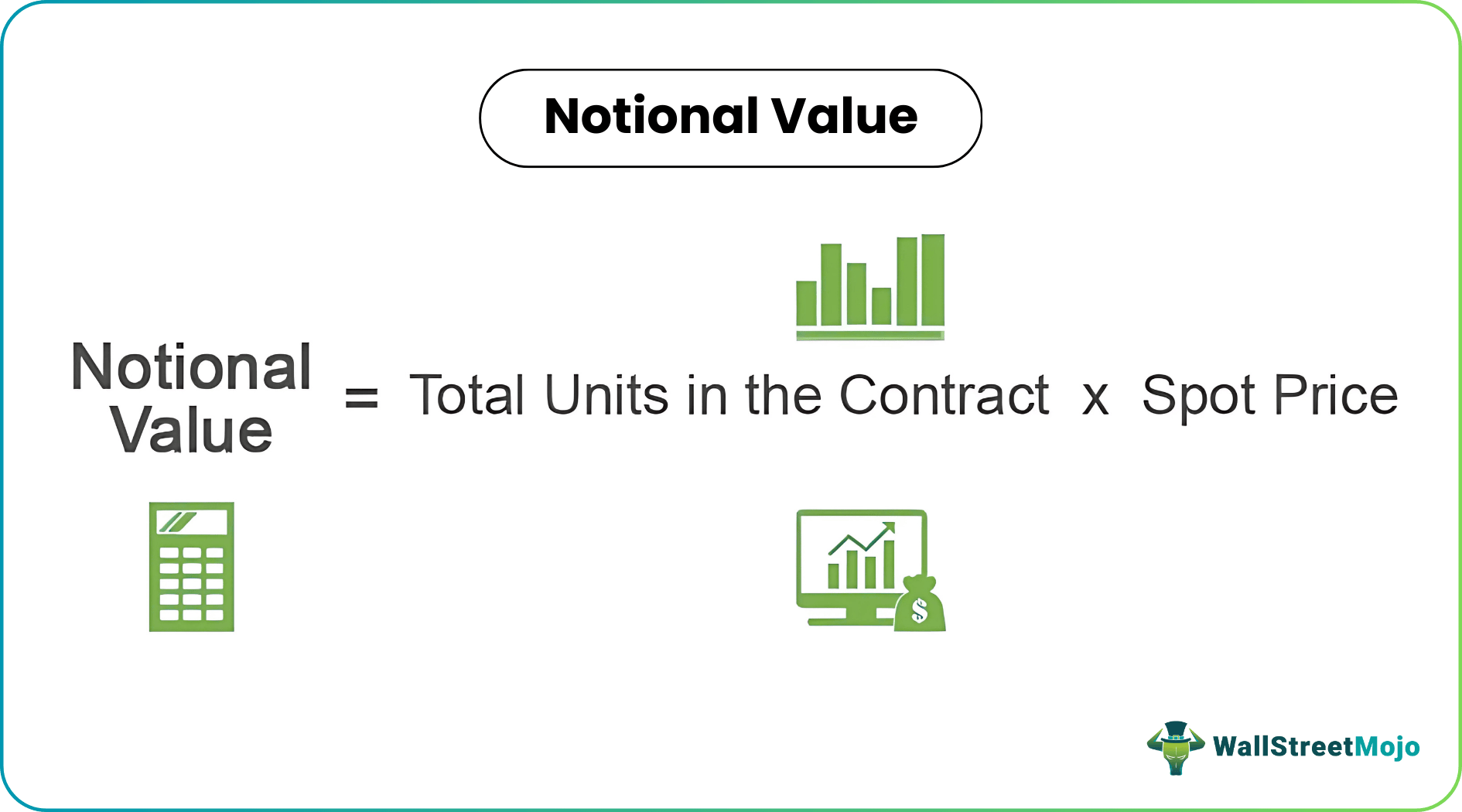
The following formula captures the physical-commodity version:
where:
- is gross notional exposure in U.S. dollars;
- is the number of contracts;
- is the contract unit, such as barrels per contract or ounces per contract;
- is the futures price, quoted in USD per barrel or USD per ounce.
The units explain why the calculation works. For crude oil:
For an index future, the contract specification supplies a monetary multiplier rather than a physical unit:
where is the dollar multiplier per index point and is the futures price in index points.
Four major-futures examples
WTI crude oil: price per barrel
Suppose you are considering a long position in two standard WTI crude-oil futures contracts. The relevant specification and price are:
- Contract unit: barrels per contract
- Futures price: USD per barrel
- Position: contracts
First find the total barrels controlled:
Then value those barrels at the futures price:
The trade is therefore:
Long two crude-oil futures contracts, representing 2,000 barrels and approximately 156,800 USD of gross notional exposure.
The 156,800 USD is not the cash required to open the trade. It is the market value of the commodity exposure represented by the position.
Gold: price per troy ounce
Now consider one standard COMEX gold futures contract at USD per troy ounce.
- Contract unit: troy ounces
- Position: contract
- Futures price: USD per ounce
One standard gold contract therefore represents approximately 235,000 USD of gross notional exposure at that price.
This is why a contract count by itself is not meaningful. “One contract” sounds small, but it can carry substantial exposure.
E-mini S&P 500: multiplier per index point
Index futures do not represent barrels, ounces, or shares held directly. Instead, the contract specification gives a dollar multiplier.
For the standard E-mini S&P 500 future:
- Multiplier: USD per index point
- Futures price: index points
- Position: contract
One E-mini S&P 500 contract at this price has roughly 264,013 USD of notional exposure.
A long position benefits when the index future rises; a short position benefits when it falls. But both have the same gross notional magnitude at the same price.
Micro E-mini S&P 500: smaller contract, same market
The Micro E-mini S&P 500, commonly called MES, is designed to provide a smaller version of the E-mini exposure. Its multiplier is USD per index point rather than USD.
At the same price of :
So one MES contract represents approximately 26,401 USD of notional exposure, one-tenth of one standard E-mini contract at the same futures price.
This smaller scale is often more practical for a paper-trading account that is learning risk-based sizing. A smaller contract is not automatically low risk, but it allows exposure to be adjusted in much finer increments.
Currency futures: connect the contract unit to the exchange rate
Currency futures use a fixed amount of the base currency. For a euro futures contract, the specification states how many euros one contract represents; the quote converts that euro amount into its USD value.
Assume a EUR/USD futures contract represents EUR and trades at USD per EUR. For two contracts:
This position represents:
- EUR of underlying currency exposure;
- approximately USD of gross notional exposure.
If you are long two contracts, you are long EUR and short the USD side of that exchange-rate exposure. If you are short two contracts, the economic direction reverses. The gross notional remains approximately 271,250 USD at that futures price.
This is closely related to your forex-lot calculation. The difference is that the listed futures contract fixes the EUR quantity for you: you choose an integer number of contracts rather than an arbitrary lot size.
What price should you use?
Notional changes as the futures price changes. It is useful to distinguish two valid figures:
| Purpose | Price to use | What it tells you |
|---|---|---|
| Planning a limit order | Your intended limit price | Potential entry exposure if filled |
| Recording an entry | Actual fill price | Entry notional |
| Monitoring an open position | Current futures or mark price | Current gross market exposure |
Suppose one MES contract is bought at .
If the future later trades at , the same one-contract position has current notional exposure of:
The contract count has not changed. Its current dollar market value has.
Always use the quote for the exact expiry contract you intend to trade. A June crude-oil future and an August crude-oil future may have different prices, even though both represent 1,000 barrels. The expiry changes the futures price used in the calculation, not the underlying contract unit.
Notional is not margin, tick value, or planned loss
These terms appear together on futures trading platforms, so keeping them separate is essential.
| Measure | What it answers | Example for one MES near 5,280 |
|---|---|---|
| Notional exposure | How much market value does the position represent? | About 26,400 USD |
| Margin requirement | How much collateral does the broker or exchange requires? | Varies by broker and conditions |
| Tick value | How much does the position change for the minimum price movement? | Defined by tick size and multiplier |
| Planned loss at stop | How much could be lost if the stop is executed as planned? | Depends on entry and stop distance |
For WTI crude oil, CME’s example shows that the contract unit is 1,000 barrels and the minimum tick is USD per barrel. Thus one tick is worth:
That tick value is important later when you size a futures trade to a fixed loss limit. But it is not the contract’s notional value. At USD per barrel, the same crude-oil contract has:
of notional exposure, while each one-tick movement is worth 10 USD.
A small margin requirement or a seemingly manageable tick value should never obscure the full notional exposure.
A reliable specification-reading routine
Before calculating a proposed futures position, identify these four items in the contract specification:
-
Exact product and expiry. Confirm you are looking at the intended contract, not a different delivery month or a similarly named micro contract.
-
Contract unit or multiplier. Look for wording such as “1,000 barrels,” “100 troy ounces,” “125,000 EUR,” or “USD 5 times the index.”
-
Price quotation convention. Check whether the quote is USD per barrel, USD per ounce, USD per EUR, or index points. The quotation must match the units used in your calculation.
-
Number of contracts. Multiply the per-contract notional by the contracts actually filled, not merely the number initially entered in a partially filled order.
A useful verification is to compare the contract unit with the stated tick value. If a specification says crude oil is quoted in USD per barrel, has a USD tick, and represents 1,000 barrels, then a 10 USD tick value is consistent. If your units do not produce the published tick value, revisit the specification before trading.
Add futures notional to your spreadsheet
Use a separate row for each expiry and contract type. A practical layout is:
| Instrument | Expiry | Direction | Contracts | Unit or multiplier | Futures price | Gross notional |
|---|---|---|---|---|---|---|
| MES | Selected expiry | Long | 1 | 5 USD per point | 5,280.25 | 26,401.25 USD |
| ES | Selected expiry | Short | 1 | 50 USD per point | 5,280.25 | 264,012.50 USD |
| CL | Selected expiry | Long | 2 | 1,000 barrels | 78.40 USD per barrel | 156,800 USD |
| GC | Selected expiry | Short | 1 | 100 troy ounces | 2,350 USD per ounce | 235,000 USD |
| EUR/USD futures | Selected expiry | Long | 2 | 125,000 EUR | 1.0850 USD per EUR | 271,250 USD |
If the number of contracts is in cell D2, the unit or multiplier is in E2, and the relevant futures price is in F2, use:
=ABS(D2)*E2*F2
For planning, record the direction separately from gross notional. For example:
Short one E-mini S&P 500 futures contract at approximately 5,280, with gross notional exposure of approximately 264,000 USD.
That sentence communicates the market, direction, contract size, price reference, and exposure far more clearly than “short one contract.”
Key takeaways
A futures contract is a standardized package of exposure. To calculate its gross notional value, multiply the number of contracts by the contract unit or multiplier and by the relevant futures price.
For commodity and currency futures:
For index futures:
At representative prices:
- One standard WTI crude-oil contract can represent about 78,400 USD of exposure.
- One standard gold contract can represent about 235,000 USD of exposure.
- One E-mini S&P 500 contract can represent about 264,000 USD of exposure.
- One Micro E-mini S&P 500 contract can represent about 26,400 USD of exposure.
Notional is the full market exposure, not the margin posted, the tick value, or the loss planned at a stop. Next, you will use the structural information you now have across forex, crypto, and futures to select liquid instruments using volume, open interest, bid–ask spread, and trading hours.
Can't find a good explanation? Sign up and we'll make it for you
Sign up