
Welcome back. In the previous lesson, you converted forex lots into base-currency units and then used the exchange rate to find the position’s notional value. Crypto uses the same underlying idea, but the order size is usually entered directly in BTC or ETH rather than in lots.
For a swing trader, this is the number that tells you the true market scale of a proposed BTC or ETH trade before you consider its thesis, stop, or margin setting. By the end of this lesson, you will be able to calculate the notional exposure of BTC and ETH spot positions, standard USDT-margined perpetual positions, and recognize the different convention used by inverse, coin-margined perpetuals.
Notional exposure: coin quantity multiplied by price
For BTC/USDT or ETH/USDT, the quoted price tells you how many USDT one coin costs.
If BTC/USDT trades at 66,200, then:
If you buy BTC, your notional exposure is:
The general formula is:
where:
- is the notional exposure in USDT;
- is the number of BTC or ETH;
- is the asset’s price;
- the absolute-value bars mean that notional is normally reported as a positive magnitude, whether the trade is long or short.
USDT is designed to track the U.S. dollar, so traders often say “USD notional” for BTC/USDT and ETH/USDT positions. More precisely, the result is USDT notional. In ordinary conditions it is close to USD value, but it is not literally a U.S.-dollar cash position.
The key distinction remains the same as in forex:
- Notional exposure is the full market value of the position.
- It is not the amount of cash posted as margin.
- It is not the amount planned to be lost at a protective stop.
- It is not necessarily the same as the balance displayed in the order ticket.
Reading a BTC limit order
The image below shows a BTC/USDT limit-buy ticket. The order is for BTC at a limit price of 66,200 USDT.
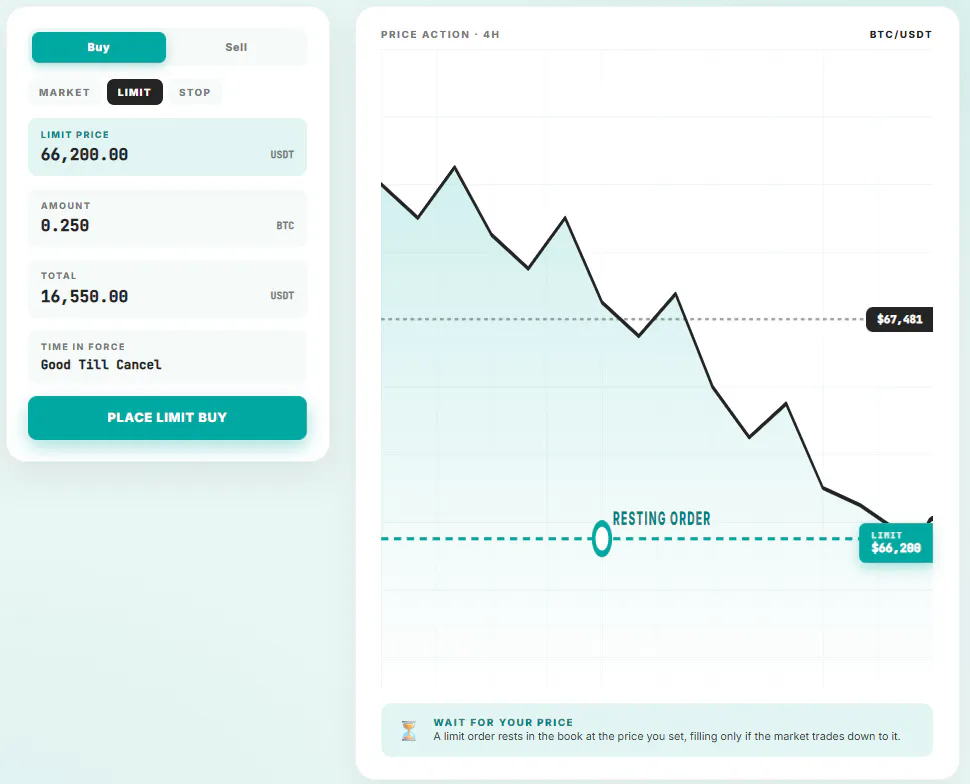
The ticket’s total can be checked directly:
Because this is a resting limit order, it is not yet an open BTC position. It represents potential exposure. Three details matter:
- Before a fill, the position exposure is zero; the order is a commitment to take exposure if filled.
- After a partial fill, calculate exposure using the quantity actually filled, not the original intended quantity.
- After entry, use the current market price, or the platform’s mark price for a perpetual, to monitor marked notional exposure.
For instance, if the full BTC order fills at 66,200 and BTC later trades at 68,000, the marked notional is:
The quantity is still BTC. Its USDT value changes because BTC’s price changes.
Spot: the position represents ownership of the coin
A BTC or ETH spot trade is straightforward. Buying spot means acquiring the asset; selling spot normally means reducing an asset balance you already hold.
Suppose you buy 4 ETH at 3,250 USDT:
Your position can be described as:
“Long 4 ETH, with entry notional of 13,000 USDT.”
Economically, you have exchanged USDT for ETH. Ignoring fees, your USDT balance falls by about 13,000 USDT and your ETH balance rises by 4 ETH.
| Spot action | BTC or ETH exposure | Quote-currency effect | Notional calculation |
|---|---|---|---|
| Buy BTC/USDT | Long BTC | Spend USDT | BTC quantity BTC price |
| Sell BTC/USDT held in account | Reduce or close long BTC | Receive USDT | BTC quantity BTC price |
| Buy ETH/USDT | Long ETH | Spend USDT | ETH quantity ETH price |
| Sell ETH/USDT held in account | Reduce or close long ETH | Receive USDT | ETH quantity ETH price |
A normal spot account does not create a short position merely because you press “sell”: you must own the coin first. Some venues offer margin borrowing for spot shorting, but that is a separate product with additional borrowing and liquidation mechanics.
USDT-margined perpetuals: same notional formula, different instrument
A standard BTC or ETH perpetual contract settled in USDT often lets you enter size directly in coins, such as BTC or ETH. In that common linear contract structure, the notional calculation is identical to spot:
The major difference is not the exposure calculation. It is the nature of the position:
| Feature | Spot | USDT-margined perpetual |
|---|---|---|
| Asset ownership | You own BTC or ETH | You hold a derivative position |
| Can take a short position easily | Usually no | Yes |
| Position expiry | None | No fixed expiry, hence “perpetual” |
| Collateral and P/L | Coin or USDT balances change through the trade | Usually margin and P/L are in USDT |
| Notional for coin-sized order | Coin quantity price | Coin quantity mark price |
BTC perpetual long
Assume you open a long BTC/USDT perpetual position of BTC when the mark price is 65,000 USDT.
You are long BTC of price exposure, with 7,800 USDT of notional exposure.
ETH perpetual short
Now assume you open a short ETH/USDT perpetual position of ETH at 3,200 USDT.
The magnitude of the exposure is 2,400 USDT, but its direction is short. You can write the trade precisely as:
“Short 0.75 ETH through an ETH/USDT perpetual, with entry notional of 2,400 USDT.”
To preserve direction in a spreadsheet, use a signed quantity:
For a long, is positive. For a short, it is negative. Thus the short ETH trade has signed exposure:
Its gross notional remains 2,400 USDT; its signed exposure is negative because it benefits from a price decline.
Position sizing with leverage: how to size crypto futures positions
Read Kraken’s explanation of notional value to reinforce the difference between the full market value of a perpetual position and the margin allocated to it. This distinction will become central in the next module on risk-based sizing and leverage.
In the section “The position sizing formula,” locate the paragraph beginning “Notional value is the total market value of your position at the current price.” Read the notional explanation. Focus on the example of 0.1 BTC: coin quantity times price determines the full exposure, independent of margin. Skip the stop-loss sizing formula for now. Then go to “How leverage affects position sizing.” Inspect the leverage comparison table and read the interpretation below it. The table shows that a fixed notional can require different amounts of margin at different leverage settings; it does not make the position itself smaller.
A leverage setting may change the collateral required by the exchange, but it does not change this core calculation. For example, a 7,800-USDT BTC perpetual is still a 7,800-USDT position whether a platform requires a large or small margin allocation. Later, you will determine whether that exposure is appropriate for account equity and a predefined stop.
Converting a desired USDT amount into BTC or ETH quantity
Some platforms let you enter an order by USDT value rather than coin quantity. In that case, rearrange the same formula:
Suppose you want approximately 5,000 USDT of BTC exposure and BTC is trading at 62,500 USDT:
So 0.08 BTC is approximately 5,000 USDT of notional exposure at that price.
For ETH, suppose the desired exposure is 3,600 USDT while ETH trades at 2,400 USDT:
This conversion is useful for checking an order ticket. If the platform accepts a USDT amount, it calculates the coin quantity for you. If it accepts coin quantity, you should calculate the approximate USDT value yourself before confirming.
For a limit order, use the limit price. For a market order, use the current ask when buying or bid when selling as a practical estimate, because execution may differ slightly from the displayed mid-price.
The important exception: inverse, coin-margined perpetuals
Not every perpetual uses coin quantity as its order-size convention. Some coin-margined or inverse BTC and ETH perpetuals are sized in a number of contracts, with each contract representing a fixed USD face value.
For example, assume an inverse BTC perpetual has:
- 30 contracts;
- contract value of 100 USD per contract;
- BTC price of 60,000 USD.
The USD notional is determined first by the contract specification:
The BTC-equivalent quantity is then:
This is why you must not blindly apply “contract count times BTC price” to an inverse perpetual. The contract’s fixed value is the starting point.
The formulas are:
where:
- is the number of contracts;
- is the USD value per contract from the specification;
- is the asset price in USD per coin.
Notice the units. Dividing USD face value by USD per BTC leaves BTC.
At the same price, a 3,000-USD face-value position corresponds to 0.05 BTC. If BTC falls, the contract’s USD face notional remains 3,000 USD, but the BTC-equivalent quantity used in the exchange’s collateral calculations changes. This is one reason inverse perpetuals require more careful reading of the contract specification and settlement terms.
For routine BTC and ETH paper trading, always identify which of these order conventions your venue uses before calculating exposure:
- Coin quantity: multiply BTC or ETH quantity by price.
- USDT amount: the platform may already display notional; divide by price to check the coin quantity.
- Inverse contract count: multiply contracts by the stated contract value; then divide by price only if you need the coin equivalent.
A compact spreadsheet layout
Add these columns to your trade-planning sheet for BTC and ETH:
| Instrument | Product type | Direction | Quantity | Entry or mark price | Gross notional |
|---|---|---|---|---|---|
| BTC/USDT | Spot | Long | 0.25 BTC | 66,200 | 16,550 USDT |
| BTC/USDT PERP | Linear perpetual | Long | 0.12 BTC | 65,000 | 7,800 USDT |
| ETH/USDT PERP | Linear perpetual | Short | 0.75 ETH | 3,200 | 2,400 USDT |
| BTC/USD PERP | Inverse perpetual | Short | 30 contracts | 100 USD contract value | 3,000 USD |
For coin-quantity spot or linear-perpetual positions, if the coin amount is in cell D2 and price is in E2, use:
Gross notional: =ABS(D2)*E2
For an inverse contract, if contract count is in D2 and USD contract value is in E2, use:
USD face notional: =ABS(D2)*E2
Before submitting a paper order, record a complete exposure sentence. For example:
“I am long 0.12 BTC through a BTC/USDT perpetual at approximately 65,000 USDT, for approximately 7,800 USDT of gross notional exposure.”
Or:
“I am short 0.75 ETH through an ETH/USDT perpetual at 3,200 USDT, for 2,400 USDT of gross notional exposure.”
That wording prevents the common mistake of describing a trade only by its margin or leverage setting, while overlooking its actual market exposure.
Key takeaways
For BTC and ETH spot positions and standard USDT-margined perpetuals:
So:
- BTC at 66,200 USDT is 16,550 USDT of notional exposure.
- ETH at 3,250 USDT is 13,000 USDT of notional exposure.
- A short ETH perpetual at 3,200 USDT has 2,400 USDT gross notional, despite having negative directional exposure.
Spot positions represent ownership of the asset; perpetual positions represent long or short price exposure through a derivative. But for common coin-sized perpetuals, the notional calculation is the same.
For inverse, coin-margined perpetuals, use the contract specification:
Next, you will use the structure information from forex, crypto, and futures to select instruments that are liquid enough for reliable swing-trade execution, using volume, open interest, bid–ask spread, and trading hours.
Can't find a good explanation? Sign up and we'll make it for you
Sign up