Hello! Welcome back.
Introduction
In our last lesson, we saw how the "shadow of the future" transforms your relationship with customers. We used the Prisoner's Dilemma to show why a one-time "defection" (like cutting corners on quality) is a poor strategy compared to the long-term gains from cooperation, which you can foster using a "Tit for Tat" approach. This is the essence of building a premium brand.
Today, we'll apply this same powerful logic to a different set of players: your competitors. The goal of this lesson is to analyze how cooperation with competitors can be sustained in a repeated game. This might sound counterintuitive—aren't you supposed to beat your competitors? Yes, but not necessarily by driving each other out of business. For a premium woodworking business like yours, avoiding mutually destructive price wars is often more profitable than engaging in them. This lesson will show you how.
1. The Competitor's Dilemma
Imagine you and another local custom furniture maker are the two main players in your area for high-end cabinets. You both face a constant choice:
- Cooperate: You both maintain high prices that reflect your quality and craftsmanship, leading to healthy profits for both of you.
- Defect: One of you drastically lowers your price to win a big project, gaining a short-term advantage in revenue and market share.
This scenario is a classic Prisoner's Dilemma, just with different players.
The Prisoner's Dilemma: Pricing
This article from the Pragmatic Institute clearly applies the Prisoner's Dilemma framework to a business pricing scenario. It will help you formalize the choice between maintaining high prices and undercutting a competitor.
Please read the first half of the article, from the beginning down to the paragraph ending '...you make $2 million.' Pay attention to how the payoffs make it tempting for each firm to lower its price, even though they both end up worse off.
As the article demonstrates, if this were a one-time interaction, the rational choice for both you and your competitor would be to lower prices ("defect"). You'd both end up with lower profits, caught in a price war. But, of course, you and your competitors are in the market for the long haul.
2. Sustaining Cooperation Through Repetition
Just as with customer relationships, the fact that you will interact with your competitors repeatedly changes the optimal strategy. The potential for future profits (or punishments) creates a powerful incentive to cooperate today.
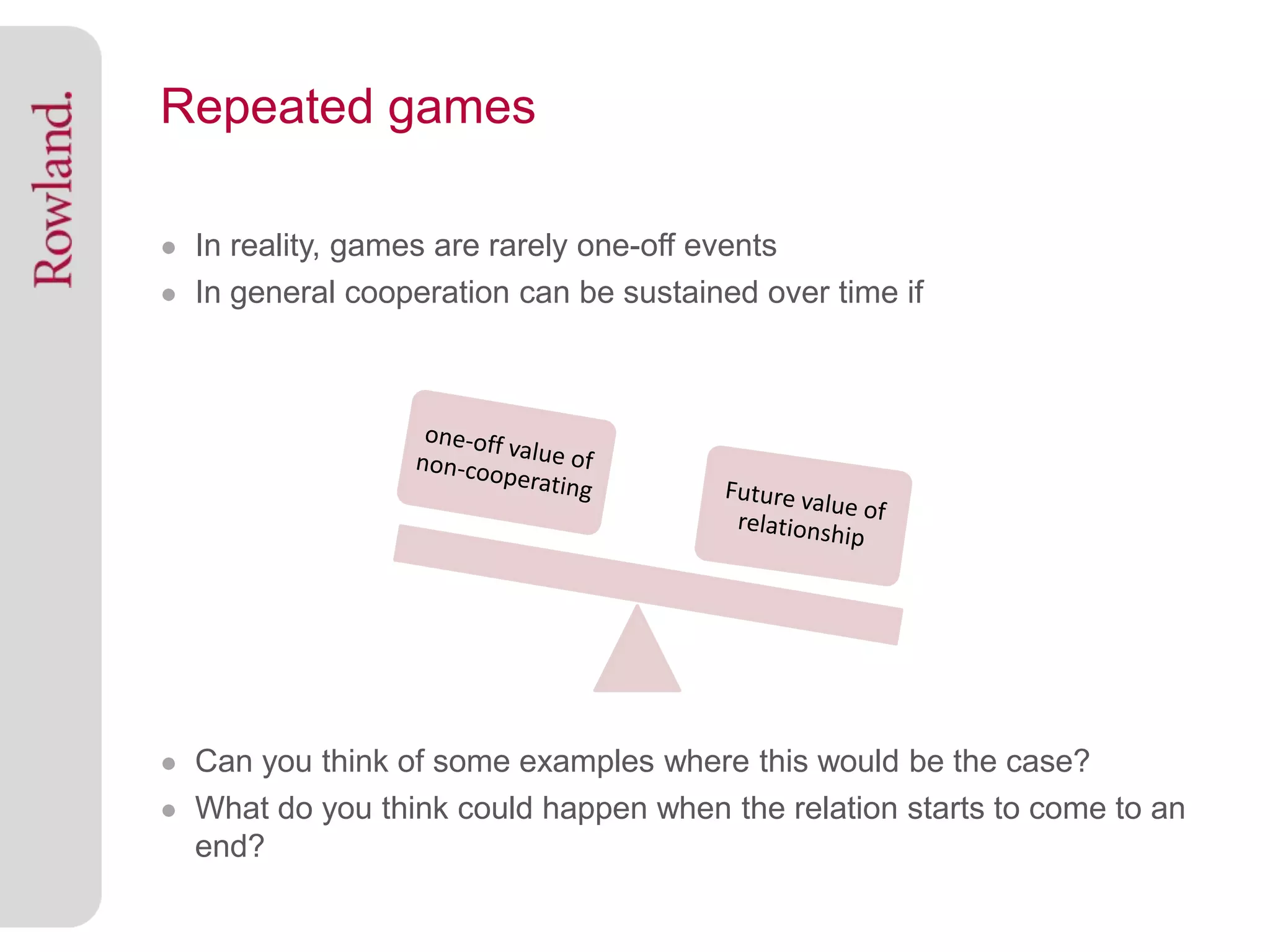
How do you and your competitors achieve this stable outcome without illegally colluding on price? The answer lies in the same strategy we discussed last lesson: Tit for Tat.
The Prisoner's Dilemma: Pricing
Let's continue with the same article, which now explains the solution to this pricing dilemma in a repeated game.
Now read the second part of the article, starting from 'What’s the solution to the prisoner’s dilemma?' down to the paragraph ending '...will follow the tit-for-tat strategy with the idea of supporting higher market prices.'
When competitors in a market implicitly follow a Tit for Tat strategy, it creates stability.
- You start by cooperating (setting a high price that reflects your premium quality).
- If your competitor maintains their high prices, you continue to do so.
- If your competitor "defects" by aggressively slashing prices, you retaliate in the next period by matching their price cut.
The threat of retaliation is often enough to prevent the initial defection. Your competitor knows that any short-term gain from undercutting you will be immediately erased when you lower your prices in response, leading to a worse outcome for everyone. This is often called "implicit collusion" or "tacit cooperation."
3. From Simple Theory to Market Reality: "Noise" and Forgiveness
In the real world, things are rarely so clear-cut. A simple, rigid Tit for Tat strategy—retaliating after every single perceived defection—can be dangerous. The market is full of "noise" and ambiguity.
What if a competitor lowers their price not to attack you, but because they are having a clearance sale on a discontinued door style? If you interpret this as a defection and retaliate with a company-wide price cut, you could trigger a price war by mistake.
This is a critical limitation of a simple Tit for Tat strategy.
This game theory problem will change the way you see the world
This segment of the Veritasium video we saw previously explains the problem of 'noise'. It shows how, when two Tit for Tat players interact, a single mistake or misinterpretation can set off a long and destructive cycle of mutual retaliation.
Please watch the clip from 19:12 to 21:34. Focus on how a single error ('noise') causes the Tit for Tat strategy to break down into a negative echo effect.
So, if a rigid Tit for Tat is vulnerable to noise, what's a better approach? A more forgiving strategy.
The Morality and Practicality of Tit for Tat
This article discusses the practical limitations of Tit for Tat and introduces a more robust alternative for real-world situations: Generous Tit for Tat.
Please read section 5, titled 'The Disadvantages of TFT and the Solution of GTFT' (this is a typo in the original, it should be section 5, which discusses GTFT). The section starts with 'To make up for the pitfalls of TFT’s unyielding retaliation...' and ends with '...the most effective strategy so long as there are many other nice strategies there to support that generosity.' Focus on how 'Generous Tit for Tat' (GTFT) handles miscommunication by not retaliating immediately.
A Generous Tit for Tat (GTFT) strategy is much better suited for a real market. Instead of retaliating after every defection, you might forgive an occasional price drop, especially if it seems temporary or targeted. You only retaliate when a competitor shows a pattern of aggressive behavior.
For your business, this means:
- Don't panic: If a competitor runs a seasonal promotion, don't immediately slash your own prices. Observe and see if their prices return to normal afterward.
- Investigate: Try to understand the reason behind a competitor's move. Is it a clearance sale? A new, lower-quality product line that doesn't directly compete with your premium offerings?
- Retaliate only when necessary: If a competitor consistently undercuts you on comparable high-end projects, then a firm response (matching their price to negate their advantage) becomes necessary to signal that you will not be taken advantage of.
Test your understanding!
You discover that a competing custom cabinet shop has just won a large contract by bidding 20% lower than your normal rate for a similar-quality project. This is the first time you've seen them be this aggressive on price.
Based on what you've learned, what are the risks of applying a simple Tit for Tat strategy versus a Generous Tit for Tat strategy in your response?
Show answer
-
Simple Tit for Tat Response: You would immediately lower your prices on the next comparable bid by 20% to retaliate.
- Risk: This could be a one-time desperate move by your competitor. Your retaliation could trigger a price war that neither of you wants, permanently lowering market price expectations for premium work. You're reacting to a single data point, which might be "noise."
-
Generous Tit for Tat Response: You would acknowledge the move but not immediately retaliate. You would continue to bid at your normal rates while closely monitoring the competitor's next few bids.
- Risk: The competitor might win another job or two with their low price before you respond. However, by being more forgiving and waiting for a clear pattern of aggression, you avoid overreacting to a one-off event and starting a mutually destructive price war. This is generally the more robust and profitable long-term strategy.
4. How to Encourage Cooperation
Since you can't legally talk to your competitors about pricing, you must foster cooperation by shaping the strategic environment. A key concept here is to "enlarge the shadow of the future."
The Morality and Practicality of Tit for Tat
The political scientist Robert Axelrod, whose work we've been discussing, outlined several ways to promote cooperation. This section of the article explains one of the most powerful: making the future more important than the present.
Please read subsection 8.1, 'Enlarging the Importance of the Future.' Focus on the three methods mentioned: making interactions more durable, more frequent, and breaking down issues.
Here’s how you can apply these ideas to your woodworking business:
- Make interactions more durable: Build a strong brand and a reputation for being a permanent fixture in the market. The more your competitors see you as a long-term player, the more they will weigh the future consequences of their actions against you.
- Make interactions more frequent: Become active and visible in your local industry. Join builder associations, attend trade shows, and network with designers. The more often you and your competitors cross paths (even socially), the more you will see each other as long-term players in a shared ecosystem, rather than anonymous rivals in a one-shot game.
- Be clear and consistent: Your marketing, branding, and pricing should send a clear signal that you are a premium business competing on quality, not price. This clarity helps competitors understand the game you are playing, making cooperative high-pricing a more stable and predictable outcome.
Conclusion
Today we've seen that the logic of repeated games extends beyond customers to your competitors. Sustaining cooperation is not about friendship; it's about creating a strategic environment where it is in every competitor's self-interest to avoid mutually destructive behavior like price wars.
Key Takeaways:
- Competitor pricing is a Prisoner's Dilemma: Every firm is tempted to cut prices for short-term gain, even though everyone is better off if prices remain stable and high.
- Repetition enables cooperation: The "shadow of the future" allows for "tacit cooperation," where firms avoid price wars because of the threat of future retaliation.
- Tit for Tat is a good starting point: It establishes a clear policy of reciprocity—cooperate, but retaliate against aggression.
- Generous Tit for Tat is better for the real world: By being more forgiving, it avoids starting price wars due to "noise" or misinterpretation, making it a more robust and profitable strategy.
- You can foster cooperation: By building a lasting brand and being a visible, consistent player in your market, you "enlarge the shadow of the future," making cooperation the most rational choice for everyone.
Preview of the Next Lesson:
We've now applied the principles of reciprocity and repeated games to both customers and competitors. In the next lesson, we will focus on a third critical group: suppliers. We will apply 'tit-for-tat' and other reciprocity strategies to build trust with suppliers, exploring how these relationships differ and how you can use game theory to negotiate better terms and ensure reliable service.