Hello! Welcome back to the course.
Introduction
In our last lesson, we established a crucial idea: the "shadow of the future." We saw how the prospect of future interactions fundamentally changes business strategy, making long-term cooperation more profitable than short-term opportunism. You learned that successful long-game strategies are typically nice, retaliatory, forgiving, and clear.
Today, we will sharpen this distinction. The goal of this lesson is to compare the optimal strategy for a one-time sale versus a long-term customer relationship. We'll use the classic Prisoner's Dilemma model to formalize this comparison. Understanding this difference is not just theoretical; it will directly inform how you approach every client interaction, from quoting a price to delivering the final product, and is the foundation for building the premium brand you envision for your woodworking business.
1. The Logic of the One-Time Sale
Imagine you're dealing with a customer you know you will never see again. This is a "one-shot" game. In this scenario, what is the most rational way to behave to maximize your profit from this single transaction?
Let's frame this with a simple business example before diving into the formal model.
This brief text poses a question that gets to the heart of today's lesson: how do your strategic considerations change when a single purchase is compared to an ongoing business relationship?
Please read the two short exercises titled 'A single internet purchase' and 'Repeated internet purchases'. You don't need to write down formal answers, but reflect on how your reasoning differs between the two scenarios.
The "single internet purchase" is a classic one-shot game. In this situation, both the buyer and seller face a powerful temptation to "defect"—the seller to not send the book, the buyer to not send the money. This tension is formally captured by the Prisoner's Dilemma.
This video provides an excellent explanation of the game's logic.
This game theory problem will change the way you see the world
This segment from Veritasium explains the setup of the Prisoner's Dilemma and demonstrates why, in a one-time game, acting in your own rational self-interest leads to a result that is worse for everyone.
Please watch from 02:24 to 04:39. Pay close attention to the payoff structure and the step-by-step reasoning that shows why 'defect' is the dominant strategy regardless of what the other player does.
As the video explains, if you only play once, the logical choice is always to defect.
- If the other player cooperates, you get a better payoff by defecting.
- If the other player defects, you get a better payoff by defecting.
Therefore, no matter what, defection seems like the best strategy. This leads to a stable outcome, the Nash Equilibrium, where both players defect and are worse off than if they had both cooperated.
For your business, this would be like you and a client in a one-time transaction:
- Cooperate: You deliver a high-quality product; the client pays promptly. (Good outcome for both).
- You Defect, Client Cooperates: You cut corners on materials to pocket extra profit; the client pays the full price for a subpar product. (Best for you, worst for them).
- You Cooperate, Client Defects: You deliver a premium product; the client finds a reason to dispute the charge or refuses to pay the final amount. (Worst for you, best for them).
- Both Defect: You deliver a shoddy product; the client pays late or disputes part of the cost. (Bad outcome for both).
In a true one-time sale, the rational strategy is to defect (cut corners), as you aim to extract maximum value from that single interaction.
2. The Superior Strategy for a Long-Term Relationship
Now, let's change one simple rule: instead of playing once, you will interact with the same person repeatedly. This is the Iterated Prisoner's Dilemma.
As the Veritasium video briefly mentions, this completely changes the game. Suddenly, your actions in one round have consequences in the next. The "shadow of the future" looms large.
This game theory problem will change the way you see the world
The simple act of repetition transforms the optimal strategy from pure self-interest to conditional cooperation. This next segment explains Robert Axelrod's famous tournament that discovered which strategy is most effective in a long-term 'repeated game'.
Please watch from 06:05 to 10:08. Focus on understanding the winning strategy, 'Tit for Tat', and how it works. Notice how it consistently outperformed more complex or aggressive strategies.
The winner, Tit for Tat, is brilliantly simple:
- Start by cooperating.
- Then, do whatever your opponent did on their last move.
This strategy succeeds because it is built on principles that foster trust and profitable long-term relationships. In the last lesson, we identified these as being nice, retaliatory, forgiving, and clear. Let's revisit those with another clear explanation.
The Evolution of Cooperation // Iterated Prisoner's Dilemma
This video from Dr. Trefor Bazett provides another excellent summary of the properties that make a strategy like Tit-for-Tat so successful in repeated games.
Watch from 11:01 to 13:44. The video outlines four key properties: being Nice, Retaliating, Forgiving, and Non-envious. Think about how each of these translates to a business policy.
So, in a long-term customer relationship, the optimal strategy is no longer to defect. It is to use a strategy like Tit for Tat: start by being trustworthy (cooperate) and then reciprocate your customer's behavior. This strategy maximizes your payoffs not in one round, but over the entire lifetime of the relationship.
3. Applying the Models to Your Woodworking Business
Let's make this concrete for your business. The key insight is that while a "true" one-time sale is rare, the mindset you adopt determines the outcome. A premium brand is built by treating every interaction as if it's part of a long-term game.
| Scenario | Game Type | Optimal Strategy | Your Business Action |
|---|---|---|---|
| A tourist wants a small, generic souvenir. You'll never see them again. | One-Time Sale (Single Prisoner's Dilemma) | Defect | The temptation is to use cheaper materials and less finishing time to maximize profit on this one sale. |
| An interior designer asks you to build cabinets for a client's home. They could bring you many more projects. | Long-Term Relationship (Iterated Prisoner's Dilemma) | Tit for Tat | You start by cooperating: using the best materials and craftsmanship to build trust. If they bring you more work (cooperate), you continue to deliver excellent quality. |
The "defection" strategy might seem profitable in the short term, but it's a "rip-off" that destroys reputation. The cooperative "Tit for Tat" strategy builds a reputation for being "Premium" or offering "High Value."
This is visualized perfectly in the Pricing Strategy Matrix.
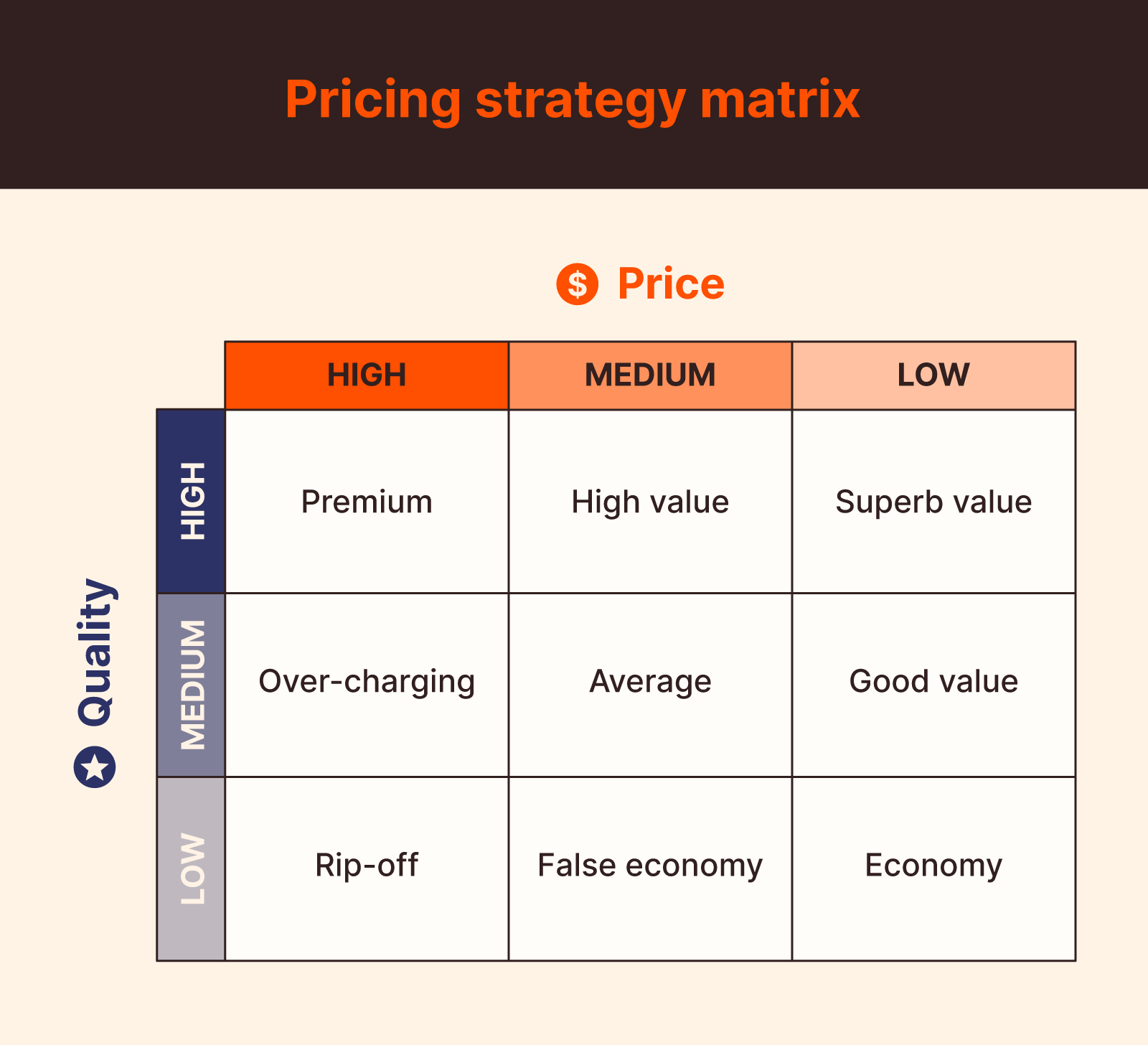
Essentially, by building a brand, you are making a credible commitment to playing the long game. You are deliberately making it too costly for yourself to defect in any single transaction because the potential damage to your brand's reputation (and all future profits) far outweighs the small gain from cutting corners once.
Test your understanding!
A new contractor offers you a job to build kitchen cabinets for a house flip. They are known for being very price-sensitive and haggling aggressively. You suspect they might be difficult to work with and may not offer repeat business.
You have two options:
- Option A: Give them a low-ball price using standard-grade materials and faster construction methods. This maximizes your chance of winning the job and protects your profit margin if they are difficult, but the quality won't be representative of your premium brand.
- Option B: Quote your standard price for high-quality materials and craftsmanship. You risk losing the job to a cheaper competitor, and if you get it, your profit margin might be squeezed by the contractor's behavior. However, the final product will reflect your brand's standard.
Which option is a "cooperate" move and which is a "defect" move? Which game do you think you should be playing here, and why?
Show answer
- Option A is a "defect" move. You are anticipating a one-shot, potentially difficult game and are preemptively cutting quality to protect your immediate profit.
- Option B is a "cooperate" move. You are starting with your standard, trustworthy offer, signaling that you intend to play a "long game" based on quality.
While the temptation to choose Option A is high (a preemptive defection), a business focused on a premium brand should almost always choose Option B. Playing the "short game" (Option A), even once, risks damaging your reputation. If someone sees the low-quality work and associates it with your brand, the long-term cost could be far greater than the profit from this single job.
Choosing Option B and sticking to your quality standards is playing the long game. Even if you don't get this specific job, you maintain the integrity of your brand, which is your most valuable asset for attracting the right kind of long-term clients.
Conclusion
Today, we've formalized the critical difference between strategies for one-off sales and long-term relationships. The Prisoner's Dilemma provides a powerful model for understanding why the optimal approach changes so dramatically.
Key Takeaways:
- One-Time Sale (Single PD): The rational strategy is to "defect" to maximize immediate, one-time profit. This often leads to a mutually destructive outcome.
- Long-Term Relationship (Iterated PD): The optimal strategy is conditional cooperation, like "Tit for Tat." Starting with trust and reciprocating the other party's actions maximizes your profit over the long run.
- Building a Premium Brand: A strong brand is a commitment to always play the "long game." It makes the cost of defection (ruining your reputation) so high that customers can trust you to cooperate (deliver quality).
Preview of the Next Lesson:
We've applied the logic of repeated games to your customer relationships. But what about your competitors? In our next lesson, we will analyze how cooperation with competitors can be sustained in a repeated game. We'll explore how strategies like Tit-for-Tat can help you and your rivals avoid mutually destructive price wars, allowing everyone to maintain healthier profit margins.