
Hello! Welcome back to your course on medical instrumentation.
In our last lesson, we explored pulse oximetry, a non-invasive optical method for measuring blood oxygen saturation (SpO2). We saw how it cleverly uses the different colors of oxygenated and deoxygenated blood to estimate oxygen levels.
Today, we shift from optics to electrochemistry. We will focus on biochemical sensors, which directly measure the chemical composition of bodily fluids, typically blood. While these methods are often invasive, they provide highly accurate and fundamental information about a patient's metabolic and respiratory state.
This lesson is designed to help you achieve the learning outcome: Describe the principles of biochemical sensors for measuring pH, pO2, pCO2, and glucose. Understanding these principles is essential for your university course, as they form the basis of critical diagnostic tools like blood gas analyzers and glucose meters.
1. Fundamentals of Electrochemical Sensing
Before we look at specific sensors, let's cover the two main electrochemical principles they rely on. Your ECE background will be helpful here, as these methods are fundamentally about measuring voltage and current.
- Potentiometry: This method measures a voltage difference (potential) between two electrodes in a solution, with the key condition that virtually no current is flowing. The voltage generated is proportional to the concentration (or more accurately, the activity) of a specific ion. This is analogous to using a high-impedance voltmeter to measure a voltage source without loading it. We will see this principle used for measuring pH and pCO2.
- Amperometry: This method measures the electric current produced by an oxidation or reduction reaction at an electrode's surface. A constant voltage is applied to drive the reaction, and the resulting current is proportional to the concentration of the substance being measured. This is like measuring the current flow in a circuit with a fixed voltage source. We'll see this used for pO2 and glucose measurements.
Most of these sensors use a two-electrode system:
- A measuring (or working) electrode, where the reaction of interest occurs.
- A reference electrode, which provides a stable, constant potential to measure against.
2. Blood Gas Analysis: pH, pCO2, and pO2
In clinical settings, pH, pCO2, and pO2 are typically measured together from a single arterial blood sample using a Blood Gas Analyzer. To get an overview of these instruments and the electrodes they contain, let's start with a video.
Blood Gas Analyzers | ABG Analyzer | Biomedical Engineers TV |
The video 'Blood Gas Analyzers' from Biomedical Engineers TV gives a concise introduction to the three key electrodes used for blood gas measurement.
Please watch the segment from 02:38 to 06:06. Focus on identifying the name of the electrode for each measurement (pH, pCO2, pO2) and the basic idea behind how each one works.
Now, let's break down the principle of each electrode in more detail, referring to the concepts you just saw in the video.
The pH Electrode (Sanz Electrode)
The measurement of pH (the concentration of hydrogen ions, H+) is the most direct potentiometric measurement.
- Principle: Potentiometry.
- Mechanism: The core of the pH electrode is a special glass membrane that is selectively permeable only to H+ ions. The blood sample flows on one side of this membrane, and a buffer solution with a known, constant pH is on the other.
- The difference in H+ concentration between the blood and the internal buffer creates a potential difference (voltage) across the glass membrane.
- This voltage is measured between a measuring electrode (e.g., Silver-Silver Chloride) inside the glass bulb and a stable reference electrode in contact with the blood sample. According to the Nernst equation, this voltage is directly related to the pH of the blood.
The pCO2 Electrode (Severinghaus Electrode)
The measurement of the partial pressure of carbon dioxide (pCO2) is a clever, indirect application of a pH sensor.
- Principle: Potentiometry (indirect).
- Mechanism: The Severinghaus electrode is essentially a complete pH sensor enclosed behind a thin plastic membrane (e.g., Teflon or silicone) that is permeable to CO2 gas but not to ions like H+.
- CO2 from the blood sample diffuses across this membrane into a thin layer of bicarbonate solution ().
- Inside this solution, the CO2 reacts with water to form carbonic acid, which then changes the H+ concentration:
- The internal pH electrode measures this change in pH, which is proportional to the pCO2 of the original blood sample.
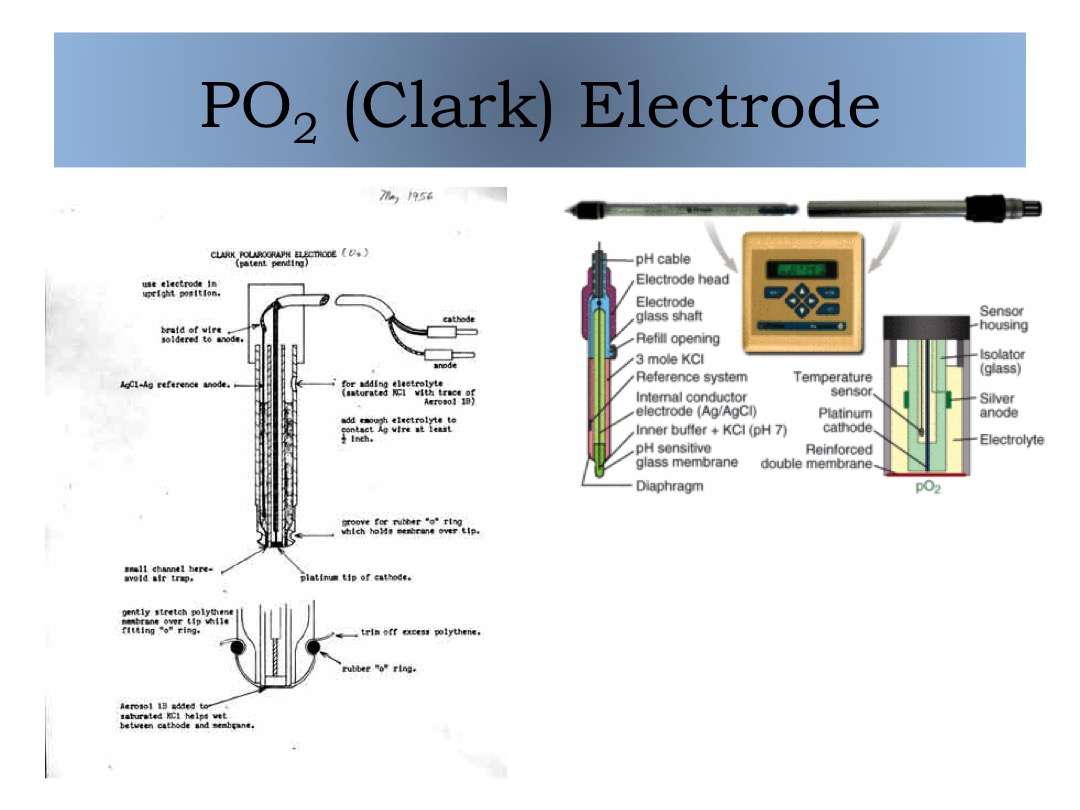
The pO2 Electrode (Clark Electrode)
The measurement of the partial pressure of oxygen (pO2) uses the amperometric principle.
- Principle: Amperometry.
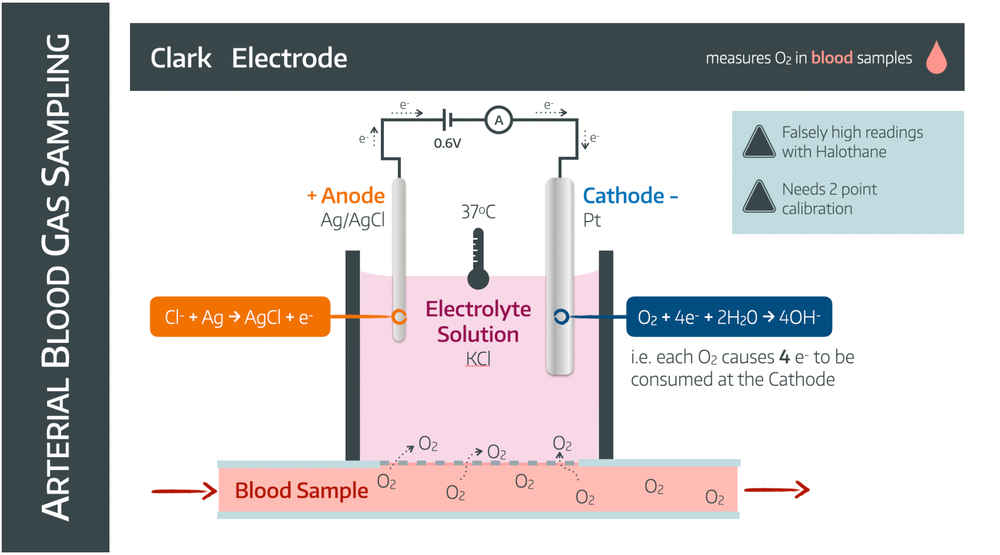
- Mechanism: A constant voltage (approx. -0.6V to -0.7V) is applied between a platinum (Pt) cathode and a silver/silver chloride (Ag/AgCl) anode.
- These electrodes are separated from the blood sample by a membrane that is permeable to oxygen. Oxygen from the blood diffuses across the membrane and is reduced at the platinum cathode.
- This chemical reduction consumes electrons, creating a current that flows from the anode to the cathode.
- The magnitude of this current is directly proportional to the rate of oxygen reduction, which in turn is proportional to the partial pressure of oxygen (pO2) in the sample.
For a more detailed textual explanation of these three electrodes, you can refer to the resource "Blood Gas Analyzers and Methodology".
Blood Gas Analyzers and Methodology
This chapter from IntechOpen provides a solid written summary of the principles of operation for blood gas analyzers.
Read section 5.1 ('Acid-base status'), including the subsections on pH and pCO2. Then read section 5.2.1 ('pO2'). This will reinforce the electrochemical principles behind the Sanz, Severinghaus, and Clark electrodes.
Test your understanding!
Match the measurement principle to the sensor.
Principles:
- Measures current from a chemical reaction.
- Measures voltage due to ion concentration.
- Indirectly measures a gas by detecting a pH change.
Sensors:
A. pO2 (Clark) Electrode
B. pCO2 (Severinghaus) Electrode
C. pH (Sanz) Electrode
Show answer
- A - 1: The pO2 electrode is amperometric, measuring the current from oxygen reduction.
- B - 3: The pCO2 electrode measures the pH change caused by CO2 diffusing into a buffer.
- C - 2: The pH electrode is potentiometric, measuring the voltage generated by H+ ions across a membrane.
3. The Glucose Biosensor
Measuring blood glucose is arguably the most common application of a biochemical sensor, vital for millions of people with diabetes. While glucose can be measured in a lab-based blood gas analyzer, the technology is famously used in portable, point-of-care glucometers.
These devices are a prime example of a biosensor: a device that integrates a biological component (like an enzyme) with a physicochemical transducer.
Let's watch a video that explains the working principle of the most common type of glucose sensor.
[Ch 3.3c] Amperometric Glucose Biosensor
This video, '[Ch 3.3c] Amperometric Glucose Biosensor', provides an excellent, step-by-step explanation of how an enzyme is used to make an electrochemical measurement of glucose.
Watch the video from 01:14 to 06:18. Pay close attention to: Why an enzyme is needed (glucose is not electroactive). The two-step reaction involving glucose oxidase and hydrogen peroxide (H2O2). How the final current relates to the initial glucose concentration. The clever engineering trick of using a second working electrode to cancel out interference.
To summarize the key steps from the video:
- The Challenge: Glucose itself is not "electroactive"—it cannot be easily oxidized or reduced at an electrode to produce a signal.
- The Biological Solution: The enzyme glucose oxidase (GOx) is immobilized on the working electrode. This enzyme acts as a highly specific catalyst.
- Step 1 - Enzymatic Reaction: GOx reacts with glucose from the blood sample to produce gluconic acid and hydrogen peroxide (H2O2).
- Step 2 - Electrochemical Reaction: The hydrogen peroxide is electroactive. It diffuses to the electrode surface where it is oxidized, producing a current that the device measures. The amount of H2O2 produced is directly proportional to the amount of glucose that was in the sample.
- Result: The measured current is proportional to the original glucose concentration.
This is known as a first-generation glucose biosensor. For additional context, it's useful to know about the different "generations" of these sensors, as well as alternative sensing methods.
Insight into continuous glucose monitoring: from medical ...
The paper 'Insight into continuous glucose monitoring' gives a broader overview of glucose sensing technologies, including the different generations of electrochemical sensors and optical methods.
Read section 4.2 'Electrochemical enzymatic glucose sensor' to understand the distinction between first, second, and third-generation sensors. Then, quickly skim section 4.3 'Optical glucose sensor' to see how the optical principles from our last lesson can also be applied to glucose sensing.
Conclusion
In this lesson, we have explored the core principles behind some of the most important biochemical sensors in medical diagnostics. These devices are remarkable fusions of chemistry, biology, and electronics.
Key Takeaways:
- Biochemical sensors measure chemical concentrations, primarily using potentiometry (measuring voltage) or amperometry (measuring current).
- pH is measured potentiometrically with a Sanz electrode using an H+-selective glass membrane.
- pCO2 is measured indirectly with a Severinghaus electrode, which is a self-contained pH sensor that detects the pH change caused by CO2 dissolving in a buffer.
- pO2 is measured amperometrically with a Clark electrode, where the current generated by the reduction of oxygen is proportional to its concentration.
- Glucose is typically measured with an amperometric biosensor. The enzyme glucose oxidase converts glucose into hydrogen peroxide, which is then electrochemically detected to produce a current proportional to the glucose concentration.
Preview of the Next Lesson:
Many of these sensors, particularly for continuous glucose monitoring (CGM), are now part of wearable systems that transmit data wirelessly. This leads us perfectly into our next topic: biotelemetry. We will explore the architecture of a biotelemetry system for wireless physiological monitoring, a key technology enabling modern wearable health devices like the ones relevant to your work at Neuraease.
Can't find a good explanation? Sign up and we'll make it for you
Sign up