
Hello! Welcome back to our module on AI and LLM Integrations.
In our last lesson, we gave our AI agent a conversational memory, allowing it to remember the history of a specific chat session. This is crucial for creating natural, stateful conversations. However, this type of memory is about the immediate past of a single interaction. What if we want our agent to have a vast, searchable knowledge base about specific topics, like your company's internal documentation, product specs, or recent news?
This is where today's topic comes in. We will explore a powerful architectural pattern that grounds Large Language Models in external, factual knowledge. By the end of this lesson, you will be able to describe the Retrieval-Augmented Generation (RAG) pattern and the role of vector databases. This is a fundamental concept for building sophisticated, reliable, and trustworthy AI applications.
The Problem: Why LLMs Need Help
Large Language Models (LLMs) like GPT-4 are incredibly powerful, but they have inherent limitations that can be problematic for real-world applications. As a developer, you know that understanding a system's failure modes is as important as knowing its capabilities.
Retrieval-Augmented Generation (RAG)
This article from Pinecone, a leading vector database company, clearly outlines the core problems that RAG is designed to solve. Understanding these limitations is key to appreciating the value of RAG.
Please read the section titled 'Limitations of foundation models'. It covers key issues like knowledge cutoffs, lack of domain-specific knowledge, and the inability to access private data, which often lead to 'hallucinations'.
To summarize, the key challenges are:
- Knowledge Cutoff: An LLM only knows about information from its training data, which becomes outdated the moment its training is complete. It has no knowledge of current events or your latest product launch.
- Lack of Private Knowledge: The model wasn't trained on your company's internal wikis, customer support chats, or personal documents. It cannot answer questions about this private data.
- Hallucinations: When an LLM doesn't know an answer, it might invent a plausible-sounding but incorrect one. This is a significant risk for any application that requires factual accuracy.
The core idea of RAG is to solve these problems not by retraining the model, but by providing it with the right information at the moment it's needed.
What is Retrieval-Augmented Generation (RAG)?
RAG is an architectural pattern that enhances an LLM's response by first retrieving relevant information from an external knowledge source and then providing that information as context within the prompt.
Essentially, you shift from asking the LLM, "What do you know about X?" to saying, "Here is some information about X. Now, using only this information, answer the following question."
The official n8n documentation provides a concise definition of RAG and its connection to vector stores.
Read the brief section 'What is RAG'. It neatly summarizes the concept of grounding responses in external knowledge.
This simple shift has profound implications: it makes the LLM's answers more accurate, up-to-date, and verifiable, as you can often cite the sources that were used to generate the answer.
The RAG Pattern: A Step-by-Step Breakdown
The RAG pattern consists of two main phases: an offline Ingestion phase (preparing the knowledge) and an online Retrieval/Generation phase (answering a query).
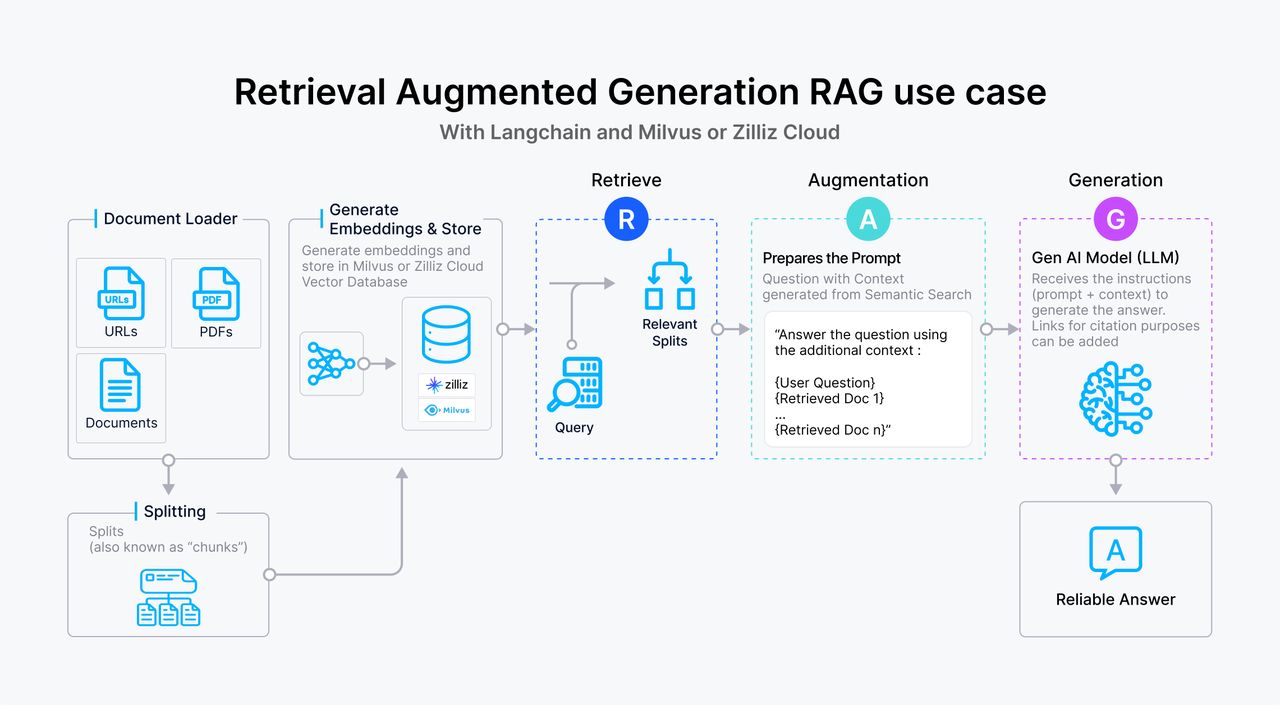
Let's explore this process in more detail.
Retrieval-Augmented Generation (RAG)
The same Pinecone article we looked at earlier provides an excellent breakdown of the components of a RAG pipeline. This will give you a solid conceptual framework.
Please read the section 'How does Retrieval-Augmented Generation work?'. Focus on the four main components described: Ingestion, Retrieval, Augmentation, and Generation. Don't worry about the details of 'hybrid search' or 'reranking' for now; focus on the main flow.
Here is a summary of that flow:
-
Ingestion (Data Preparation):
- Load: You start with your source documents (PDFs, web pages, text files, etc.).
- Chunk: You split these documents into smaller, manageable pieces or "chunks." This is important because you'll only retrieve the most relevant chunks, and these chunks need to fit within the LLM's context window.
- Embed: Each chunk is passed through an embedding model, which converts the text into a numerical vector (an array of numbers). This vector represents the semantic meaning of the text.
- Store: These vectors, along with the original text chunks, are stored in a specialized database called a vector database.
-
Retrieval & Generation (Answering a Question):
- Embed Query: When a user asks a question, their query is also converted into a vector using the same embedding model.
- Retrieve: The system performs a similarity search in the vector database. It looks for the text chunks whose vectors are mathematically "closest" to the query's vector. This is how it finds the most semantically relevant information.
- Augment: The original user question and the retrieved text chunks are combined into a new, augmented prompt for the LLM.
- Generate: The LLM receives this augmented prompt and generates an answer that is grounded in the provided context.
The Engine of RAG: Vector Databases
The "Retrieval" step is the heart of RAG, and it's powered by vector databases. But why can't we just use a standard SQL database with a LIKE query?
The simple answer is that keyword matching is not the same as understanding meaning. A user might search for "early career dog food," but your document might use the term "puppy nutrition." A keyword search would fail, but a semantic search would understand that these phrases are related.
What is a Vector Database? Powering Semantic Search & AI Applications
This video from IBM Technology provides an excellent, intuitive explanation of what vector databases are and why they are necessary to bridge this 'semantic gap'.
Watch the video from the beginning until 02:49, then skip to 07:28 and watch until the end (09:29). Focus on: The concept of the 'semantic gap' and why traditional databases struggle with it. How vector embeddings capture semantic meaning, positioning similar items close together in 'vector space'. The challenge of searching these vectors and the use of Approximate Nearest Neighbor (ANN) algorithms. The direct connection between vector databases and RAG.
As the video explains, a vector database is designed for one primary task: finding the nearest neighbors to a given query vector, and doing so at incredible speed, even with millions or billions of items. This is what enables real-time semantic search.
This next clip provides a very practical, n8n-centric explanation of why this is so useful.
The Best Vector Database for n8n RAG Agents
This video from Mike Pekka frames the role of a vector database in a way that's immediately relevant to an automation developer.
Watch the short segment from 00:36 to 01:51. The key insight here is that you can't just stuff all your data into the prompt; it would overwhelm the AI. The vector database acts as a smart filter, providing only the most relevant pieces of information.
RAG in an n8n Workflow
Now that we have the concepts, let's see what this looks like inside n8n.

Let's trace the data:
- Ingestion (Top Flow): An event (like a form submission) triggers the workflow. Data is loaded, passed to an
Embeddingsnode, and then aVector Storenode saves it to a database like Supabase or Pinecone. This is the offline process of building your knowledge base. - Retrieval (Bottom Flow): A chat message comes in. It's routed to an
AI Agent. The agent, configured to use the vector store as aTool, takes the user's question, retrieves relevant context from the store, and passes both to theChat Modelto generate a grounded answer.
Test your understanding!
A user asks your RAG-powered chatbot about your company's new product, "Project Nebula," which was announced yesterday. Without RAG, the LLM hallucinates that "Project Nebula" is a new sci-fi movie. With RAG, it correctly describes the product's features.
Based on the RAG pattern, explain step-by-step why the RAG system succeeded where the standalone LLM failed.
Show answer
- Ingestion: The RAG system succeeded because sometime after the announcement, an ingestion workflow was run. The press release or product page for "Project Nebula" was loaded, chunked, converted into vector embeddings, and stored in the vector database. The standalone LLM's knowledge is outdated and doesn't include this new information.
- Retrieval: When the user asked about "Project Nebula," the RAG system converted this query into a vector. It then performed a similarity search in the vector database and found the chunks of text from the press release that were semantically related to "Project Nebula."
- Augmentation & Generation: The system created a new prompt for the LLM that included the user's question and the factual text from the press release. The LLM then used this provided context to generate a correct, factual answer about the product, rather than relying on its old, irrelevant training data.
Conclusion
You now have a strong conceptual understanding of Retrieval-Augmented Generation, one of the most important patterns in modern AI development. It is the key to creating applications that are not only intelligent but also accurate, up-to-date, and grounded in reality.
Key Takeaways:
- RAG solves key LLM limitations: It addresses knowledge cutoffs, lack of access to private data, and reduces hallucinations.
- The pattern is two-fold: A one-time Ingestion phase to build the knowledge base, and a real-time Retrieval/Generation phase to answer questions.
- Vector databases are the core engine: They enable efficient semantic search, finding information based on meaning rather than keywords.
- Embeddings are the language of meaning: They are numerical representations of text, images, or other data that allow for mathematical comparisons of similarity.
Preview of the Next Lesson:
We've covered the "what" and the "why." In the next lesson, we'll dive into the "how." You will build your very first RAG workflow in n8n, focusing on the ingestion pipeline. We'll take a document, process it, and populate a vector store, laying the foundation for our knowledgeable AI agent.