
Hello. In the previous lesson, we placed Delphi, Athens, and Sparta on a shared timeline and saw a basic contrast: Athens and Sparta were poleis whose political power shifted dramatically, while Delphi’s authority rested on its religious and Panhellenic standing. A timeline, however, is only as reliable as the evidence used to build it.
This lesson introduces the main kinds of ancient evidence historians use for all three places. By the end, you should be able to identify each type, say what it can reveal, and recognize why the evidence available for Delphi, Athens, and Sparta is uneven. This matters especially for Sparta: a lack of surviving Spartan self-description means that later and external accounts can easily become mistaken for Sparta’s own voice.
Ancient evidence is not one thing
When historians study ancient Greece, they do not simply open a book written in antiquity and read off “what happened.” They assemble a case from surviving traces. Some are objects; some are texts; some combine both. Each trace was originally created for a particular purpose, often very different from helping future historians.
The principal categories are:
- Archaeological and architectural evidence: buildings, foundations, roads, graves, pottery, tools, weapons, sculpture, and the layers in which objects were found.
- Inscriptions: texts carved, painted, stamped, or scratched onto stone, bronze, pottery, buildings, and other objects.
- Visual and artistic evidence: vase paintings, relief sculpture, statues, coins, and images on seals.
- Written literary evidence: histories, speeches, plays, philosophical works, travel writing, biographies, and religious narratives.
- Coins and other officially marked objects: evidence for political authority, local identity, economic activity, and changing control of a place.
These categories overlap. A statue base may be both an excavated object and an inscription. A coin is simultaneously a small metal object, an official visual image, and a text if it carries a legend. A temple is architecture, but its location and dedications can also reveal political competition.
A useful principle is:
Ancient evidence is evidence of what people made, wrote, displayed, or remembered. It is not automatically a neutral record of what really happened.
For example, an Athenian victory monument is strong evidence that Athenians wanted visitors to see a particular victory and associate it with Athenian prestige. It is weaker evidence for the complete course of the battle, the experience of defeated people, or whether the monument’s message was accepted by everyone.
Archaeology: material remains in their original setting
Archaeology is the modern study of physical remains, rather than a category of ancient evidence in itself. Archaeologists recover and interpret buildings, objects, soil layers, and landscapes. Their most important question is often not merely what was found? but where, with what, and in what layer was it found?
A bronze vessel found in a securely dated sanctuary deposit can tell us more than the same vessel without a known findspot in a private collection. Context can reveal whether an object was:
- a religious dedication;
- an item used in daily life;
- part of a grave offering;
- deliberately buried after damage or destruction;
- reused in a later building;
- or moved long after its original use.
Delphi: a sanctuary reconstructed from monuments and offerings
At Delphi, archaeology is especially central because the sanctuary itself is an enormous historical document. The Temple of Apollo, Sacred Way, treasuries, theatres, athletic facilities, statue bases, and votive deposits show that Delphi was visited, funded, and reshaped by people from far beyond its immediate region.
A treasury was a small building, often constructed by a polis, to house and display valuable offerings. Its presence was religious, but it was also political. A city that built a prominent treasury was announcing wealth, success, and participation in the wider Greek world.
Archaeological evidence can show:
- that a building existed;
- its approximate date and later alterations;
- its materials and scale;
- who may have paid for it, if an inscription survives;
- how visitors moved through the sanctuary;
- and how monuments were placed beside, in front of, or against rivals’ monuments.
It cannot, by itself, tell us exactly what every visitor thought when seeing the structure. Interpretation requires comparison with inscriptions and written accounts.
The physical placement of monuments at Delphi is particularly revealing. A city’s dedication did not stand in an empty museum-like space. It stood among the offerings of rivals. Later communities sometimes built monuments that blocked or diminished the visibility of earlier displays. Sacred space could therefore preserve a visible argument about power.
Inscriptions: ancient words in durable materials
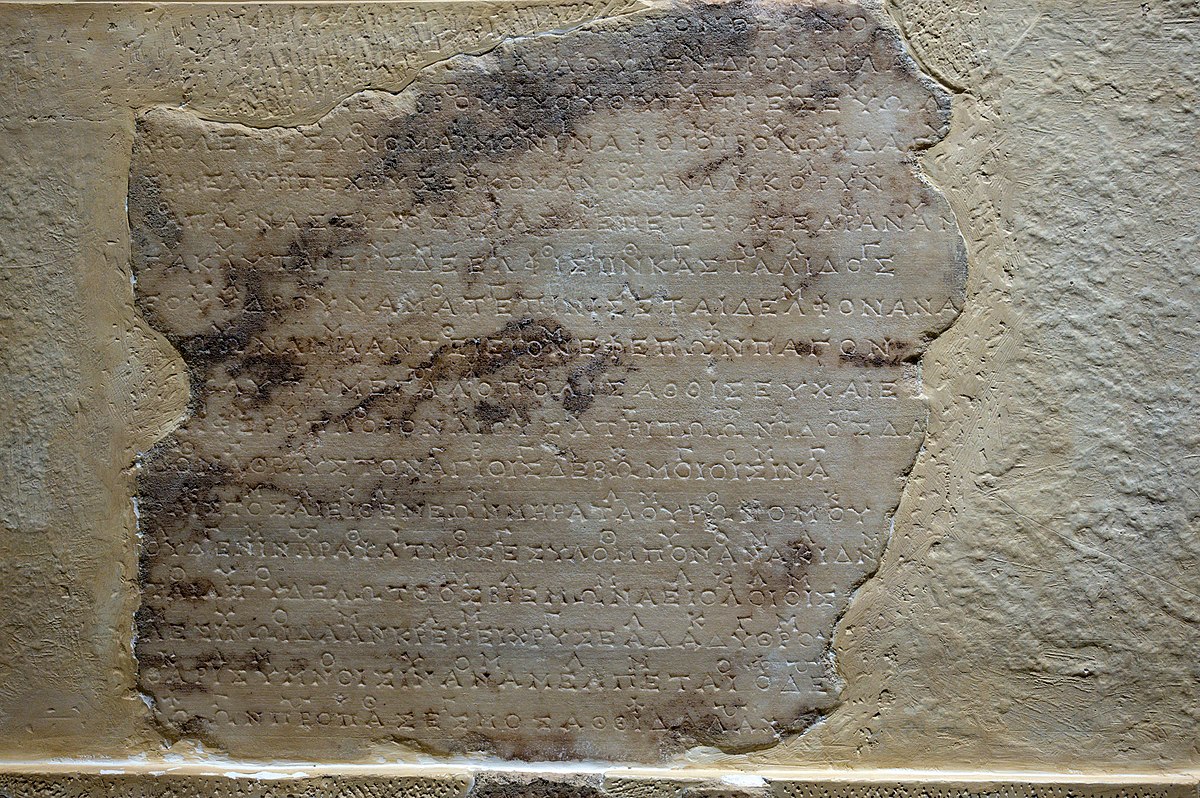
An inscription is a text placed on a physical surface. Since stone and bronze survive more often than papyrus, inscriptions are among the most valuable forms of evidence for Greek public life.
They can record:
- laws and decrees;
- treaties and alliances;
- lists of names;
- financial accounts;
- dedications to gods;
- building records;
- festival regulations;
- manumissions, or formal releases from slavery;
- memorials for victories, the dead, and political leaders.
Unlike a modern document, an inscription was often meant to be displayed publicly. Its wording and location therefore mattered. An inscription could inform people, but it could also claim legitimacy, honor a benefactor, intimidate rivals, or preserve a preferred version of events.
Delphi: inscriptions as religious and political evidence
At Delphi, inscriptions help historians identify dedications, reconstruct the sanctuary’s administration, and trace the presence of communities from across the Greek world. A statue without its base may be difficult to identify. A surviving inscribed base can name the dedicator, the god honored, and sometimes the occasion for the gift.
But inscriptions need careful reading. Consider a monument celebrating a military victory. It may tell us who claimed credit for the victory, but it may minimize allied contributions or omit inconvenient facts. The inscription is not useless because it is self-promoting. Its self-promotion is itself evidence: it reveals how a community wanted to be seen before a Panhellenic audience.
Professor Michael Scott’s lecture provides two useful examples of source criticism at Delphi: a visual representation that cannot be treated as a straightforward report, and monuments whose inscriptions shaped memories of the Persian Wars.
Prof. Michael Scott 'Delphi: Centre of the Ancient World' Lecture on 2nd July 2018
Watch “Delphi: Centre of the Ancient World,” a lecture by Professor Michael Scott for Classics and Ancient History at Warwick. These excerpts show why historians must ask who made an image or monument, for whom, and what message it was designed to convey.
First watch the vase analysis. Scott explains why a fifth-century BCE vase image associated with an oracle consultation cannot simply be treated as a factual picture of the Pythia at work: it was made for export and depicts mythic figures. Then watch the Persian monuments, focusing on how fragmentary inscriptions and commemorative monuments at Delphi express both Greek collective identity and rivalry among individual poleis.
Athens: public records and the evidence of ostracism
Athens has an unusually rich body of inscriptions. Its democracy produced public decrees, tribute records, religious regulations, casualty lists, legal texts, and records connected with civic administration. This does not mean that every Athenian voice survives. It means that the activities of the citizen state, especially its public and financial decisions, have left an unusually substantial trace.
One distinctive Athenian form of evidence is the ostracon: a broken piece of pottery used in the procedure called ostracism. Citizens could write the name of a man on a shard. If the legal requirements for the vote were met, the person whose name received the most votes was sent into temporary exile.

This small object illustrates an important distinction between what an artifact directly shows and what historians infer:
| Claim | How strongly does the ostracon support it? |
|---|---|
| Athenians could inscribe political names on pottery fragments. | Strongly: the object directly preserves such a name. |
| Ostracism was a real civic procedure. | Strongly, when combined with many comparable ostraca and literary accounts. |
| The writer personally disliked or feared Cimon. | Possible, but uncertain. The shard records a choice, not the writer’s reasons. |
| Cimon was necessarily ostracized because of this particular shard. | Not established by the single object. The wider historical conclusion needs other evidence. |
This is the basic habit of evidence-based history: make claims no larger than the evidence permits.
Images, art, and coins: evidence with conventions
Visual evidence can be vivid, but it is not a photograph. Greek artists used conventions: gods can appear in human form, heroes may be shown beside historical figures, and scenes may represent myth rather than everyday reality. Vase paintings can tell us much about elite drinking culture, religious imagery, armor, social ideals, and artistic tastes. They usually cannot be treated as literal snapshots of ordinary life.
The same caution applies to sculpture. A statue of a victorious athlete is evidence for commemoration, wealth, artistic technique, and ideals of the body. It does not mean every Greek person looked or behaved like the statue.
Coins are another important form of visual evidence. Their images and inscriptions can identify a city, ruler, deity, or political claim. Athenian coinage, famously associated with Athena and the owl, projected civic identity far beyond Attica. Spartan coinage and economic practices require more caution, since popular claims about Spartan rejection of money are often based on later, simplified accounts rather than a complete body of Spartan evidence.
For all visual material, historians ask:
- Is this a mythological, religious, political, or everyday scene?
- Who paid for it?
- Who was meant to see or use it?
- Was it produced locally or for export?
- Does the image show actual practice, an ideal, a joke, a warning, or a traditional story?
The export issue is particularly important. A Greek vase made for buyers in Italy may tell historians about Athenian workshops and what foreign customers wanted to purchase. It may be less reliable as direct evidence for daily life in Athens itself.
Literary sources: indispensable, but never transparent
The best-known ancient evidence for Athens and Sparta often comes from written authors. These include historians such as Herodotus, Thucydides, and Xenophon; Athenian playwrights and orators; and later writers such as Plutarch and Pausanias.
Literary evidence can provide narratives, speeches, motives, and descriptions that archaeology cannot. Thucydides, for example, is essential for reconstructing the Peloponnesian War. Herodotus preserves stories of Greek encounters with Delphi and of the Persian Wars. Later authors preserve traditions about Spartan institutions and customs.
Yet every literary source has limits:
- An author writes from a particular political and social position.
- A speech reported in a history may not reproduce the precise words said on the occasion.
- A comedy exaggerates for humor.
- A biography may organize a life around moral lessons.
- A later author may describe a past society through the concerns of their own period.
- The surviving text may be separated from the events by decades or centuries.
This does not mean literary texts should be dismissed as “biased.” All evidence has a perspective. The historian’s task is to identify it.
Delphi and written oracles
Literary sources preserve many famous Delphic oracles, including responses supposedly given to Croesus of Lydia and to Athenians during the Persian invasion. These accounts are crucial evidence for how Greeks represented the authority of Delphi and how later communities interpreted difficult decisions.
However, they are usually not surviving transcripts written down inside the Temple of Apollo at the moment of consultation. A narrative written by Herodotus records an oracle as part of a historical story, with a literary purpose and a particular interpretation. Historians therefore distinguish between:
- the possibility that a consultation occurred;
- the exact wording of the response;
- the later meaning attached to it;
- and the story’s role in explaining why a political decision was made.
This distinction becomes especially important when an oracle is ambiguous. A later author may present an outcome as if it had been predicted clearly, even when people at the time debated what the response meant.
The three places have unequal evidence
The most important comparative conclusion is that Delphi, Athens, and Sparta do not survive in the historical record in the same way. Their differences in evidence shape the kind of history we can write.
| Place | Especially valuable evidence | What it can reveal well | Main limitation |
|---|---|---|---|
| Delphi | Sanctuary architecture, dedications, statues, inscriptions, literary accounts of the oracle | Panhellenic religion, interstate competition, patronage, commemoration, sanctuary administration | Dedications are often claims of prestige; literary oracles may be preserved or reshaped by later writers. |
| Athens | Public inscriptions, archaeology of the Acropolis and Agora, ostraca, coinage, speeches, drama, histories | Democratic institutions, imperial activity, civic religion, elite debate, public commemoration | The evidence is often produced by male citizens, elite authors, or the state; it does not represent every inhabitant equally. |
| Sparta | Archaeology, sanctuaries, material culture, limited inscriptions, and accounts by non-Spartan or later writers | Settlement, cult, social structure, warfare, external reputation, broad institutional outlines | Far fewer surviving Spartan texts mean that outsiders’ descriptions can dominate the picture. |
The scarcity of Spartan self-description is a historical fact with major consequences. It does not prove that Spartans never wrote, created art, traded, debated politics, or changed over time. It means that much evidence has not survived, or has not survived in a form comparable to Athens’ inscriptions and literary output.
This makes an argument from silence risky:
“We have little surviving evidence for X” is not the same claim as “X did not exist.”
A city’s literary silence may result from preservation, destruction, the materials used for writing, later copying choices, or unequal archaeological excavation.
The following brief segment makes this problem explicit.
History Summarized: The Cities of Ancient Sparta
Watch “History Summarized: The Cities of Ancient Sparta” by Overly Sarcastic Productions for a concise introduction to Sparta’s evidentiary problem. The relevant point is not that all non-Spartan accounts are false, but that historians must separate external observation from Spartan self-representation.
Watch the source problem. Focus on the claim that modern views of Sparta rely heavily on Athenian and later Roman perspectives, and note why admiration, hostility, and fascination can all distort a historical picture.
A practical method for handling any ancient source
When encountering an artifact, inscription, or passage, use this seven-part check:
- Identify the type of evidence. Is it an object, image, inscription, building, coin, or literary text?
- Date it. Was it made during the event it describes, shortly afterward, or centuries later?
- Locate it. Where was it found, and where was it originally displayed or used?
- Identify the producer. A city government, a wealthy individual, a priesthood, an artist, a soldier, or a later author may each have different interests.
- Identify the audience. Local citizens, sanctuary visitors, foreign buyers, a ruler, or readers of a history?
- Determine its purpose. Was it intended to record, persuade, honor, entertain, worship, regulate, or criticize?
- Corroborate it. Does another type of evidence support, complicate, or contradict the claim?
Consider a Spartan dedication at Delphi. It may be archaeological evidence because it is a physical monument; epigraphic evidence if it has an inscription; political evidence because it celebrates a victory; and religious evidence because it is offered to Apollo. Its value becomes clearer when it is compared with its placement in the sanctuary, Athenian counter-monuments, and written accounts of the conflict.
The goal is not to find one perfect source. It is to build the most convincing explanation from several imperfect sources.
Conclusion
The main forms of ancient evidence for Delphi, Athens, and Sparta are archaeology and architecture, inscriptions, visual art, coins, and literary texts. Delphi is especially well understood through its sanctuary, dedications, and inscribed monuments; Athens through an exceptional combination of public inscriptions, material remains, and written works; and Sparta through a more difficult mixture of archaeology, limited local records, and often external literary accounts.
Three cautions should guide the comparison:
- Material remains need their original context.
- Public monuments and inscriptions make claims as well as preserving information.
- A lack of evidence, particularly in Sparta’s case, is not proof that nothing existed.
Next, we will examine a related challenge more directly: how to distinguish ancient evidence from the later idealization of Athens and Sparta.
Can't find a good explanation? Sign up and we'll make it for you
Sign up