
Hello. In the previous lesson, you learned that historical evidence comes in different forms—buildings, inscriptions, objects, images, coins, and literary texts—and that none of these simply delivers the past without interpretation. Athens has an unusually rich body of public records and literature; Sparta is much more often seen through external and later accounts. That imbalance is the essential background for this lesson.
We now take the next step: distinguishing evidence about Athens and Sparta from the idealized versions of those communities produced by ancient admirers, later writers, political thinkers, and modern popular culture. The aim is not to replace one stereotype with another. It is to make claims at the scale the evidence supports.
Evidence is always evidence of something
A source does not become useless because it is biased, late, commemorative, or idealizing. Instead, ask a precise question:
What can this source reliably tell us, and what claim would exceed its limits?
This is especially important when studying two places that have become symbols.
- Athens is often treated as the birthplace of democracy, freedom, civic participation, theatre, philosophy, and rational debate.
- Sparta is often treated as the opposite: a society of perfect discipline, collective sacrifice, military superiority, and austere obedience.
Both images contain elements connected to historical realities. Athens did develop a remarkable form of citizen democracy. Sparta did become a powerful land-based state with unusually effective military organization in some periods. But neither label is a complete description of a changing society inhabited by people with unequal status, conflicting interests, and practical limitations.
A useful distinction is between four different things:
| What you encounter | What it may be evidence for | What it cannot automatically prove |
|---|---|---|
| A contemporary object or inscription | A practice, decision, dedication, or public claim at a particular time | The private views of everyone involved |
| A near-contemporary literary account | How an author interpreted events and institutions | An unbiased record of every detail |
| A later ancient account | Later memory, admiration, criticism, and tradition | Exact conditions centuries earlier |
| A modern artwork, film, or political argument | Modern or later uses of Athens and Sparta | The realities of Classical Greek life |
The word primary source can mislead if it is treated as a synonym for “true.” An Athenian decree is a primary source for what the Athenian state publicly decided or claimed. It may still omit people affected by the decision. A Roman author writing about Sparta is a primary source for Roman ideas about Sparta, even if the author is a limited source for fifth-century BCE Sparta.
This is the central habit of source criticism: match the source to the question.
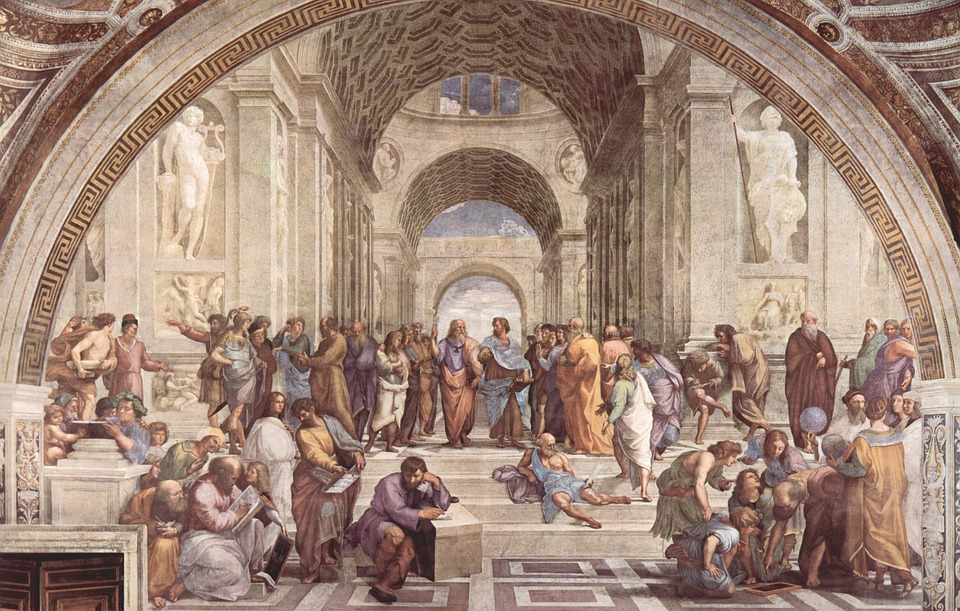
Raphael’s School of Athens provides a clear example. Plato, Aristotle, Socrates, and other thinkers are gathered in a harmonious, monumental setting that never existed in this form. The fresco does not show us an ancient Athenian school. Yet it is historically valuable: it reveals how Renaissance Europe imagined classical antiquity as a unified intellectual inheritance. It idealizes the Greek past in order to express a later cultural vision.
The same logic applies when modern writers invoke “Athenian democracy” or “Spartan discipline.” Before asking whether the image is flattering or hostile, ask: when was it made, by whom, for whom, and for what purpose?
A practical test for idealization
Idealization often turns historical complexity into a model meant to be admired, feared, copied, or condemned. Watch for language that makes an entire society seem timeless and uniform:
- “Spartans were always trained to fight.”
- “No Spartan ever surrendered.”
- “Athenians believed in equality.”
- “Athens was the first true democracy.”
- “Sparta rejected wealth and luxury.”
- “The people ruled Athens.”
Such statements should make a historian pause—not because they are necessarily wholly false, but because words such as always, never, all, pure, perfect, and the people often conceal qualifications.
Use this five-part test.
-
Date the source and the claim.
Is the source contemporary with the period it describes? Is it describing Archaic, Classical, Hellenistic, or Roman Sparta? A claim about “Athens” also needs a date: democratic institutions changed over time. -
Identify the speaker.
Is this a public inscription, an Athenian comic playwright, a Spartan poet, an Athenian critic, a Roman biographer, or a modern political writer? Their perspectives are not interchangeable. -
Separate description from prescription.
A text may tell readers how people ought to behave rather than how they normally did behave. A moral saying about courage is not a census of real conduct. -
Look for those left outside the image.
Who is invisible in a celebration of democracy or military discipline? In Athens, women, enslaved people, resident foreigners, and children were outside the citizen body. In Sparta, helots and perioikoi were outside the privileged Spartiate citizen class. -
Corroborate across source types.
Compare a later anecdote with contemporary poetry, archaeology, inscriptions, military history, and evidence from other Greek communities. Agreement does not guarantee certainty, but unsupported claims should be held more cautiously.
A compact formula is worth remembering:
An ideal is evidence for what people valued or wanted others to believe. It is not automatically evidence that society consistently achieved that ideal.
Sparta: from historical power to the “Spartan mirage”
Sparta is particularly vulnerable to idealization because its own surviving written voice is limited. We have important early Spartan poetry, including Tyrtaeus and Alcman, and we have material evidence from Sparta and Laconia. But we do not possess a surviving Spartan historical narrative comparable to Thucydides’ account of Athens and the Peloponnesian War. Much of the familiar picture comes from outsiders and, often, from writers living long after Sparta’s greatest power had declined.
The result is sometimes called the Spartan mirage: an image of Sparta shaped by admiration, moral storytelling, and later political uses of Spartan traditions.
Why the Sparta you know Never Existed
Watch “Why the Sparta You Know Never Existed” from toldinstone. It offers a useful overview of why the famous Spartan image is difficult to separate from later admiration and Roman-period storytelling.
Watch the source problem, focusing on the difference between external accounts, later romanticization, and the evidence for wealthy Spartan citizen life. Then watch the later legacy, which challenges the simple opposition between Athens and Sparta and explains how Spartan traditions continued to be performed and remembered in Roman times.
A classic idealized image presents every Spartiate as:
- poor and indifferent to luxury;
- trained relentlessly from childhood as a professional soldier;
- individually fearless and incapable of surrender;
- politically equal to every other Spartiate;
- wholly unlike an Athenian.
Each part needs qualification.
The military ideal
The story of Thermopylae in 480 BCE is central. King Leonidas and a small Spartan force became symbols of courageous resistance against the Persian invasion. The decision to remain in the pass after it had been outflanked created an exceptionally powerful memory. But Thermopylae was a Greek defeat, not a battlefield victory, and Spartans were not the only Greeks who remained to fight. Thespians and Thebans were also present in the final stand, though later memory often made the story overwhelmingly Spartan.
That does not mean Spartan courage at Thermopylae was invented. It means that a real event was transformed into a moral exemplar. The event became larger than its immediate military outcome.
The danger comes when a later reputation is projected backward. Sparta did develop notable strengths in hoplite warfare, including organization, discipline, and the ability to maneuver formations in ways that impressed other Greeks. Yet this does not support the broader myth that Spartans were born invincible warriors or that every aspect of their society existed only to produce soldiers.
The Spartans at war - Myth vs reality - Ancient World Magazine
Read Ancient World Magazine’s “The Spartans at War: Myth vs Reality” to trace how Thermopylae, military organization, later admiration, and modern popular culture became entangled in the image of Sparta.
In the section “Sparta’s military reputation,” read the discussion from the opening through the conclusion. Pay special attention to the Archaic and Thermopylae evidence: distinguish what the sources say about early Sparta from what later readers assumed. Then, in “Did the Spartans deserve their reputation?”, read the discussion of actual Spartan military practices and limitations. Focus on the qualified military case: the article argues neither that Sparta was uniquely superhuman nor that it had no military advantages. Finally, under “Worship of Sparta as a military power,” read from the history of the myth. Notice the shift from ancient commemoration to Roman-era moralizing and then to modern popular culture.
The careful conclusion is therefore not “Sparta was militarily ordinary” and not “Sparta was unbeatable.” A stronger conclusion is:
Sparta acquired real military strengths, but its extraordinary reputation was amplified by the memory of Thermopylae, its battlefield successes, the fear of its opponents, and later admiration.
Austerity, education, and social reality
The ideal Spartan was also said to reject luxury. Later accounts dwell on plain clothing, black broth, iron currency, hard beds, silence, and scorn for comfort. Such traditions may preserve real Spartan ideals of restraint and civic conformity. But ideals of austerity were not identical to a society without wealth.
Spartiate citizens were a privileged class supported by agricultural production extracted from helots. They had leisure for hunting, communal meals, sport, religion, and in some cases expensive pursuits such as horse ownership and chariot racing. A citizen’s apparently simple public lifestyle could coexist with landholding, dependence on unfree labor, and access to wealth.
This changes how we interpret the famous phrase “equality among Spartans.” It referred, at best, to a restricted body of male citizens. It did not describe equality across all people living under Spartan power.
Likewise, the agoge, Sparta’s educational system, was demanding and important, but it should not be imagined as a modern military academy. The evidence supports physical training, discipline, group life, music, literacy, and preparation for a citizen’s public role. It does not support the claim that young Spartans spent every moment mastering combat technique or that Sparta had a professional army in the modern sense.
When you encounter a vivid Spartan anecdote—especially a short, perfect saying attributed to Leonidas or another famous figure—treat it as a clue to a tradition of Spartan self-presentation and later admiration. It may preserve something genuine. But its polished form, moral message, and often late preservation mean it needs corroboration before it can bear a large historical claim.
Athens: democracy is real, but not modern democracy
Athens receives a different kind of idealization. Rather than the land of disciplined warriors, it often appears as the original home of freedom, reason, equality, and popular self-government. This image has had enormous influence, especially in modern political thought.
Unlike Sparta, Athens has extensive contemporary evidence for public political life: decrees, legal records, ostraca, buildings, speeches, histories, and drama. That abundance means historians can establish a great deal about Athenian institutions. It does not mean that Athens was a modern democracy in miniature.
What did democracy really mean in Athens? - Melissa Schwartzberg
Watch TED-Ed’s “What Did Democracy Really Mean in Athens?” by Melissa Schwartzberg. Use it to identify both a genuine institutional difference between Athenian and modern democracies and the limits of Athenian political inclusion.
Watch institutions and sortition for the contrast between direct participation, selection by lot, and modern representative elections. Then watch the excluded majority. Keep the two ideas together: broad participation among citizens existed alongside exclusion from citizenship for most residents.
Athenian democracy involved unusually extensive participation by male citizens. The Assembly could make major decisions; many offices and jury positions were assigned by lot; and citizens could participate directly rather than simply electing representatives to govern in their place. Those are major historical facts.
But several idealizing shortcuts need to be rejected.
“Athens was ruled by everyone”
Athens was not ruled by every person living in Attica. Women, enslaved people, resident foreigners known as metics, and children were excluded from full civic participation. Even among adult male citizens, practical factors such as wealth, distance, work, family obligations, political reputation, and rhetorical skill affected who could participate regularly and effectively.
Thus, “rule by the people” must be translated historically. The demos was not the whole population in the modern sense. It was the legally recognized citizen body.
“Athenian democracy meant equality”
Athenian democratic ideology valued a form of political equality among citizens. Yet equality was bounded by citizenship, gender, legal status, and wealth. A poor citizen could participate in political institutions in ways unavailable to a wealthy metic or enslaved person, but this did not eliminate social hierarchy or economic inequality.
Moreover, ancient Athenians themselves debated democracy fiercely. Plato criticized aspects of democratic life; Thucydides explored both the capacity and volatility of Athenian collective decision-making; Aristophanes satirized political behavior. Such texts should not be used merely as simple proof that democracy failed. They are evidence that democracy was contested, analyzed, praised, and criticized by people who lived within its world.
“Athens is simply the ancestor of modern democracy”
Modern democratic states usually depend on representation, constitutions, broad adult citizenship, electoral competition, political parties, and large bureaucratic institutions. Classical Athens operated differently. Its democracy was direct in important ways, rested on a limited citizen body, and relied heavily on practices such as selection by lot.
The point is not that Athenian democracy was unimportant because it differed from modern systems. Its difference is precisely why it must be understood on its own terms.
Beyond the Modern Myths of Ancient Athens | Church Life Journal | University of Notre Dame
Read “Beyond the Modern Myths of Ancient Athens” from the University of Notre Dame’s Church Life Journal. The article is a modern interpretation, not ancient evidence; its value here is its explanation of how later political writers have repeatedly created simplified versions of Athens for their own arguments.
Read the opening discussion through the end of the section’s account of the modern “folk myth” of democracy. Begin at the article’s opening and use the modern-democracy discussion to track how ideas such as popular sovereignty and the will of the people can be projected back onto Athens. Then continue with the following section, beginning “Both Lippmann and Achen and Bartels,” through its conclusion. Focus on returning to ancient contexts. Notice the method: examine contemporary authors and institutions, include marginalized groups, and avoid treating Athens as either a flawless model or a simple warning.
The strongest historical formulation is:
Athens created a highly participatory democracy for a restricted class of male citizens; its achievements and tensions cannot be captured by either “perfect democracy” or “mob rule.”
Both phrases are later interpretive frames. They may begin from real features of Athenian political life, but they simplify a much more complex system.
Comparing the two idealizations
Athens and Sparta are often presented as natural opposites: democratic versus oligarchic, naval versus land-based, artistic versus martial, free versus disciplined, talkative versus silent. Some contrasts are historically meaningful, but the total opposition is misleading.
Both were Greek poleis structured around the political dominance of a limited male citizen body. Both depended on the labor of people without full political rights. Both competed for prestige, used religion in public life, fought wars, and changed over time. Neither was a fixed essence.
The table below models the kind of cautious comparison you should aim for.
| Simplified claim | Evidence-based revision | What to investigate |
|---|---|---|
| “Sparta was a society of full-time soldiers.” | Spartan citizens had military obligations and developed effective collective discipline, but they were also landholding elites supported by helot labor and participated in wider Greek cultural practices. | Date of the source; evidence for actual training; role of helots and perioikoi |
| “Spartans never surrendered.” | Thermopylae became a powerful model of resistance, but Spartan forces did surrender, including at Sphacteria in 425 BCE. | Whether the claim comes from a commemorative story, a battle narrative, or later moralizing |
| “Sparta had no luxury.” | Spartan ideals favored restraint, but citizens could possess wealth and participate in elite activities. | Difference between public ideology, private practice, and the evidence for material culture |
| “Athens was government by all the people.” | Athenian citizens exercised unusually direct political power, but citizenship excluded women, enslaved people, metics, and minors. | Who counted as a citizen; who could attend, speak, hold office, or serve on juries |
| “Athens was just like a small modern democracy.” | Athens was a direct democracy with extensive use of sortition and a restricted citizen body, not a representative democracy with universal suffrage. | Ancient political vocabulary and institutional practices |
| “Athens was free; Sparta was unfree.” | Both societies offered political privileges to limited citizen groups while relying on major exclusions and forms of unfreedom. | Whose freedom is being described and at whose expense |
This is not an argument that all differences disappear. Athens and Sparta did organize public authority differently. Rather, it is a warning against comparisons built from slogans.
A source-audit method you can use
When you read an account of Athens or Sparta, make a short source-audit note in four lines:
-
Claim: Write the statement in precise language.
Example: “Spartan boys were trained from childhood to be invincible soldiers.” -
Source and date: Identify who says it and when.
Is the claim based on an early Spartan poem, Xenophon, a Roman author such as Plutarch, archaeology, or a modern film? -
What it supports: State the modest conclusion.
For example: “There was a distinctive Spartan system of education and discipline for citizen boys.” -
What it does not prove: Name the overreach.
For example: “It does not prove that every Spartiate received constant weapons training, that Sparta lacked non-military culture, or that Spartans could not be defeated.”
Apply the same discipline to Athens:
- Claim: “Athens was a democracy.”
- What it supports: Citizens could participate directly in major institutions, and many offices were allotted by lot.
- Necessary qualification: Citizen status was restricted, and the political system was not equivalent to a modern representative democracy.
- Further question: Is the writer praising democracy, condemning it, or using Athens to make a modern political argument?
The aim is neither cynicism nor hero worship. We do not dismiss every famous story as false, and we do not accept it merely because it is famous. We assess what kind of source it is, what historical setting produced it, and how far its evidence can reasonably take us.
Conclusion
The most important distinction from this lesson is between a source’s historical value and the broad historical claim someone wants to make from it.
For Sparta, later admiration of Thermopylae, discipline, austerity, and political stability helped produce an image of timeless military perfection. Sparta possessed real military strengths and distinctive institutions, but its reputation was magnified by commemoration, fear, Roman-era moralizing, and modern reuse.
For Athens, abundant evidence confirms substantial citizen participation and distinctive democratic institutions. Yet modern ideals of universal freedom, popular sovereignty, and representative democracy should not be projected directly onto a society in which most residents lacked citizenship.
Keep these three principles in view:
- Later accounts can be excellent evidence for later memory without being straightforward evidence for an earlier reality.
- An ideal tells us what a society or admirer valued; it does not prove everyday practice.
- Athens and Sparta should be compared through dated evidence, not through inherited slogans.
Next, the course moves into religion, government, and public authority, beginning with how consultation of Apollo’s oracle at Delphi worked in practice.
Can't find a good explanation? Sign up and we'll make it for you
Sign up