
Hello! This first lesson is the Unit 1 half of your emergency review for AP World History: Modern. Unit 1, The Global Tapestry, is less about memorizing a single timeline and more about recognizing what was happening in different world regions at roughly the same time, from c. 1200 to c. 1450. Unit 2 will build on this foundation by following the trade networks that connected many of these societies.
Your goal today is to distinguish regions quickly and accurately using three AP-ready categories: how states built power, which belief systems shaped society, and what supported the economy. By the end, you will have a comparison chart you can use for multiple-choice questions, SAQs, and essays.
Start with the comparison mindset
In AP World, a state is a political territory governed by some central authority. The important question is not simply “What was the Song Dynasty?” It is:
How did the Song state gain, organize, and keep power—and how was that similar to or different from other states?
Use these three lenses every time you see a region in Unit 1:
-
State-building: Who held power, and what tools did they use?
Examples include bureaucracies, military conquest, tribute systems, feudal ties, labor obligations, and control of trade. -
Belief systems: What religious or philosophical traditions shaped legitimacy, social order, or culture?
Examples include Neo-Confucianism, Islam, Hinduism, Buddhism, Christianity, and Indigenous traditions. -
Economic patterns: What generated wealth and supported the state?
Look for agriculture, labor systems, manufacturing, tribute, or strategic control of trade routes.
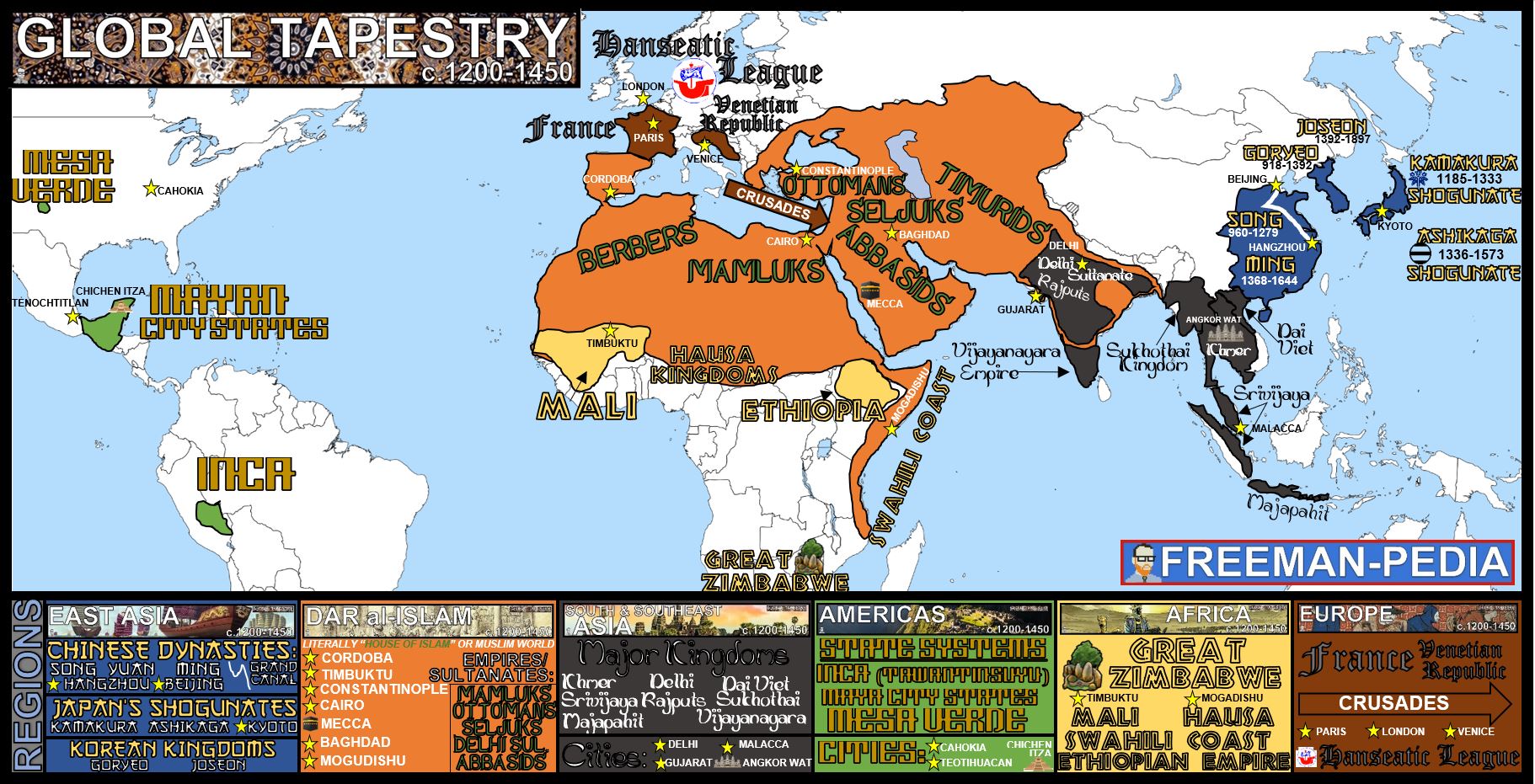
A useful way to remember Unit 1 is that all regions had complex societies, but complexity took different forms. A centralized empire with exam-selected officials was not “more advanced” than a trade-based city-state or a labor-based Andean empire; each used institutions suited to its geography, traditions, and resources.
For a fast visual tour, watch this focused regional review.
AP World UNIT 1 REVIEW (Everything you NEED to KNOW!)
Watch “AP World UNIT 1 REVIEW (Everything you NEED to KNOW!)” from Heimler’s History as a rapid global survey. Its strongest feature is that it consistently connects each region’s political structure, beliefs, and economy—the exact categories you need for comparison.
Watch Song China for Neo-Confucianism, civil service exams, Champa rice, and commercialization. Then watch Dar al Islam, focusing on the political fragmentation of the Abbasid world and the continuing unifying role of Islam. Continue with South Southeast Asia for Hinduism, Buddhism, Islam, the Delhi Sultanate, and regional trade states. Watch the Americas especially carefully: it makes the key Aztec tribute versus Inca mita contrast. Finish with Africa and Europe. As you watch, write only three notes per region: one state-building tool, one belief system, and one economic base.
Your Unit 1 regional comparison chart
Do not try to treat every region as politically or religiously uniform. The chart identifies the dominant AP World pattern and gives anchor examples—evidence you can use in an SAQ or essay.
| Region | State-building: how power worked | Belief systems and legitimacy | Economic patterns and anchor examples |
|---|---|---|---|
| East Asia | Song China was highly centralized. The emperor governed through an expanded bureaucracy, and officials were selected through civil service examinations based on Confucian texts. Chinese institutions also influenced Korea, Japan, and Vietnam. | Neo-Confucianism reinforced hierarchy, filial piety, and the emperor’s moral authority. Buddhism remained influential, especially in East Asia. | Agricultural expansion supported population growth, especially Champa rice. The Grand Canal linked regions. Commercialization expanded markets for silk and porcelain. |
| Dar al-Islam | The Abbasid Caliphate fragmented, so the Islamic world was politically divided among states such as the Seljuks, Mamluks, and Delhi Sultanate. Turkic military leaders became especially important. | Islam provided a major cultural and legal framework across politically separate states. Sharia shaped law; Sufis spread Islam through flexible, devotional practices. Judaism and Christianity also remained present. | Urban commercial centers and long-distance merchants linked much of Afro-Eurasia. Islamic states benefited from participation in trade and from intellectual exchange centered in cities such as Baghdad. |
| South and Southeast Asia | Political authority was diverse. The Delhi Sultanate ruled much of northern India, while the Hindu Vijayanagara Empire developed in the south. The Khmer Empire was land-based; Majapahit used its maritime location and control of trade. | Hinduism remained strong in South Asia; the Bhakti movement emphasized personal devotion and questioned aspects of caste and gender hierarchy. Buddhism and Islam shaped Southeast Asia, while Sufism encouraged Islamic conversion. | Agriculture sustained powerful land empires such as Khmer, while port cities and maritime states gained wealth by controlling trade between China, India, and the Islamic world. |
| Africa | Africa contained both empires and city-states. Mali used control of trade and tribute to build a major West African empire. The Hausa states and Swahili coast were more politically fragmented. Great Zimbabwe controlled regional trade, and Ethiopia had a Christian monarchy. | Islam spread through trade and was especially important among elites in Mali and along the Swahili Coast. Ethiopia remained Christian. Great Zimbabwe maintained Indigenous religious traditions. | Trade was decisive: Mali profited from gold and salt across the Sahara; Swahili cities connected African goods to the Indian Ocean; Great Zimbabwe exported gold and ivory while also relying on agriculture and cattle. |
| Europe | Western Europe was relatively decentralized. In feudalism, lords granted land to vassals in exchange for military service. Kings, nobles, and the Church shared authority. | Roman Catholic Christianity united much of western Europe culturally, while Eastern Orthodoxy shaped the Byzantine world and Kievan Rus. Jewish and Muslim communities also existed in Europe. | Most people lived in agricultural manorial economies. Serfs worked land tied to manors in exchange for protection; local lords held substantial political and economic power. |
| Americas | The Aztecs expanded through military conquest and demanded tribute from conquered peoples. The Inca built a more centralized empire using provincial administrators, roads, and quipu record keeping. Mississippian societies such as Cahokia developed complex chiefdoms. | States connected political authority to Indigenous religious traditions. Aztec rulers supported religious rituals, including human sacrifice; Inca rulers were associated with sacred authority and the Sapa Inca’s divine status. | Aztec chinampas supported the huge city of Tenochtitlan. The Inca used the mita, a required labor obligation, for roads, agriculture, mines, and other state projects. Andean societies also adapted agriculture to difficult terrain. |
A few contrasts deserve special attention because they are common AP World evidence:
- Song China versus medieval Europe: Both had social hierarchies and agriculture-based economies. But China used a centralized bureaucratic state and civil service exams, whereas Europe relied more heavily on local nobles, feudal relationships, and manors.
- Aztec versus Inca: Both expanded through conquest and relied on subject populations. However, the Aztecs generally demanded tribute, while the more centralized Inca state directly mobilized labor through the mita system.
- Mali, Swahili cities, and Southeast Asian port states: All benefited from trade, but Mali was a large inland empire connected to trans-Saharan exchange, while Swahili and many Southeast Asian states were coastal or maritime commercial centers.
- Dar al-Islam versus Europe: Islam connected a politically fragmented but culturally linked region. Christianity connected Europe culturally too, but western Europe remained particularly decentralized politically.
To reinforce the chart, use this concise written review after the video.
AP World Unit 1 Review: The Global Tapestry (1200-1450) | Fiveable
Read Fiveable’s “AP World Unit 1 Review: The Global Tapestry” to verify the evidence in your chart. It is especially useful for keeping the central comparison clear: regions could share a need for legitimacy and labor, while using very different governing institutions.
In the “Unit 1 review notes,” read the regional summaries beginning with “East Asia: Song China and Its Influence.” Continue through the Africa and Europe summaries, then read “Comparing State Formation Across Regions.” Read the regional comparison sequence, focusing on one concrete piece of evidence for each row in your chart rather than trying to memorize every name.
Turn the chart into historical analysis
Memorizing the chart is useful, but AP questions reward a second step: explaining why a similarity or difference existed.
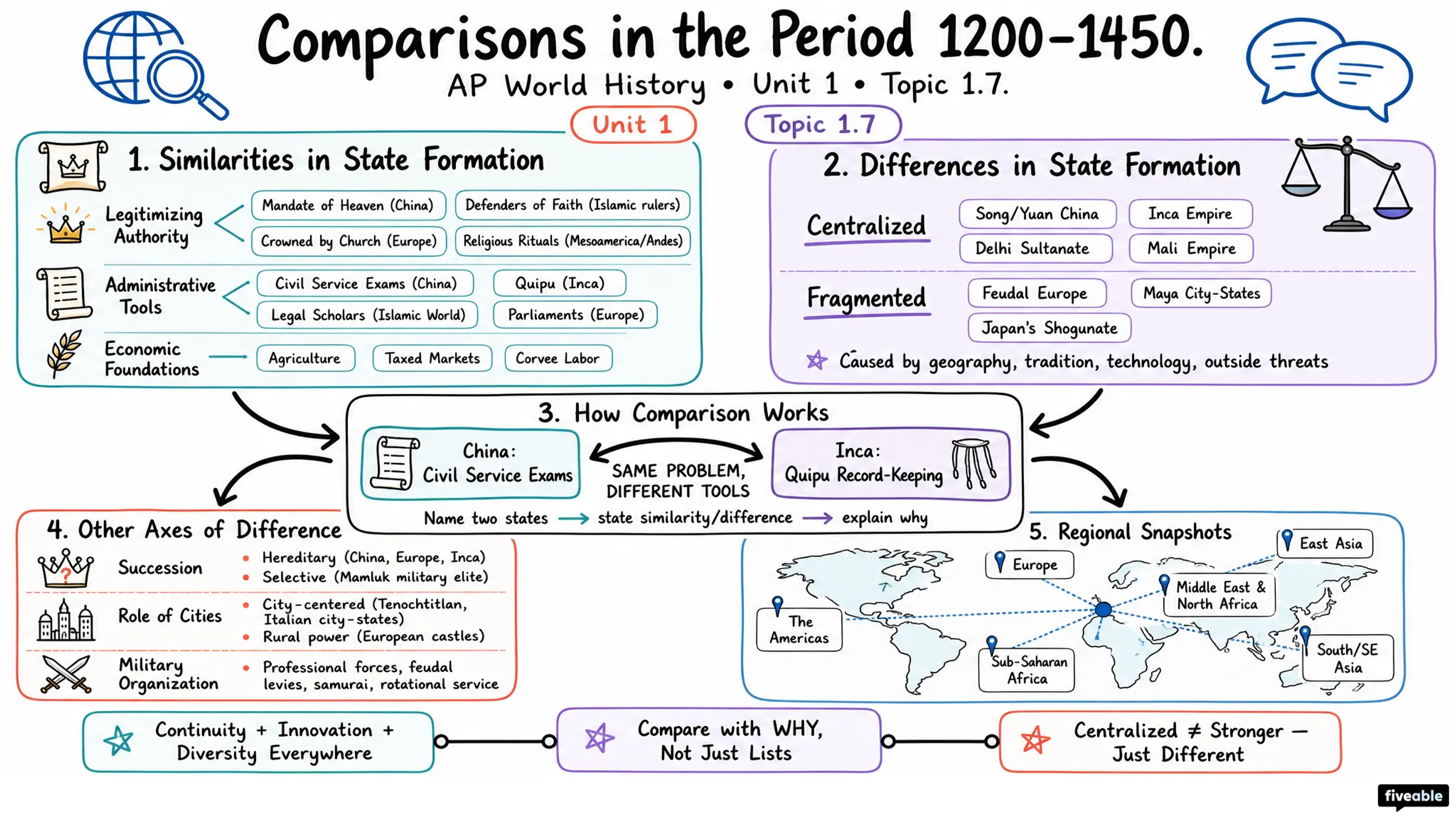
The broad similarity
Across the world, rulers sought to make their authority seem legitimate and to obtain the resources needed to govern.
They used several recurring tools:
- Belief systems: Song rulers promoted Neo-Confucian social order; Islamic rulers drew on Islamic law and identity; European monarchs and nobles worked alongside the Church; American rulers connected political authority to religious traditions.
- Labor and taxation: Aztec tribute, Inca mita labor, European serfdom, and agricultural surplus all helped elites and states access resources.
- Military force: Conquest mattered in the Aztec, Inca, Delhi Sultanate, and many Islamic states.
- Trade: Mali, Great Zimbabwe, Swahili city-states, and Southeast Asian states gained power by controlling access to valuable commercial routes.
The broad difference: centralization
A strong comparison category is the degree of centralization, meaning how directly a state could govern people across its territory.
| More centralized | More decentralized or fragmented |
|---|---|
| Song China: emperor, bureaucracy, civil service exams | Medieval western Europe: nobles and local lords held much authority |
| Inca Empire: administrators, road system, mita labor, quipu | Aztec Empire: tribute from conquered communities with substantial local autonomy |
| Mali Empire: imperial control over strategic trade routes | Swahili Coast and Hausa states: networks of separate city-states |
| Some Islamic empires: military rulers and Islamic legal institutions | Dar al-Islam overall: many states shared Islam without forming one unified empire |
The key point is not that centralized states were automatically stronger. A decentralized system could still be influential, prosperous, or resilient. The Swahili city-states, for example, did not need one empire to become major participants in Indian Ocean trade.
A model AP-style comparison claim
A high-quality claim has three parts:
- identify a similarity or difference;
- give specific evidence for both sides;
- explain the significance.
For example:
Both Song China and the Inca Empire created highly centralized states that extended authority beyond their capitals. Song rulers used a Confucian bureaucracy staffed through civil service examinations, while Inca rulers organized labor through the mita system and administered territory using roads and quipu records. Their methods differed because Song China relied on a long-established written bureaucratic tradition, whereas the Inca governed a mountainous empire through labor obligations and infrastructure.
Notice that this does more than list facts. It makes an argument about methods of rule.
Make this test-ready in five minutes
Use the following quick retrieval routine before a quiz or test:
- Redraw the six-row chart from memory with only the region names first.
- Fill in one state-building tool per row.
- Add one belief system and one economic fact per row.
- Circle the three contrasts most likely to appear in questions:
- Song China and Europe
- Aztec and Inca
- Mali and the Swahili Coast
- Practice writing comparison statements using this frame:
Both ___ and ___ used ___ to support political authority. However, ___ relied more on ___, whereas ___ relied more on ___.
Avoid these common Unit 1 mistakes:
- Dar al-Islam was not a single empire. It was a broad region connected by Islam even after Abbasid political power fragmented.
- Islam did not erase all local traditions. In Africa, South Asia, and Southeast Asia, it often blended with existing practices; adoption also varied by class and region.
- Europe was not politically unified just because it was Christian. Roman Catholicism created cultural ties, but feudalism decentralized political power.
- Aztec tribute and Inca mita were not the same. Tribute meant goods and services extracted from conquered peoples; mita was a structured state labor obligation.
- Trade-based states still depended on local production. Commerce was their political advantage, but agriculture, mining, and craft production remained essential.
Key takeaways
From c. 1200 to c. 1450, states across the world built and preserved power through a mix of administration, military force, religion, labor systems, agriculture, and trade.
The fastest way to distinguish regions is to remember these anchors:
- East Asia: centralized bureaucracy, Neo-Confucianism, commercialization.
- Dar al-Islam: politically diverse Islamic states, cultural unity through Islam, commercial and intellectual networks.
- South and Southeast Asia: Hinduism, Buddhism, and Islam interacting; land empires and maritime trade states.
- Africa: trade-centered empires and city-states; Islam, Christianity, and Indigenous traditions.
- Europe: Catholic or Orthodox Christianity; feudal decentralization and manorial agriculture.
- Americas: Aztec tribute and chinampas; Inca mita, roads, and centralized administration.
Next, you will move into Unit 2 and examine how commercial practices, technologies, states, and empires expanded the Silk Roads, Indian Ocean, and trans-Saharan networks—the connections that helped many of these regional systems grow.
Can't find a good explanation? Sign up and we'll make it for you
Sign up